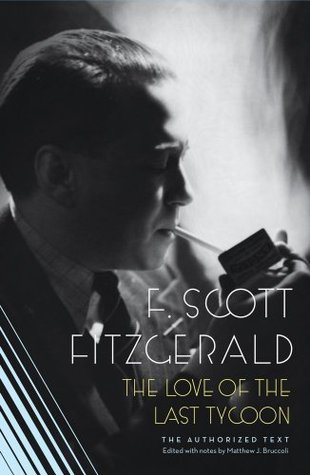
Classics Club #2: “The Last Tycoon” by F. Scott Fitzgerald

The Last Tycoon is a novel that resists coherent discussion, for one obvious reason: it was never finished. F. Scott Fitzgerald died well before he could complete his story of Hollywood romance and industry politics, or even finish conceptualizing it (the narrative point of view, for instance, is something of a mess). Fitzgerald did have extensive notes on how he envisioned the novel progressing beyond what was written, but because The Last Tycoon is still visibly a work-in-progress, I wouldn’t consider those notes to be authoritative.

Thus, when it comes to something like evaluating a character arc, the unfinished nature of the work presents some challenges for the reader. As an example, I’m going to look briefly at Episode 17, the latest section of the novel that Fitzgerald was able to write, and try to figure out where that leaves the novel’s protagonist, Monroe Stahr. As we’ll see, the fact that The Last Tycoon ends where it does may give the reader a much more sour impression of Stahr’s character than they may have gotten in the hypothetical completed version of the novel.

First, some context: It’s the Golden Age of Hollywood, where the young widower Monroe Stahr is a successful studio executive. One day, during an earthquake, he sees a woman on the studio lot who looks exactly like his deceased wife. He eventually meets the woman, Kathleen, and starts up a halting relationship with her. However, Kathleen is engaged to a man who will be arriving in town shortly. Stahr doesn’t believe that Kathleen truly loves her fiancé, and thinks he might have a chance with her. But at the very end of the penultimate (existing) episode, Stahr receives a telegram from Kathleen that reads: “I WAS MARRIED AT NOON TODAY GOODBYE” (p. 118).

Stahr thus begins Episode 17 heartbroken, which is not a great state of mind to be in for this particular scene. He has a meeting with two people: Brimmer, a man who wishes to organize a labor union at Stahr’s studio, and Cecelia, the daughter of Stahr’s business partner and the one who arranged the meeting between Stahr and Brimmer. (Cecelia is also the novel’s narrator, which makes her the Nick Carraway to Stahr’s Jay Gatsby, if Nick Carraway weren’t an objective observer and instead had a lifelong crush on his subject.) Emotions would be running high in this situation as is, but Kathleen’s telegram has just complicated matters further.

The meeting starts of tense but cordial, and even though the two men have drastically different views and goals, they seem to like each other. They laugh at each other’s quips, and are capable of recognizing each other’s strengths. But even if the meeting were to end with mutual understanding, it almost certainly could never end with an agreement. Stahr, as Cecelia says earlier in the novel, carries himself like an “oracle,” someone who “must be right always, not most of the time, but always—or the structure would melt down like gradual butter” (p. 56). If Stahr doesn’t want his studio to unionize, then as far he’s concerned, that’s that. As amiable as Stahr is, he is accustomed to getting his way, not just in business matters, but in personal matters as well.

This is why Kathleen’s telegram wounds Stahr so: he’s apparently misjudged the relationship between Kathleen and her fiancé. (Cecelia has a flash-forward in this section that suggests things were a little more complicated than they have may seemed, but Stahr never learns any of that.) He more or less played casting director is pursuing Kathleen in the first place: she was perfect in the role of his wife, in multiple senses. It must have look fantastic on paper. But it was all for naught. The telegram proves that he was wrong, and as a consequence he’s been denied the chance of romantic fulfillment. It’s the most direct challenge to his self-image that Stahr faces in the novel.

Stahr carries all that into the meeting, and while up to this point he’s kept that disappointment in check, it starts to burst forth once the three of them go to a restaurant for dinner and he starts drinking. Cecelia is particularly perceptive of this shift. Upon seeing Stahr down three cocktails in quick succession, she tells him, “‘Now I know you’ve been disappointed in love'” (p. 124). Stahr tries to deny he’s even been drinking, but it’s a rather ineffectual deflection. When he starts bragging to Brimmer about how friendly he used to be with the studios directors, Cecelia compares his spiel to “Edward the VII’s boast that he had moved in the best society in Europe” (p. 125). She doesn’t yet know the full story, but she can sense that Stahr is clinging to a rosier version of himself.

This is especially ironic, because the version of Stahr we see in Episode 17 is easily him at his most repugnant. He refers to Brimmer as a “soapbox son-of-a-bitch” and starts bashing the various directors he’s worked with over the years (p. 125). And the more that Stahr drinks, the worse it becomes:

Stahr ordered a whiskey and soda and, almost immediately, another. He ate nothing but a few spoonfuls of soup and he said all the awful things about everybody being lazy so-and-so’s and none of it mattered to him because he had lots of money—it was the kind of talk you heard whenever Father and his friends were together. I think Stahr realized that it sounded pretty ugly outside of the proper company—maybe he had never heard how it sounded before. Anyhow he shut up and drank off a cup of black coffee. I loved him and what he said didn’t change that but I hated Brimmer to carry off this impression. I wanted to see Stahr as sort of technological virtuoso and here Stahr had been playing the wicked overseer to a point he would have called trash if he had watched it on the screen.

“The Last Tycoon,” p. 126 (emphasis original)

The fact that Cecelia, who is as close to an unreliable observer-narrator as one can get, feels the need to reevaluate her perception of Stahr tells us how far he has strayed from his normal presentation. Granted, for as boisterous as Stahr has become, he’s still capable of self-reflection, as we see when he explains to Brimmer his relationship with screenwriters:

“I never thought,” he said, “—that I had more brains than a writer has. But I always thought that his brains belonged to me—because I knew how to use them. Like the Romans—I’ve heard that they never invented things but they knew what to do with them. Do you see? I don’t say it’s right. But it’s the way I’ve always felt—since I was a boy.”

“The Last Tycoon,” p. 126 (emphasis original)

Stahr understands, on some level, that a writer’s brains don’t in fact belong to him, that for all his power he cannot use to people to perfectly serve his ends at all times. But, alas, there is no epiphany or change in direction forthcoming. The group then heads over to Stahr’s house (but not before Stahr, to Cecelia’s disappointment, stops for another drink along the way), where Stahr decides to pick a fight with Brimmer. Brimmer backs away, but Cecelia realizes it’s not of fear: “There was an odd expression in his face and afterwards I thought it looked as if her were saying, ‘Is this all? This frail half sick person holding up the whole thing'” (p. 128, emphasis original). Stahr persists, though, and then Brimmer promptly kicks his ass.

That one, little question—”Is this all?”—captures Stahr’s collapse so completely. There’s a kind of revulsion in that question, a mixture of pity and contempt that speaks volumes to the gap between Stahr’s self-perception and reality. I had a similar feeling towards the end of John Green’s The Fault in Our Stars, when Augustus literally collapses trying to buy cigarettes at a gas station, or in D. H. Lawrence’s Lady Chatterly’s Lover, when Clifford stubbornly tries to power his motorized wheelchair through the muck. With all these characters, in watching them desperately try to do something that might not be worth doing, I felt some unease, some uncertainty as to how to process things. My sympathies had to battle my disgust, which is why, in the case of all those novels, those are the scenes that have lingered in my mind the longest.

Of course, neither Green nor Lawrence ends their novels with those scenes, and Fitzgerald almost certainly had further plans for Stahr. But that disastrous meeting is basically the last scene in the book as written. Augustus and Clifford get some sort of dénoument afterwards, even though neither of them is protagonist of their respective novels. But unforeseen circumstances robbed Stahr (and the reader) of any closure. His arc ends unnaturally, at its lowest point, and that’s what we must carry with us.


Please feel free to share your thoughts on The Last Tycoon in the comments below. I’d also be curious about what you all think of the sense of pity/disgust I’ve described feeling towards certain scenes. I’ve thought about those scenes from Green and Lawrence a lot of the past few years, but I’ve never been certain what to do with them.

If you’d like a preview of what’s to come in my Classics Club project, you can access my list of fifty books here. As of writing this post, the only other book I’ve tackled so far is W. H. Auden’s The Dyer’s Hand, which you can read more about here.

And, as always, thank you for reading!

Tracy K. Smith’s “Declaration”: An Analysis

Tracy K. Smith is someone who should need no introduction, but seeing how even the superstars of contemporary poetry are relatively obscures, here goes: she is the current Poet Laureate of the United States, a professor at Princeton University, author of several books of poetry (including the 2012 Pulitzer Prize-winning Life on Mars [Graywolf, 2011]), and all-around inspiring figure in the literary world. Seriously, go read her.

I’m currently working my way through her most recent collection, Wade in the Water (Graywolf, 2018), and I was so struck by one of the pieces that I set aside everything else and started writing up an analysis of it. That’s how most of these blog posts start, really: something I read makes me think so rapidly that I have no choice but set everything down (and hopefully, set everything in order). The poem in question is called “Declaration”; you can read it on the Poetry Foundation website, where there’s also a recording of Smith reading the poem aloud.

The first thing to note about “Declaration” is that the words themselves are not of Tracy K. Smith’s creation. Instead, “Declaration” is an example of erasure poetry, a form of found poetry in which the poet takes a pre-existing text and removes (“erases”) some or most of the original words, such that the remaining words form a new composition, often one that comments on the original text. Though erasure poetry doesn’t really involve writing as we normally conceive of it, it still requires a kind of creative vision: the ability to see new contexts for old words, to find subversive potentials in someone else’s language.

In this case, Smith uses the United States Declaration of Independence as her source text, which is perhaps the most famous document I’ve seen a poet black-out. However, if you haven’t read the original document (and didn’t see Smith’s title), I wouldn’t blame you if you didn’t realize what Smith was doing here. I think it may be helpful, then, to talk about the declaration for a bit.

When we think of the Declaration of Independence, we tend to think of the lofty rhetoric near the beginning: “We hold these truths to be self-evident, that all men are created equal, that they are endowed by their Creator with certain inalienable rights, that among these are Life, Liberty and the pursuit of Happiness.” But such eternally quotable assertions about natural law and political philosophy are a small percentage of the document’s word count, because the Declaration of Independence was not written to be a treatise. It was a written in a specific context for a specific purpose: to state the intention of Britain’s North American colonies to break away from the mother country.

That context explains why most of the document is devoted to listing off the colonies’ grievances against George III. The history of “repeated injuries and usurpations” is the justification for the war for independence, for a course of action that would have been considered treasonous had Britain prevailed in the conflict. The list explains why, per the authors, the declaration is necessary. Yet because the content of the section is so tied to a particular moment in history, it’s the part whose present-day power would seem rather limited. I mean, we’re not exactly stirred to anger these days by hearing references to the Quartering Act, right?

At least, that’s what I used to think, until July 4, 2017. That was the day that NPR decided to adapt their Independence Day tradition of reading the declaration on-air for Twitter. In a series of over 100 tweets, NPR’s Twitter account relayed the entire text of the declaration, like a town crier with WiFi. Most people recognized the exercise as a simple patriotic observance, but a small number of people, mostly of a right-wing persuasion and likely seeing the tweets outside of their full context, assumed NPR was criticizing Donald Trump and even advocating for revolution.

Now, if you’re like me, your first impulse is some good old cathartic laughter: “Haha, the Make America Great Again people don’t recognize the Declaration of Independence!” These randos on Twitter saw a news organization commemorating Independence Day, and assumed it was an attack on their fearless leader. But by accident, the people outraged over this exercise revealed that the declaration remains a powerful document in its entirety. How can anyone reading the declaration from start to finish come upon a sentence like, “A Prince whose character is thus marked by every act which may define a Tyrant, is unfit to be the ruler over a free people,” and not connect it to the present moment? And that’s with context. Now imagine seeing that sentence while idly scrolling through Twitter. Yes, these Trump supporters were off-base on the intention of the exercise, but if it were an institution less staid than NPR, I don’t think it would be that unreasonable an inference.

So, to summarize this long digression: the grievance section of the Declaration of Independence, even though it is the least-recognized and most-dated part of the document, is still a powerful piece of rhetoric, perhaps especially when the language is removed from the original context. And with all that in mind, we can now ask ourselves: What does Tracy K. Smith do with it?

The first thing I’ll note is that Smith leaves the rhetorical structure of the source material largely intact. The primary device used in the grievance section of the original document is syntactic parallelism, especially anaphora (repeating words at the beginning of consecutive phases, e.g., “He has refused to Assent to Laws . . . He has forbidden his Governors to pass Laws . . . He has refused to pass other Laws . . . etc.”). Smith’s “Declaration” preserves that formal element, and if anything amplifies it by also using epistrophe (repeating words at the end of consecutive phrases). The result is something which condenses the grievance section down the sensation of listening to it:

He has plundered our—

                                                  ravaged our—

                                                                                destroyed the lives of our—

taking away our—

                                     abolishing our most valuable—


and altering fundamentally the Forms of our— (lines 3-8)

Yet while Smith preserves the source material’s form, she seems to have eliminated, erased, its content. We have all these transitive verbs which are incomplete without grammatical objects, all these phrases which sound in need of closure. One might be tempted to say that what Smith has done is transform the Declaration of Independence into something close to theoretically pure rhetoric.

That, for the record, would be a perfectly fine approach for an erasure poem based on the Declaration of Independence. Perhaps it would reveal the emptiness behind the lofty ideals and philosophy which the document advocates for: all so much pleasant-sounding air. But Smith has something more specific in mind with this. After all, the passage quoted above is not free of content. Those verbs—”plundered,” “ravaged,” “destroyed,” “taking away,” “abolishing”—have charges, connotations, that pure sound would not have. And they start to call to mind a particular piece of context behind the source material, the inescapable contradiction at the heart of American history.

You probably know where we’re going with this, but to make it explicit: the country that extolled the equality and inalienable rights of “all men” permitted and was built on chattel slavery. The men who stuck their necks out in accusing George III of tyranny practiced their own tyranny upon the black slaves they and their fellow citizens owned as property. It is the unpardonable hypocrisy that has continued to haunt the United States from its inception to the present. One cannot in good conscience read the Declaration of Independence without mentally raising that objection to it.

Some might say, of course, that we can separate the admirable aspects of the declaration from the moral failings of the society that produced it, that we can discard the slavery and keep the inalienable rights. (One hears this a lot with regards to Enlightenment-era philosophy.) And that’s why I think Smith’s choice to make “Declaration” a found poem is so powerful: it suggests that such a separation is impossible. In the process of blacking-out the original text, her artistic vision knows to preserve such phrases as “the circumstances of our emigration / and settlement here” (13-14) and “taken Captive / on the high Seas / to bear” (15-17). She sees the sorts of grievances the declaration’s signers lobbed at the crown, and highlights how they were blind to the same faults in themselves.

Smith is not the first person to use the Declaration of Independence for critical purposes, of course. Martin Luther King, Jr. quoted from it during his “I Have a Dream” speech, only to then call it a “promissory note” that has gone unfilled. Ho Chi Minh cited it, alongside France’s Declaration of the Rights of Man and of the Citizen, at the beginning of the Vietnamese Proclamation of Independence, then attacked the Western imperial powers for violating those cherished principles. But Smith’s poem feels even more scathing than those instances. MLK and Ho Chi Minh emphasized the ideals of the Declaration of Independence—ones that society has failed to live up to, yes, but ideals worth aspiring toward. But with “Declaration,” one senses that the ideals themselves have been tainted. For a poem that appears so halting on the page, that’s one hell of a strong theme.


That’s it from me. But what about you? What are your thoughts on “Declaration,” or on found poetry in general? Feel free to sound off in the comments! And if you’re looking for more thoughts on recontextualizing the classics, you may want to check out my piece on Mary Reid Kelley and Patrick Kelley’s short film In the Body of the Sturgeon, which rearranges Longfellow’s The Song of Hiawatha into a story about a submarine’s crew near the end of the Second World War.

And, as always, thank you for reading!