Recent Publication: Valparaiso Poetry Review

VPR

Here’s some exciting news: one of my poems is now available in the most recent issue of Valparaiso Poetry Review! It’s called “Indiscriminate Archive,” and here’s a bit of trivia for you: this was the very last poem that I wrote while I was an MFA candidate at Johns Hopkins.

You can read “Indiscriminate Archive” here. Special thanks to VPR’s editor, Edward Byrne, for selecting my work. While you’re there, be sure to read the other fabulous poets featured in the issue, including work from Jeff Ewing, Elizabeth Knapp, and John Sibley Williams.

John Dryden’s “To the Memory of Mr. Oldham”: An Analysis

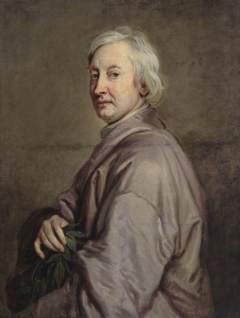
Kneller, Godfrey, 1646-1723; John Dryden (1631-1700), Playwright, Poet Laureate and CriticI’ve talked about John Dryden on this blog before, way back in 2016, in a look at his poem “Astræa Redux.” But for today, I’m not interested in 17th-century English politics or lovely descriptions of Dover’s cliffs. Nor am I interested in tackling any of Dryden’s extended satires and allegories—no point trying to condense “Absalom and Achitophel” into a blog post. Instead, I’d like to highlight a short delight of his, one which I envy for its tight control of tone and language: “To the Memory of Mr. Oldham.”

The “Mr. Oldham” of the title refers to John Oldham, a 17th-century satirist whom Dryden greatly admired and who died in 1683 at the age of thirty. Published the following year, “To the Memory of Mr. Oldham” is both a tribute to a talent gone too soon and a showcase for Dryden’s own skills as a poet. Like a great number of Dryden’s poems, it’s written in heroic couplets: rhyming, self-contained and balanced pairs of iambic pentameter lines.

Let’s have a look at the text, shall we?

“To the Memory of Mr. Oldham”

Farewell, too little and too lately known,
Whom I began to think and call my own;
For sure our souls were near ally’d; and thine
Cast in the same poetic mould with mine.
One common note on either lyre did strike,
And knaves and fools we both abhorr’d alike:
To the same goal did both our studies drive,
The last set out the soonest did arrive.
Thus Nisus fell upon the slippery place
While his young friend perform’d and won the race.
O early ripe! to thy abundant store
What could advancing age have added more?
It might (what nature never gives the young)
Have taught the numbers of thy native tongue.
But satire needs not those, and wit will shine
Through the harsh cadence of a rugged line.
A noble error, and but seldom made,
When poets are by too much force betray’d.
Thy generous fruits, though gather’d ere their prime
Still showed a quickness; and maturing time
But mellows what we write to the dull sweets of rhyme.
Once more, hail and farewell; farewell thou young,
But ah too short, Marcellus of our tongue.
Thy brows with ivy, and with laurels bound;
But fate and gloomy night encompass thee around.

The great challenge Dryden faces in writing “To the Memory of Mr. Oldham” lies in its very concept: it is an elegy written to honor a satirist. The poem cannot be entirely mournful, as that would not fit the person of John Oldham. But it cannot be entirely playful, either; neither the dictates of the genre nor basic respect for the dead would allow for it. No, Dryden must balance these two disparate moods, which requires some finely-tuned craft.

One way Dryden successfully negotiates these mixed moods is through his choice of allusions. In lines 9-10, he invokes the friendship between Nisus and Euryalus, two figures who appear in Virgil’s Aeneid. Specifically, Dryden refers to an episode in Book V, a footrace that Nisus and Euryalus partake in during the funeral games for Anchises. The text of Dryden’s poem lays out a solemn treatment of the event: Nisus loses his footing (“fell upon the slippery place”), which allow Euryalus, who had been trailing, to come from behind and win. This is of course a parallel for the relationship between Oldham and Dryden: Oldham’s great satires predated Dryden’s, but Dryden lived longer and would achieve much greater fame (“The last set out the soonest did arrive”).

However, looking into the full context of the allusion reveals a comic, almost absurd dimension to it. Nisus doesn’t merely trip; he sets off a chain of events befitting a gross-out slapstick comedy, complete with animal viscera. I’ll quote the full sequence from Dryden’s own translation of the Aeneid, which he’d publish a full fourteen years after Oldham’s death:

Now, spent, the goal they almost reach at last,
When eager Nisus, hapless in his haste,
Slipp’d first, and, slipping, fell upon the plain,
Soak’d with the blood of oxen newly slain.
The careless victor had not mark’d his way;
But, treading where the treach’rous puddle lay,
His heels flew up; and on the grassy floor
He fell, besmear’d with blood and holy gore.
Not mindless, then, Euryalus, of thee,
Nor of the sacred bond of amity,
He strove th’ immediate rival’s hope to cross,
And caught the foot of Salius as he rose.
So Salius lay extended on the plain;
Euryalus springs out, the prize to gain,
And leaves the crowd: applauding peals attend
The victor to the goal, who vanquish’d by his friend. (5.426-441)

In other words: Nisus slips in a pool of sacrificial blood, getting absolutely soaked in it; then, he grabs the second-place runner, Salius, by the foot, so that his good friend Euryalus can cross the finish line first. Not the most dignified conclusion to a sporting event. One can see why Dryden would leave out certain parts of that anecdote in his elegiac poem, at least explicitly. But the context for the allusion is still there, and the informed reader could get a little chuckle from that knowledge.

Beyond the content of the poem, Dryden also uses its form to balance its serious and comic aspects. After spending the first ten lines establishing the close connection he felt with Oldham, Dryden wonders what “could advancing have added more” to his friend (line 12). It’s at this point that Dryden brings up a common criticism of Oldham’s verse: it’s rough and lacking in polish. Dryden, though himself a paragon of Restoration sophistication, doesn’t hold Oldham’s rugged poetry against him—at least, not beyond some lighthearted ribbing.

That Oldham apparently required schooling in “the numbers of [his] native tongue” (i.e., the meter of English poetry) certainly sounds like a diss (14). And Dryden is more than capable of taking inferior poets to task; just read “Mac Flecknoe” for proof. But that one line is as pointed a Dryden’s pen gets. If anything, he is apologetic for Oldham’s technical deficiencies.

First off, the “native tongue” quip is preceded by the parenthetical qualifier, “(what nature never gives the young)” (13). Meter takes time to master, and Oldham alas was robbed of so much time. Second, Dryden insists that Oldham’s chosen field, satire, “needs not those” strictly metrical lines, and that “wit will shine / Through the harsh cadence of a rugged line” (15-16). Indeed, that line is self-demonstrating: leading with a two deviant metrical feet, full of sibilants, stops, and weak central vowels. It’s not quite Pope’s Essay on Criticism, but it’s still pretty clever. Finally, Dryden elevates Oldham’s esteem by tacking a swipe at their poetic rivals: rough meter is “a noble error” in a time “When poets are by too much force betray’d” (17-18).

Now, at this juncture, Dryden is at risk of drifting too far into satire. In a 25-line poem, there isn’t that much room for digressions on poetic fashions. This is why I find lines 18-21 so crucial in the poem’s overall construction. On a formal level, these lines bear all the marks of a turning point in a poem of heroic couplets: a triplet rhyme ending with an alexandrine (i.e., a line of iambic hexameter). On a content level, these lines return our attention to Oldham himself, to his “generous fruits…gathered ere their prime”. Those poems Oldham wrote, Dryden says, “showed a quickness,” one which “maturing time” may not have aided, for it “mellows what we write to the dull sweets of rhyme.”

Yet this is the exact moment the poem itself “mellows,” use the “dull sweets” of the triplet and the extra foot of the alexandrine to slow the pace, to wind the reader down into an appropriately reflective mood. From this point on, the satirical aspects of the poem recede, giving ground entirely to elegy. Dryden goes on to call Oldham the “Marcellus of our tongue” (referring to the great but short-lived Roman general), bestowing his spirit “with ivy, and with laurels,” while the reality of death, “fate and gloomy night,” “encompass” his friend (24-25). If the poem has lost some of the tonal complexity seen in the Nisus and Euryalus allusion or the riffs on numbers, it’s only because the world has lost, in Dryden’s eyes, an unappreciated source of humor.

What do you think of Dryden’s poem? If you have thoughts you’d like to share, or suggestions more classic poems to give the old close reading, let me know in the comments.

Charlotte Smith’s “Written in the Church Yard at Middleton in Sussex”: An Analysis

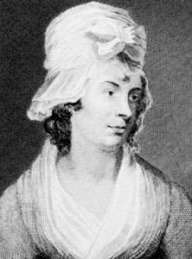
Charlotte SmithLet’s take a deep dive into a poem, shall we?

I first became aware of Charlotte Smith’s poetry during the first semester of my MFA, when, for reasons I won’t bore you with, I had to recite her “Ode to Death” for workshop. I distinctly remember its accepting attitude towards its subject—not quite Dickinson’s friendly relationship with it in “[Because I could not stop for death],” but still cordial, curious even.

Recently I decided to look through more of her work, and lo and behold, the first of her poems in The Norton Anthology of Poetry deals with a similar theme:

“Written in the Church Yard at Middleton in Sussex”

Pressed by the moon, mute arbitress of tides,
While the long equinox its power combines,
The sea no more its swelling surge confines,
But o’er the shrinking land sublimely rides.
The wild blast, rising from the western cave,
Drives the huge billows from their heaving bed,
Tears from their grassy tombs the village dead,
And breaks the silent sabbath of the grave.
With shells and seaweed mingled, on the shore
Lo! their bones whiten in the frequent wave;
But vain to them the winds and waters rave;
They hear the warring elements no more:
While I am doomed, by life’s long storm oppressed,
To gaze with envy on their gloomy rest.

There’s a lot we can, and will, talk about here, but this being a sonnet, why don’t we start with the turn in the final couplet?

The ending of this poem is somewhat odd, even unsettling. After three quatrains of detached observations of a coastal graveyard, the speaker turns to her own, morbid concerns: she is “doomed” to “envy…their gloomy rest.” Not only is this turn emotionally dispiriting, but it also seems to rest on a false premise: what “gloomy rest” is there in this graveyard?

In “The Sonnets of Charlotte Smith” (published in Critical Survey 4.1, pp. 9-21, 1992), Stella Brooks focuses on the poem’s diction to get to the heart of the apparent contradiction. Although the speaker

longs for their oblivion for herself…the preceding violation of the “silent sabbath” of the graves, the shock of the “village dead” being “torn” from their tombs by the “huge billows,” the “raving” of the “winds and waters” have suggested anything but the claimed oblivion; the graves have been disturbed, there is no “gloomy rest” for their inmates. (p. 14)

Of course, Brooks does not see this discrepancy between the speaker’s description of the graveyard and her interpretation of it as a flaw in the poem. Rather, that discrepancy is emblematic of a “turbulent Romantic fantasy” (p. 14). The speaker has a need to express her heightened emotions, in spite of the constraints placed upon her.

I’d like to push Brooks’ reading a bit further, for the poem strains against more than just the facts of the case. The formal elements of a poem, after all, are another kind of constraint. In case of this sonnet, elements that would ordinarily suggest calm and composure in fact hold back an uncontrolled force of emotion.

To start, let’s continue talking about endings: line-endings. A quick glance reveals that of the sonnet’s 14 lines, 13 of them end with some form of punctuation, from the brief pause of a comma to the heavy stop of a period. End-paused lines are famous for slowing the pace at which one reads a poem, as they represent both the end of a unit of syntax (a phrase or a clause) and a unit of verse (a line). Further, when end-paused lines occur with such regularity, they give the poem another measured music in addition to the meter (more on which later).

There’s only one line in Smith’s sonnet, line 9, which lacks end-pausing punctuation, and naturally this moment represents a turning point in the poem: “on the shore / Lo! their bones whiten”. It’s an awkward line-ending, as the next line all but starts with terminal punctuation, with that exclamation point coming just one syllable in. The poem’s rhythm staggers right as the speaker confronts the full extent of the graveyard’s damage. The speaker has mentioned how the sea has degraded the graveyard prior to this, but those descriptions tend towards abstraction: “village dead,” “the silent sabbath of the grave.” Here, though, death is rendered concrete: whitened bones “with shells and seaweed mingled.”

Now, line 9 may be the point where the poem’s composure completely dissolves, but Smith has been building up to this moment throughout the first two quatrains.  The apparent calm in the lead-up is illusory. For one thing, the sound-play in the first eight lines is incredibly emphatic. The first two rhymes are on the similar-sounding [aɪdz] (“tides”/”rides”) and [aɪnz] (“combines”/”confines”), with either sound amplifying the other. Internally, the lines are super-charged with repeated sounds: “Pressed”/”arbitress” and “moon”/”mute” in line 1, the double alliteration of “huge billows” and “heaving bed” in line 5, the sibilance of “breaks the silent sabbath” in line 8, and so forth.

It’s difficult to read this poem aloud without feeling a bit pompous, the sound-play is so heavy and the lines so measured. One imagines Smith declaiming this piece to the decay before her, arms raised to the heavens like a capital-R Romantic heroine, trying to convey her emotions to the spirits. But behind all that power, there’s also strain, and that strain comes through in the poem’s meter.

The first quatrain scans pretty regularly for a sonnet, with no line straying too far from iambic pentameter. Line 1 has an authoritative initial trochee (“Pressed by | the moon…”) and line 2 starts with a double iamb (“While the | loud e | quinox…”), but beyond those two substitutions, it’s four lines of forceful iambs. (Even if we give “power” its modern two-syllable scansion, the stresses stay on the same syllables in the line; the anapest changes very little.) What’s more, the stresses keeps accentuating words relating to strength: “pressed,” “loud,” “power” “swelling surge.”  If not for the rhyme, I could almost see King Lear reciting these lines on the stormy heath.

But the second quatrain does not scan so easily. Consider lines 5 and 6:

The wild blast, rising from the western cave,
Drives the huge billows from their heaving bed

Forcing these lines to fit the mold of iambic pentameter is a challenge. The mid-line comma and the possibility of pronouncing “wild” as two syllables suggest we scan the first three words as two iambs (“The wi | ld blast“). The rest of line 5, meanwhile, has a fairly intuitive cadence: “ris | ing from | the wes | tern cave.” Putting both parts together, though, we end up with six stresses instead of five. We can either demote “from” to an unstressed syllable, which maintains the semantic emphases but producing an ungainly scansion (“The wi | ld blastrising | from the wes|tern cave“), or we can elide “wild” into one syllable and demote either it or “blast,” which makes for a better-scanning line but is unsatisfying semantically. Who says “wild” or “blast” weakly?

Line 6 presents a similar problem, with a natural reading producing a six-stress line. Demoting “from,” as it did before, makes for an even worse scansion than before: “Drives the | huge bil | lows from | their hea | ving bed.” The other option, demoting “drives” or “huge,” as it did before, forces us to de-emphasize a strength-related word, exactly what the poem encouraged us to do in the first quatrain. Gone are the forceful declamations; uncertainty now reigns. The poem may get back on song in the next two lines, with just the initial trochee in line 7, but it does so just in time for the bodies to start surfacing.

All of the above may be interesting, but how does it factor in to the poem’s conclusion? Well, it justifies how the speaker could possibly see “gloomy rest” in this scene. The disturbed dead are numb to the chaos around them, unable “to hear the warring elements.” But more than that, the dead cannot think or feel, whereas the speaker is compelled to contemplate their fate, with all that loud language and emotion discussed above bouncing about in her head. The one thing someone in such a position could envy is quiet. But in the Romantic world of Smith’s poetry, that is impossible. The speaker can only “gaze with envy” at the possibility.

To end on a (slightly) cheerier note: Lit Brick has an amusing summation of the poem in webcomic form, so enjoy that!

What do you think of Smith’s sonnet? Have any suggestions for more classic poems to dissect? Feel free to share in the comments.
Four Fragments on Nothing

Let me take you back, briefly, to late 2010.

My 12th-grade AP English teacher, Mr. LoGiudice, is out of school for reasons I can’t remember now, but he told us the day before he’d be absent. He’s left the substitute with a prompt that we’re to spend the entire period writing about. We just finished the unit on Shakespeare, so I’m expecting something related to Bard.

The substitute grabs a piece of chalk and, with a slightly confused manner about her, writes the prompt on the board, which I quote now in full:

Nothing.

There’s some laughter around the room, with a bit of disbelief mixed in. Who can possibly take this prompt seriously? Who can write an essay, even an awful SAT-style essay, on “nothing”? So I’m not sure anyone does. Certainly I don’t.

By this point in my life I have fancied myself a poet, by which I mean I like writing ballad-esque song lyrics and have been reading The Complete Idiot’s Guide to Poetry. As such, I decide to write a poem on nothing, a poem that interrogates the very concept of nothing.

It is, in something approaching an irony, the longest poem I have ever written up to this point: two pages written out, split into four sections. (That’s not actually very long, but I tend to cap out around 20-30 lines.) I throw in every approach to nothing I can think of. Allusions to Seinfeld, that show about nothing. Quotes from King Lear, where we’re admonished: “Nothing will come of nothing. Speak again.” The brains of politicians, because nothing is easier than mocking politicians.

I turn it in. I feel good about it. I go on to include it in at least one of my college applications. And for the longest time, I think no more of it.

*     *     *

Now, the purpose of that prompt in the context of the class was to introduce the unit on existentialism and absurdism, on the search for meaning in a universe that has none. It was a way of transitioning us from Shakespeare to Sartre, from Edgar and Edmund to Vladimir and Estragon. We never, so far as I can recall, discussed what we wrote the day Mr. LoGiudice was absent.

Yet I feel that little poem I wrote must have had some impact on me, because “nothing” keeps popping up in my work. “Nothing” grows in the fields. Magicians hide “nothing” up their sleeves. I speak of “a thunderclap / that releases nothing.” There is “nothing” to be concerned about.

One construction, in particular, I’ve discovered I’m fond of: “nothing but.” It’s a curious phrase, highlighting the object being named by denying the reality of all other objects. It’s so brazen an approach that it always carries an air of absurdity. It also lends itself to undermining itself. One of my published poems, “Rural Sound Check,” begins like this:

Nothing but pebbles sliding
under my sneakers, nothing
but groundhogs and garter snakes
darting through leaves on the roadside…

These two phrases cannot be true simultaneously; each denies the other. The implication must be that what the speaker initially believes to be nothing is, in fact, something, many things even.

Compare that to John Brehm’s poem “Sound Check, Rural Manhattan,” which directly inspired mine. His begins not with a “Nothing but…,” but a “Just…”: “Just a jumble of songs and jackhammers and / roaring garbage trucks…” Brehm’s speaker does not necessarily deny the existence of other sounds, merely their apparent significance. It is, perhaps, a more honest and nuanced way to approach his subject than I take. After all, when you begin as nihilist, there’s only one direction to go.

*     *     *

In The Wilds of Poetry: Adventures of Mind and Landscape, David Hinton describes the poetry of Gustaf Sobin like so:

A Sobin poem opens a “talk of mysteries,” a force field of wonder and query and unknowing. It begins somewhere already in process (often marked by ellipses), as if its beginnings were lost, thereby suffusing itself in silent/unsayable origin. It is often fragmentary, or otherwise fully of empty interstice. The language is always provisional, decontextualized, conditional, incomplete, full of words like as if, might, would, could. It revels in a vocabulary of vanishing: vestige, relic, obfuscated, elision, obliterated, nothing, extinguished, dismantled, empty, dissolving, invisible, illegible, abolished, nothing. (p. 290)

I’m not sure why Hinton feels the need to list the word “nothing” twice, but it illustrates the difficulty in writing about that which is mysterious or absent: we lack a good vocabulary for it. We end up speaking in negations (nothing, invisible, illegible) or in terms of destruction (dismantledabolished), rather than the continuous, affirmative presence that we might mean.

Granted, a creative poet can find ways around this problem of language. Sobin, for example, uses the power of the line-break to separate the prefix from the base word, allowing the word and its negation to exist simultaneously. One can see this in the poem “Languedoc,” with the phrase “that thin / il- / legible tremor” (lines 19-21). The tremor’s illegibility is made its most legible trait, rather than a problem we have in perceiving it.

But more often than not, in attempting to describe that which we call nothing, we’re left with abstraction, reiteration, and frustration. We may, after a time, feel like Prufrock: “That is not what I meant at all; / That is not it, at all.” Or, again, like Prufrock: “That is not it at all; / That is not what I meant, at all.”

*     *     *

I must confront the possibility that this post is a way of intellectualizing a personal fear of mine: have I nothing to say? Are my poems merely an excuse to string sounds and images together, with no recognizable end? Or do I have a subject, but lack the language to even think it, let alone record it?

A word I now realize is missing from Hinton’s analysis of Sobin: “doubt.” Why speak in a manner “provisional, decontextualized, conditional, incomplete,” why lead a poem with an “as if” or a “just,” why dismissively call these reflections “fragments,” why speak of “nothing” in the first place—if there is nothing to doubt?

Rhyme in Bob Dylan’s “Queen Jane Approximately”

This week, I’d like to talk about one of my all-time favorite songs, Bob Dylan’s “Queen Jane Approximately,” and about how it uses different kinds of rhyme to reinforce its meaning.

First released on Dylan’s 1965 masterpiece album Highway 61 Revisited, “Queen Jane Approximately” seems to have a very straightforward rhyme scheme. It’s composed of five stanzas, each following an abaBB pattern, where the capital letters represent the refrain line (“Won’t you come see me, Queen Jane?”). It’s a pattern only slightly removed from the classic ABXB pattern of the ballad, one of the fundamental forms in poetry and music.

However, the abaBB pattern only tells part of the story. The rhymes all have stress placed on the second-to-last syllable, while the b rhymes have stress placed on the last syllable. For an example, let’s consider the first stanza:

When your mother sends back all your invitations
And your father to your sister he explains
That you’re tired of yourself and all of your creations
Won’t you come see me, Queen Jane?
Won’t you come see me, Queen Jane? (lines 1-5)

As you can see, Dylan alternates between these two kinds of rhymes, poly- and mono-syllabic. But what good does knowing that do us when it comes to analyzing the song?

To see how the rhyme in “Queen Jane Approximately” reinforces the meaning, I’m going to consider two ways of conceptualizing these sorts of rhymes. The first way is to think about them is in terms of the masculine/feminine distinction.

Masculine rhyme, in traditional English-language poetics, refers to a rhyme in which the stress falls on the last syllable. All monosyllabic rhyme pairs (e.g., “dog” / “blog”) are examples of masculine rhyme, but so are polysyllabic rhyme pairs like “deny” / “reply“—effectively, the actual rhyme there is “-ny” / “-ply.”

Feminine rhyme, on the other hand, refers to a rhyme in which the last syllable is unstressed, but the second-to-last syllable is stressed. The classic example is “sharing” / “caring.” (Note that something like “sharing” / “sing” would not be a true rhyme, because the stress patterns don’t match up: the former ends unstressed, the latter stressed.)

Now, the masculine/feminine distinction plays into a restrictive view of gender norms, in which masculinity is coded as strong and femininity as weak, which is why the terms are (slowly) falling out of favor. Yet that wouldn’t necessarily prevent the distinction from providing a useful framework for approaching the song. Indeed, I can imagine a song that alternates between feminine and masculine rhymes, as Dylan’s does, in order to encode the text of the poem as a dialogue: the “female” voice speaks, then the “male,” and so forth.

Alas, such dialogue encoding doesn’t really apply to “Queen Jane Approximately.” To start with the obvious: the song is wholly in the voice of the speaker, with Queen Jane as the addressee. In fact, Queen Jane doesn’t even have much of a voice in the speaker’s description of her. She is spoken to (“…all the bandits that you turn your other cheek to / All lay down their bandanas and complain” [16-17]) and she is spoken of (“…your father to your sister he explains / That you’re tired of yourself and all of your creations” [2-3]). But she doesn’t speak much herself, and when she does try to communicate with others, she is ignored (“…your mother sends back all your invitations” [1]).

You might argue that, by systematically inserting feminine rhymes into the song, Dylan can still imply a conversation between Queen Jane and the speaker. But it’s hardly clear that either Queen Jane or the speaker even wants to be part of a conversation. After all, in the final stanza the speaker pitches himself as “somebody you don’t have to speak to” (23). If Queen Jane and speaker ever get together, it will take the form of a one-way lecture—in other words, the exact thing they’re doing now.

Granted, this line of inquiry has helped to shed some light on the song, but only in how proposed framework doesn’t fit the situation. So rather than using the masculine/ feminine distinction, I would suggest we approach the rhyme in “Queen Jane Approximately” with a rising/falling framework instead.

At first, this proposal seems like a mere relabeling of terms: all masculine rhymes are rising rhymes (the meter of a line “rises” when it ends with a stressed syllable), and all feminine rhymes are falling rhymes (the meter “falls” with an unstressed syllable). However, these different terms have different implications. No longer are we think of the rhymes in terms of gender, and therefore people. Rather, we can think of the rhymes in terms of “direction,” where rising is positive and falling is negative.

Note that each stanza of “Queen Jane Approximately” follows the same, two-part syntactic structure: “1) When [X], 2) won’t you come see me, Queen Jane?” The first part describes a series of conditions, and the second suggests a course of action in response to them. Let’s consider the both parts of that structure in turn.

When the speaker lists off the background conditions of Queen Jane’s life, it sounds thoroughly unpleasant. Given that she is always referred to as “Queen Jane,” we can safely say that she holds (or at least, believes that she holds) a high station in the world, yet she is being subjected to constant torment. This has all the makings of a declension story. When even “the flower ladies want back what they have lent you,” you have fallen from the heights (6).

As it happens, every stanza’s “when” clause contains both of its falling rhyme words. Queen Jane’s world is dominated by these weak, unstressed endings, which match her apparent fall. It is true that each “when” clause also contains a rising rhyme word, which could somewhat dampen that effect. But Dylan tends to pick words with negative connotations for that position (“vain,” “pain,” “complain”), so the semantics tend to drown out the sound.

But while Queen Jane, literally and aurally, spends most of each stanza in descent, the refrain offers the prospect of restoration. The line “Won’t you come see me, Queen Jane?” not only proposes a solution, it also ends emphatically: “Queen Jane” easily scans as a spondee (two stressed syllables). The refrain not only ends with a rising meter, it seemingly compensates for her previous declines.

Viewed in this light, “Queen Jane Approximately” is not merely another classic Dylan sneer-song, à la “Like a Rolling Stone” or “Positively 4th Street.” It becomes comforting, albeit a bit patronizing. No matter how far one falls, it’s still possible to rise for a strong finish.

Recent Publication: Spillway

spillway25

This year’s issue of Tebot Bach’s poetry journal Spillway has recently come out, and it includes a poem by yours truly: “The Magician’s Retirement Speech.” It’s quite an honor to see my work alongside the likes of Ilya Kaminsky, David St. John, and the late Chana Bloch.

Special thanks to outgoing editor Susan Terris, and congratulations to my fellow contributors!

Spillway 25 is available for purchase from their website.