Recent Publication: Review of “Not Elegy, But Eros” by Nausheen Eusuf (The Hopkins Review)

Eusuf Review

I’m happy to announce that my review of Nausheen Eusuf’s debut poetry collection Not Elegy, But Eros (NYQ Books, 2017) has just been published in the most recent issue (11.3) of The Hopkins Review.

Special thanks must go to David Yezzi, for encouraging me to try my hand at a poetry review; to Katherine Sharpe, for her patience as an editor; and, of course, to Nausheen Eusuf, for writing this wonderful collection.

Rather than leaving you with an excerpt of the review, I’ll quote the beginning of “Selfie,” one of my favorite pieces in Eusuf’s book that, alas, I did not have the space to talk about in the piece itself. I hope this will encourage you to give Not Elegy, But Eros a read.

excerpt from “Selfie”

If self’s the man, she’s the wife
who follows, shadow-faithful
through your twilight haunts
and midnight jaunts, who knows
your revels and your despair,
your zits and your stomach pits…

Not Elegy, But Eros is available through the publisher, NYQ Books, as well as through Barnes & Noble and Amazon. If you’d like to read my full review of it, you can subscribe to The Hopkins Review.

Oh, Where Have You Been: A Chain of Influence from “Lord Randall” to Iron & Wine

For this post, we’re going to look at three songs which I think share a pretty direct lineage. I encourage you to give all three tracks a listen if you don’t know them already. (And if you do know them, give ’em another listen anyway. They’re all good songs!) Some of the similarities and differences will likely be apparent even going in cold, while others I think become clearer after some discussion.

Now that we’re all on the same page, let’s start our deep dive.

I. “For it’s now that I’m dying…”

The first song is the early-modern English folk ballad “Lord Randall.” As with basically all folk ballads passed down through the oral tradition, there are many versions of the song that you can find. I’ve gone with Jean Ritchie’s recording because I’m fond of her voice, but what I’m about to say applies to pretty much any version of the song that you might come across.

“Lord Randall” tells the woeful tale of its title character. Our young man has been in “the wild wood” with his true love, who made him “eels boiled in broth” for dinner. This dinner appears to have had an ominous effect, because his bloodhounds “swelled and they died,” and upon returning home his mother deduces that he’s been poisoned. In his final breaths, Lord Randall wills his possessions to his parents, while to his true love: “I’ll leave her hellfire,” for she is the killer. It’s an old-fashioned murder ballad, and one that turns on a mystery to boot.

To get a good handle on the song’s form, let’s take a look at the first stanza.

“Oh, where have you been, Lord Randall my son?
Oh, where have you been, my handsome young man?”
“I’ve been to the wild wood. Mother, make my bed soon,
For I’m weary with hunting, and I fain would lie down.”

On a skeletal level, “Lord Randall” uses a loose variation of long meter, where each line of the quatrain has four strong stresses (“Oh, where have you been, Lord Randall my son?”) I say “loose,” because the third and fourth lines of each stanza arguably have five stresses each, but as Ritchie sings them the middle-most accents (“Mother” and “and,” respectively) don’t get the same emphasis as the others. Also of note: “Lord Randall” doesn’t rhyme, but rather uses consonance to link the ends of each line sonically. The constantly changing vowels may sound awkward to modern ears, but I’d argue that the lack of perfect rhymes fits the tragic subject matter.

One might also note that “Lord Randall” is dramatic in nature, by which I mean it presents itself as a dialogue between two characters. Each stanza begins with Lord Randall’s mother asking a question about her son’s recent journey, and ends with Lord Randall’s response and a plea that he’s tired and “fain would lie down.” In this song, much of the conflict is driven by an imbalance of information: the mother is in the dark, and her son is reluctant to tell her the whole truth.

A final noteworthy aspect about the song’s structure is its heavy use of refrains. The second halves of both of the mother’s lines are repeated in each stanza (“Lord Randall my son,” “my handsome young man”), as is most of the son’s dialogue with some variations. This heavy repetition makes the song’s dialogue highly stylized, if not ritualistic, but it also gives the song’s narrative an interesting progression. Even though the mystery continues to unfold in the listener’s ear, it simultaneously keeps turning back to previously stated niceties. The story is both linear and cyclical.

In terms of the narrative, what I find most compelling about “Lord Randall” is the gradual change in the title character’s attitude from start to finish. It’s easy to read the son’s responses to the mother’s questions as attempts to end the conversation. “Let’s stop talking,” he seems to say, “I want to go to bed.” Once the fact of his dying comes out, though, he stops trying to shut down the dialogue. Instead, he starts speaking performatively, his words assigning goods and fates upon his relations. At the moment of his death, he finally takes action.

II. “I’m a-goin’ back out…”

Let’s jump now from early-modern England to the mid-20th-century United States. Released in 1963 as part of the seminal album The Freewheelin’ Bob Dylan, “A Hard Rain’s a-Gonna Fall” occupies a unique position in Dylan’s early discography. The song is a mixture of Dylan’s three primary impulses from this period: the socially-conscious songs that made him famous, like “Blowin’ in the Wind” and “Masters of War”; the impressionistic, more personal lyrics he would start fully exploring on Another Side of Bob Dylan (1964); and, our main focus here, the canon of English-language folk songs that drew Dylan to the Greenwich Village scene in the first place.

As we did with “Lord Randall,” let’s take a look at the opening stanza to get a sense of the form:

“Oh, where have you been, my blue-eyed son?
Oh, where have you been, my darling young one?”
“I’ve stumbled on the side of twelve misty mountains.
I’ve walked and I’ve crawled on six crooked highways.
I’ve stepped in the middle of seven sad forests.
I’ve been out in front of a dozen dead oceans.
I’ve been ten thousands miles in the mouth of a graveyard.
And it’s a hard, and it’s a hard, it’s a hard, and it’s a hard,
It’s a hard rain’s a-gonna fall.”

The influence of “Lord Randall” should be apparent. Just like the earlier folk song, “A Hard Rain’s a-Gonna Fall” is a piece of dramatic poetry, between an unidentified parent and their “blue-eyed son” who has been out in the world and experienced a great deal. The parent’s dialogue in particular calls to mind “Lord Randall,” with the repetition of “Oh, where have you been” and the affectionate terms for their child.

When the blue-eyed son starts speaking, though, “A Hard Rain’s a-Gonna Fall” starts to deviate from its model. While Dylan’s song maintains the loose, four beat rhythm, it does not bother with the strict consonance of its predecessor; in fact, it forgoes similar end sounds entirely. Instead, the song’s organizing principle is parallel syntax: each line begins with the same construction of “I’ve + [verb]” (except in the final stanza, which includes “Where…” statements as well). More so than popular song, the piece resembles free verse poetry in the vein of Walt Whitman’s Leaves of Grass or Christopher Smart’s Jubilate Agno. It’s an unconventional choice, but that syntactic repetition still gives the piece a strong sense of musicality.

Further, as you’ve no doubt noticed, the son’s dialogue in each stanza is far more expansive and variable than it is in “Lord Randall.” In the folk song, the son always speaks two lines at a time, and if you factor out the refrains his responses are quite curt: “I’ve been to the wild wood,” “I dined with my true love,” etc. By contrast, the son in Dylan’s song is someone given to rambling. Not counting the closing refrain (more on which later), the son’s parts in each stanza range from 5 to 12 lines. The strictures of the folk song literally cannot contain this character’s speech.

And just what does the blue-eyed song have to say? Well, as is often the case with Dylan’s lyrics, there isn’t really a coherent literal scenario. This is no murder ballad, with a clear and causal narrative. Instead, the poem is organized around a series of associative leaps. It’s not a travelogue, but a creatively arranged list of impressions. Still, one can often see links between one image and the next. The first stanza, for instance, uses number as a jumping-off point (“twelve misty mountains,” “six crooked highways,” “seven sad forests”), while in the second stanza the “black branch with blood” precedes hammers “a-bleedin’.” As with much of Dylan’s work, the point is not to pin down one true meaning, but rather to play around with what has been suggested.

Still, the song does end on one clear note: the speaker has to keep telling their story. There is some bleak event on the horizon, that “hard rain” the speaker keeps returning to in the closing refrains. What that hard rain signifies is, of course, not stated, but whatever it is, it calls for a response. Thus, in that last stanza, the conversation shifts from the past to the future. “Oh, what’ll you do now?” the parent asks, and the son says he’s “a-goin’ back out ‘fore the rain starts a-fallin’.” He will return to the world, as grim as it is, and deliver his message:

And I’ll tell it and think it and speak it and breathe it
And reflect it from the mountain so all souls can see it.
Then I’ll stand on the ocean until I start sinkin’,
But I’ll know my song well before I start singin’.

Like “Lord Randall,” “A Hard Rain’s a-Gonna Fall” ends on an active note for the speaker, in this case, laying out a plan for the future. But the tones seem quite different. There’s no resignation present here, no reluctant acceptance of death. The son does not give into that hard rain, does not say he “fain would lie down.” Instead, it ends with optimism, so much so that the verse even indulges in some concluding slant rhyme couplets. Dylan has taken the raw materials of “Lord Randall,” and used them to tell a totally different story.

III. “I dreamt of that sound…”

The link between “Lord Randall” and “A Hard Rain’s a-Gonna Fall” is pretty : the latter directly lifts the structure of the former. The link between “A Hard Rain’s a-Gonna Fall” and our final song for today, on the other hand, is more speculative on my part. A quick Google search tells me that I’m not the first to make this connection, but it’s entirely possible that the similarities here unconscious rather than intentional.

With that disclaimer out of the way: let’s move up to January 2011. It’s my senior year of high school, and I’ve been conversant in Bob Dylan’s music for about two years. Sam Beam (better known as Iron & Wine), a singer I’ve just become familiar with, has released his fourth studio album, Kiss Each Other Clean. The lead-off track, “Walking Far from Home,” is an emotional power-bomb of song—one that still gives me chills—but I can’t shake the feeling that I’ve heard something like it before. A few listens later, and it hits me: it’s a rewriting of “Rain.”

Like Dylan’s song, “Walking Far from Home” strings together an associative list of images detailing a journey out in the world, with heavy use of parallel syntax to organize things. The speaker has seen everything from “children in a river” whose “lips were still dry” to “a bird fall[ing] like a hammer from the sky.” Once again, there’s no clear narrative here, but rather a series of impressions building to a climax.

Yet for all the similarities in content, there are some significant differences in structure. Take a look at the opening stanza here:

I was walking far from home,
Where the names were not burned along the wall.
Saw a building high as heaven
But the door was so small, door was so small.

First off, for the first time in our discussion we have perfect rhyme in a stanza, with “wall” and “small” helping to form an ABXB rhyme scheme. This already sets it apart from both “Lord Randall” (consonance) and “A Hard Rain’s a-Gonna Fall” (unrhymed). Second, while it’s possible to squeeze or expand lines into the four-beat pattern of its predecessors, that involves stressing words against the manner in which they’re sung. It’s a rhythm perhaps reminiscent of the ballad, but not committed to it. Third, the use of refrains only survives in the “echoing” final lines of each stanza, so the effect of cycling through a linear story has mostly been cut.

But the most significant structural change can only become obvious when the song is viewed in totality: there’s no dialogue. The speaker is the only one, well, speaking in the piece, and they’re not even implied to be addressing anyone in particular; there is a “you,” but the relationship between speaker and addressee is left vague. In that regard, Iron & Wine goes further than Dylan in making the “Lord Randall” narrative ambiguous. Not only is the content of their speech rendered impressionistic, as it is in Dylan’s song, but also the circumstances of their speech are left unstated.

I think this move, turning the dialogue of the previous two songs into an internal monologue, helps to explain the shift in how this song ends. The speaker in “Walking Far from Home” doesn’t conclude with a performative utterance like Lord Randall, nor does he resolve himself to a future course of action like the blue-eyed son. Instead, he uses the final verse to suggest that he’s come to a personal revelation because of his travels: he “saw a wet road form a circle / And it came like a call, came like a call / From the Lord.” What was once a movement toward external-facing action has now become the spark for inward-facing change.

IV. “Join me in song…”

To wrap this all up: why should we care about any of this? What difference does it make if we can trace contemporary indie music all the way back to early-modern folk songs? Isn’t this all just academic, all just trivia?

Well, partially. I did start writing this because I merely found it interesting. But I do think these songs offer us a lesson in how to use past works for inspiration. You’ve likely heard the expression, “Everything’s a remix,” that is, all art is a reworking of something that came before it. I think that’s true in the broad strokes, but it can miss the most important part of remixing: making what’s old into something new.

We can see that in these three songs. A 17th-century balladeer’s tale of murderous betrayal and motherly affection helped Bob Dylan to write a impressionistic call to action in politically stressful times. In turn, that song may have sparked Iron & Wine to write about an intimate form of salvation along a similar journey. These songs are, ultimately, in conversation with each other. But “in conversation with” does not mean “repeating.” There is little “remaking” here, and much more “making new.”

So, if you find yourself in a writing rut, you can look to a past work, figure out what makes it tick, and then write your own version of it. Just don’t be afraid to go unexpected places with it.

*          *          *

Thanks for reading! If you enjoyed this piece and would like to hear me yammer on some more about Bob Dylan, I wrote another blog post last year about the use of masculine and feminine rhyme in “Queen Jane Approximately” that you might find interesting.

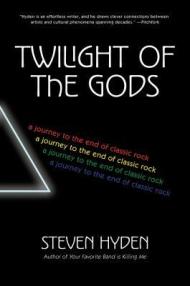
Play the Hits, But Play Them Slant: On Steven Hyden’s “Twilight of the Gods”

I used to read a lot of Steven Hyden columns when I was in high school and undergrad. I’d look forward every month to him and Genevieve Koski debating the merits of various Hot 100 songs for The A.V. Club’s “This Was Pop” feature, and I immensely enjoyed some of the essay series he authored, such as Whatever Happened to Alternative Nation? (The A.V. Club, 2010) and The Winners’ History of Rock and Roll (Grantland, 2013). The way Hyden gracefully ties together basic rock history with his personal experiences, growing up in small-town Wisconsin and developing a fascination with classic rock, always appealed to me. After all, I felt I could relate to that story. I, too, was from a kid from the boondocks who became infatuated with the culture of the recent past.

However, I stopped keeping up with his work after Grantland, where he was a staff writer, ceased publication in 2015, and so I wasn’t aware that Hyden was still writing until I came across Brooke’s review of Twilight of the Gods: A Journey to the End of Classic Rock (Dey Street, 2018). Seeing that review triggered some warm memories for me, and I immediately put the book on my to-read list.

HydenStill, I went into Twilight of the Gods with an uncertain feeling, not because I didn’t know what to expect, but because I was fairly sure that I did. How much of the book, I thought to myself, would be brand new (or at least, new-to-me) insights and arguments, and how much would be reworded or repeated versions of past columns, ones that I had already read for free? That’s really something one must keep in mind when reading any book by a columnist: the possibility that you’ve literally read this all before.
Reprinting older material in a new format is, I want to stress, not necessarily a bad impulse. A contemporary short story collection may consist entirely of pieces first published in The New Yorker, but having a single volume of stories is certainly less cumbersome than tracking down a dozen random back issues of a magazine. And the ways an author orders and revises those stories may illuminate certain themes or connections among them that reading the stories in isolation would never reveal. Twilight of the Gods, I felt the need to remind myself, could do much the same for Hyden’s music writing.

With that as preamble, I’m going to ask two questions of this book. First: to what extent is Twilight of the Gods a rehashing of Hyden’s previous work? Second: in what ways does Hyden repackage that material, and do those methods improve the experience of reading it?

Question 1: What Have We Seen Before?

According to the book’s copyright page, four of its nineteen chapters contain direct reprintings of previously published material: three from The A.V. Club and one from Uproxx (which comes from that period after I’d lost touch with Hyden). That was actually less than I’d expected, and I only noticed one of them during my read-through: the chapter entitled “Keep On Loving You,” on 1970s and 1980s “corporate rock,” which reuses a large portion of his essay on REO Speedwagon’s 1981 album Hi Infidelity. I might use this as evidence that Hyden has good taste in his own work, as I’d rank that article among the best pieces he’s written. If Twilight of the Gods accomplished nothing else, I would still be glad that it helped preserve a solid piece of writing.

Of course, a writer can repeat themselves without doing so verbatim. Some sections are technically new pieces of writing but bare striking resemblances to earlier works. A good example is the Aerosmith section of the drugged-out rocker chapter, “Draw the Line,” which reads like a slightly condensed version of the band’s part in The Winners’ History of Rock and Roll. The two versions hit all the same beats: Aerosmith starts as a band famous for their party-ready music and their drugged-fueled creative process, who fall off for several years before they embrace sobriety and professional songwriters and attain even greater commercial success, serving as an exemplar of society’s changing attitudes towards drug use and artistry. Both versions even go out of their way to mention how getting Aerosmith concert tickets is a plot point in Dazed and Confused. The expression of the ideas differs, but the substance is mostly the same.

Beyond arguments and insights, Hyden has a habit of reusing anecdotes outside their original context. For example, that Hi Infidelity article mentioned above opens with a bit about Hyden’s mother excitedly confusing R.E.M. with REO Speedwagon, but that doesn’t appear in the corporate rock chapter. Instead, it’s included as an aside-within-an-aside in the chapter about live albums, “Hello There (Live at Budokan).” The book is peppered with moments like that: brief flashes which would only draw attention if, like me, you had no life seven years ago and reread Hyden’s columns like they were about to go sour.

From all the above, I’d say that, to someone familiar with Hyden’s previous work, Twilight of the Gods will definitely sound familiar, but the experience of reading it won’t be completely redundant. Whether that’s enough to make the book worth a read is up to you—and if you’ve never read Hyden, I suspect it’s wholly irrelevant.

With that out of the way, let’s turn to the more interesting question.

Question 2: How Has It Been Repackaged?

Let’s start this section off with the macro-level, and get the book’s major misstep out of the way. Hyden structures these otherwise loosely-connected essays around Joseph Campbell’s notion of the monomyth, or hero’s journey. The book is broken up into four parts, each of which is named for a section of the hero’s journey, from the start of their quest to their moment of transcendence. In practical terms, this means that each section’s essays roughly touch on the same theme: one section will talk about the roots of the classic rock, another about the decadence and corruption associated with it, another with the format’s decline in popularity, etc.

For the record, I tend to find the popular usage of Campbell to be rather tedious in the best of times, but in the case of Twilight of the Gods it actively weakens the book by asking the reader to look for a progression that doesn’t exist. Hyden knows that explaining classic rock is too messy a subject to fit into this sort of straitjacket, and for all the personal moments in the book, they’re not focused enough for the collection to be a work of self-revelation. It is true that Hyden often wants to highlight the quasi-spiritual aspects of being a classic rock fan, saying he was drawn to “the mythology of it, which satisfied the part of my psyche that demanded connection to a vast, awe-inspiring reality.” But there would simpler ways of conveying that notion than halfheartedly gesturing towards some hero’s journey.

I think Hyden would have done better to keep the connective tissue linking the essays to a minimum, because his quiet callbacks to earlier pieces can be pretty powerful. The best example is from “Keep On Loving You,” right as he closes out the REO Speedwagon section, where he refers back to earlier essays about his teenage passion for the classic rock staples in a moment of empathy with his mother:

My mom would never describe Hi Infidelity in these terms, but I think REO Speedwagon for her represented a more down-to-earth version of the rock mythos. As a kid, I was attracted to larger-than-life rock stars with exaggerated personas rooted in decadent mysticism. I longed to go on a misty mountain hop and venture all the way to the dark side of the moon. But my mother was too experienced to buy into those silly, pie-in-the-sky fantasies. What she longed for was more mundane but in a way no less fanciful—a decent guy who was earnest about love. That’s why Hi Infidelity made her heart sing. Her notes might have been off-key, but they were true.

Importantly, this closing paragraph is not part of the original piece of Hi Infidelity. It’s the sort of insight that Hyden probably had previously come to, but which didn’t fit in with that first conception of the piece. In the context of a broader account of classic rock, though, Hyden has a justification for making that link between mother and son in the text itself.

Even within individual essays, Hyden finds ways to refine points he has previously mulled over, finding new significance for them in the context of classic rock’s complete story. The most explicit instance is in “So Bad,” in which Hyden directly quotes his essay on the “five-albums test.” In a long parenthetical to that essay, he also defines the concept of a “good ‘bad’ album,” an album from a genius-level artist which is interesting precisely because of its relative badness. (As a long time fan of Neil Young, I am overly acquainted with this sort of record.)

Twilight of the Gods isn’t the first time that Hyden has returned to the “good ‘bad’ album” concept; he ran with it a bit further when discussing The Rolling Stones’ 1981 album Tattoo You. But in both those earlier articles, one can sense Hyden feels stymied. He has this idea about “good ‘bad’ albums,” but hasn’t yet figured out why anyone should care about it. (Indeed, the Tattoo You piece starts with Hyden expressing surprise that no one had latched onto the idea in the comments for the five-albums test article.) It’s not until he gets to this book, this personal history of classic rock, that he finds the importance behind this pet concept of his—it’s central to being a younger fan of older music:

It’s the only way to discover “new” music if you’re into classic rock—you must dig into the albums that people tell you that you won’t like, and you must listen to them many, many times until you find a way to like them. Because you will inevitably tire of Pet Sounds, and when that happens you will come around to Love You and marvel over the daffy synth sounds in “Johnny Carson,” and speculate over whether Brian Wilson’s state of mind makes this song an intentional classic or an act of unintentional “outsider art” brilliance. Over time, you might even convince yourself that Love You is better than Pet Soundsbut, really, it’s just that liking Love You is more interesting, because music critics haven’t told you how to feel about it for fifty years. Love You doesn’t contain better music than Pet Sounds, but it does offer more in the way of discovery and surprises.

As a writer, this is the sort of thing I wish every big project would give me. Putting together a collection should not merely be a means of presenting previously written material. It should be a means of figuring out what the author wanted to write in the first-place, but couldn’t figure out until now. That Hyden is able to do so in Twilight of the Gods makes me both envious and hopeful.

On the whole, Twilight of the Gods isn’t a revelation for someone who has previously read Hyden’s work, but, lackluster superstructure aside, it’s a chance to see Hyden’s writing as the best version of itself, a place to see thoughts which were still works-in-progress or presented incompletely as the tight statements on music they were meant to be. It’s like listening to a bunch of Fleetwood Mac demos, and then hearing their polished versions on Rumours. They may ultimately be the same songs, but the compiling and revising has made them sparkle just a bit more.

*          *          *

Thanks for reading! If you enjoyed this and want to read more pieces which straddle the line between review and analysis, you might like to read my thoughts on A Journey Through Tudor England by Suzannah Lipscomb.

On Paratext: An Essay Near Knowing

Note: This post is an imitation of the style of essay found in Brian Blanchfield’s book Proxies: Essays Near Knowing (Nightboat, 2016).

On Paratext

Permitting Shame, Error and Guilt, Myself the Single Source

The first context in which I heard the word “paratext” spoken aloud was, of all things, a speedrun. For his contribution to Summer Games Done Quick 2018, FoldableHuman (a.k.a. Dan Olson) played through the notoriously bad survival-horror game Amy. Whereas most speedrunners, based on the limited sample of such runs I’ve watched, focus their commentary on the mechanical aspects of playing the game quickly, FoldableHuman made his run a presentation on the narrative and thematic aspects of the work. Notably, during a tedious-to-play-through segment of Chapter 3, he took the time to discuss how the game’s title character, a young girl who the player-character must shepherd through a sudden zombie apocalypse, is coded as being on the autism spectrum. Amy’s autism is not explicitly mentioned in the game itself, though her in-game behavior may suggest it. Rather, one finds evidence in the game’s paratext.

Paratext—that which is around the text, above and beyond it—refers to the collection of ancillary texts which frames the main text, which attracts and transitions the audience into it. Sometimes the paratext is attached to the text itself, as in the title of a poem, or a video game’s packaging. Other times it’s disconnected, obscure, even private: an advertisement, say, or the artist’s personal correspondence. In the case of the Amy speedrun, FoldableHuman cites the existence of marketing materials and interviews with the developers as evidence that the title character should be understood as being on the autism spectrum. As such, it is fair to criticize the game for how it depicts people in that community—its paratext invites that discussion.

Since watching that speedrun, the word “paratext” has been on my tongue a great deal. There are two reasons for this, I suspect. The first is that I find “paratext” to be a fun word, a word which at the same time evokes the fantastical and the mundane. On the one hand, it calls to mind such words as “paranormal” and “parapsychology,” terms which suggests worlds and ways of knowing beyond everyday experience. After all, one must often dig beyond the naked text to find the paratext. On the other hand, paratext has a certain “parenthetical” quality to it. A phrase enclosed by parentheses is implied to be digressive, expendable, interesting as trivia but not essential to the main argument. The oddity (the paradox?) of parentheses is that, by their visual appearance, they call attention to what they’re supposed to close off. We are told not to judge a book by its cover, but if covers were pointless would publishers bother including them?

The second is that I want to write an imitation of the style of essay found in Brian Blanchfield’s Proxies: Essays Near Knowing. Among the devices which Blanchfield uses frequently, especially at the beginning of essays, is meditating on a word, discussing its etymology and drawing out its implications. I feel that to write a successful Blanchfield imitation, I need a suitable word, and “paratext” is the best that I’ve come up with. It’s semi-obscure, and even better, I think that acknowledging paratext would have some thematic resonance with Blanchfield’s book.

To start with the title, that omnipresent example of paratext, the book is called Proxies and subtitled Essays Near Knowing, both of which suggest something that can only be approached indirectly, or partially. “This book will be exploratory,” the title tells us, and we may see the paratext surrounding it as a guidebook, a map, for that exploration. Moving to the book as a physical object, we find a rather minimalist display: the title and the author’s name in white text, printed on a black field. No cover image, no exciting typeface—this is a book where language, and by that I mean pure language, has primacy over the visual, or the visual rendered through text. (I’ve been tempted to include some visuals in this blog post—a picture of the book, an embed of the archived Amy speedrun—but to do so, I believe, would violate the spirit of Blanchfield’s work.)

Turning Proxies over to the back cover, we find the kind of paratext I most associate with poetry collections and literary prose: the blurb. Blurbs from critics or established writers are a standard part of book marketing, but my preferred genres raise the blurb to a vacuous artform. The literary blurb attempts to canonize a given book through sheer grandiosity, as though every collection were the First Folio and every friend and former teacher tasked with writing one, Ben Jonson. My senior year of undergrad, I complained to my thesis advisor about the blurb-industrial complex, and as a result he lent me a copy of Nick Demske’s self-titled collection of quasi-sonnets, whose sole blurb is a generic commendatory letter from Paul Ryan, Desmke’s representative in Congress, on winning a poetry prize. I have to assume Ryan never read the book, though most blurbs are so generic, who’s to say that’s not the case from writers as well?

Personally, I’ve stopped reading the content of blurbs. I merely skip to the attribution line now, and use my knowledge of the blurb-writers’ own works as a proxy for what the text in question will be like. If Brenda Shaughnessy likes a book, my thought process goes, I might enjoy the book; if Graham Foust likes it, I should stay away. In the case of Proxies, Blanchfield received a blurb from Claudia Rankine, the poet behind Citizen: An American Lyric, which I first read for an informal book club while at Johns Hopkins; Maggie Nelson, whom I have heard of but have never read; and two others whose names were wholly foreign to me. Not the ideal line-up of writers for me to make a judgment, but Rankine’s name may have sold me on Proxies had I come to the text naively. Whereas the cover design draws my attention to the book’s language, Rankine’s endorsement primes me for a book of social engagement, one which will be sympathetic to or in the voice of marginalized groups.

Further down the back cover, one finds the name of the publisher: Nightboat Books. For a giant publishing house, the presence of the name means very little to the reader; it’s hard to say what exactly the HarperCollins brand means. For small presses, though, there’s more often a distinct house “style.” In the case of Nightboat, the name signifies a level of formal inventiveness and academic density. I’ve had a mixed history with Nightboat’s catalog. On the one hand, I greatly admired Jill Magi’s Labor, which combined poetry with prose narratives and instruction manuals to comment on the contemporary state of the academic worker. It was a book I pulled at random from the Hopkins library stacks, and I’ve considered finding it to be among my happiest accidents. On the other hand, I found Bhanu Kapil’s Ban en Banlieue to be needlessly opaque, a work whose whole text reads more like paratext. I read it for the same book club for which I read Citizen, and I contributed nothing to that particular discussion. I’m certain that had I done so, it would have come out as little more than frustrated rage.

At certain moments, in hindsight, I suspect my hostile reaction to Kapil’s work was grounded less in aesthetics than in my own insecurities. I was the youngest member of our cohort at Johns Hopkins, the one person who came straight from undergrad, and I feared at the book club that I was also the person least versed in contemporary developments in poetics. While I had read some late 20th- and 21st-century poetry in writing workshops, almost all the poetry I had studied in a critical context was early modern: Chaucer, the Renaissance dramatists. Kapil’s book demanded a fundamentally different background to understand it, perhaps, and it is so much easier for readers to blame the book than themselves.

Nightboat tends to publish authors who the Johns Hopkins English Department would invite to give poetry readings. I was a student in the Johns Hopkins Writing Seminars, whose taste in poetry is traditional, canonical, formalist. The English Department, on the other hand, prefers that which is contemporary, subversive, experimental. At least, so go the stereotypes. I’m told that there is a rivalry, if not outright hostility, between the two departments, although just about every interaction I had with the English department, faculty and students both, was at least cordial and oftentimes friendly. Indeed, I knew one of the English doctoral candidates from my time at Carnegie Mellon. (To a certain, the grad students in both departments had to get along, as we shared a common workspace.)

It was at one of the English Department poetry readings that I first became aware of Proxies. In effect, if not in fact, this was the primary paratext that brought me to Blanchfield’s work. It was a Friday in late October 2016, right after our readings class for the week had let out. (Indeed, my colleagues and I had to hustle downstairs and down the hall to make in on time, because our class ran long.) The room was pretty packed compared to the other readings in the series, and in my opinion the crowd’s presence was more than justified. Blanchfield’s presentation was engaging, but natural, never self-consciously performative. His choice of essay to read showcased the breadth of his powers as a writer, offering something to audience members of all aesthetic stripes. I dare say it was the best reading I saw while at Hopkins, certainly the best out of the English Department.

In one crucial sense, though, the reading was a disappointment. The event was advertised as being a poetry reading—even reading the text comes with paratext—but it seems the people in charge of booking writers for the series neglected to tell Blanchfield that. He did what writers are wont to do at such events: read from the book he was trying to promote. To the extent that was his goal, it worked. In the parlance of the book blogging world, Proxies immediately went onto my TBR afterwards. Had I been a fan of his verse, I may well have been put out by that turn of events. But then again, if what is delivered is engaging, who cares about the packaging? Paratext is merely suggestion, not a contract, right?

The place where the concept of “paratext,” as I’ve been discussing it, feels most relevant to Proxies is also the place where I’m least certain the term applies: the introduction laying out the project. The conceit, or less charitably the gimmick, of Blanchfield’s book is that all the information presented in each essay is based solely on his memory. He makes no use of search engines to find facts; he doesn’t return to books to verify how he paraphrases their points. (To paraphrase, that is, to speak around what has been said.) Instead, he includes a lengthy section at the back of the book called “Correction,” where he corrects whatever mistakes he subsequently finds in the essays, for instance, how he attributes Plato’s mistrust of poets to Aristotle.

Is that introduction paratext? I’m not certain. An introduction does constitute part of a book’s front matter, alongside (para-) such elements as dedications, epigraphs, and the table of contents: all clear instances of paratext. But that page-and-a-half of preamble is so integral to understanding the essays as a collection that deeming it above, beyond or around the main text doesn’t capture its significance. Or is the correction section the truly integral part of the text, and the introduction merely the explanatory link between the essays and the corrections? I’m alas a poet, and one not especially fluent in literary theory. I’m not qualified to discuss these topics. I have just used the format of Blanchfield’s essays to give myself permission to do so.

In fairness, I’d argue that’s also what Blanchfield’s essays do for the author himself. From their titles, their paratext, one might assume his essays are technical and detached. They have names like “On Propositionizing,” “On Abstraction,” “On the Leave.” And, true, many start out that way. But those high-minded concepts are really entry points, permission, to discuss more intimate matters. “On Frottage,” the piece he read at Johns Hopkins, begins with an exploration of queer sexual terminology before transitioning to his life as a gay man in 1990s New York, during the height of the AIDS epidemic. “On Peripersonal Space,” my pick for the collection’s best essay, uses the title concept as a metaphor for Blanchfield’s formerly tight, now strained relationship with his mother.

I’ve done nothing quite so bold or naked here, though I believe thinking through this piece has allowed me to reflect on my time at Johns Hopkins. I find myself at a transitional point in my professional life, and I’m still unsure of how to process everything that has happened in the past few years. (Certainly “On Dossiers” has scared me off of pursuing academia, at least in the near term.) Perhaps I have latched onto paratext over text because it represents the point before commitment, the last experience before actual experience. It is the perfect element for someone who is only “near knowing” at time of composition.

Correction.

In FoldableHuman’s Amy commentary, he does not use the exact word “paratext,” but rather its adjectival form: “There is no direct reference to autism in the game, but there are paratextual references to it. It was used in interviews, in promotional materials for the game. The developers did highlight this aspect of it.”

In addition to the title, subtitle, and author’s name, the front cover of Proxies also includes, in small print and curly brackets, the phrase “a reckoning.” Neither the other paratextual elements nor Nightboat’s website indicate that this phrase is an additional subtitle. Rather, it appears to serve a similar function as the phrase “Poems” or “A Novel”—identifying the genre of a work while suggesting it possesses an aura of literary quality, the sort of paratext that brings not the reader, but a particular kind of reader, to the text.

According to Goodreads, I first placed Proxies on my to-read shelf on October 7, 2016, which would hardly qualify as “late” in the month.

Displacing Anxiety: Thoughts on Jill Bialosky’s “Driving Lesson”

Whenever I’m reading a poetry collection and I come across a piece that immediately captures my imagination, I like to flip to the acknowledgments page and see where that poem was originally published. Sometimes it’s out of idle curiosity, sometimes it’s because I’m looking for promising places to submit my own work, and sometimes it’s just to see if I can send someone a link to the poem without having to find a copy machine. Most often, the source is one of the usual suspects: Poetry, AGNI, The Kenyon Review. Every once in a while, though, the acknowledgements page gives an unexpected answer.

Such a surprise came to me while I was reading Jill Bialosky’s The Players (Knopf, 2015), as I learned that my favorite poem in the collection, “Driving Lesson,” was originally published in, of all places, The Chronicle of Higher Education, under the similar but more intimate title of “Teaching My Son to Drive.”

I’m not certain how the piece was originally published, but I was able to find the text of that earlier version of the poem on the Chronicle website. In what is an otherwise wholly digressive moment in her essay “Poetry and Suicide” (which, fair warning, discusses exactly that), Lisa Russ Spaar highlights “the ways in which Bialosky gives the antic world agency and displaces onto the careening trees, racing squirrels, and wild thrashers all of the mother’s anxiety about her son’s rite of passage.” On the whole, I find Spaar’s connection between the topic of suicide (which, in fairness, has touched Bialosky’s life greatly) and the argument of the poem to be rather tenuous. But that notion of displacing anxiety does, I think, fit nicely with how the poem handles ambiguous language.

Reading the poem, we understand that the speaker, a mother confronting the fact that her teenage son is growing more independent and that there is nothing she can do to prevent it, is projecting her dread onto the world around her. When she looks down at the speedometer and tells the reader, “I want him to slow down” (line 20), we understand that the speaker means two things simultaneously. First, on a literal level: she wants her son, who’s learning how to drive, to ease up on the gas. Second, on a metaphorical level: she wants her son, who’s approaching adulthood, to stop growing up.

That latter desire is, of course, impossible to satisfy; time simply doesn’t work like that. By using the external material of the speedometer as a point of reference, as a object onto which she can displace her anxiety, the speaker pulls off a nifty substitution: an impossible desire gives way to an attainable one. Her son cannot slow down the passage of time, but he can slow down the car. Perhaps, one may speculate, that would be good enough for the mother in these circumstances.

In terms of the how speaker displaces anxiety, the speedometer example is easy to pick out because the two elements of the process, the feeling and the object, come in quick succession. More interesting, however, are the places where those two elements are displaced from each other within the text of the poem. To read “Driving Lesson” involves coming across quasi-universal statements along the lines, “I want him to slow down,” without having their immediate context. There’s a consistent ambiguity at work here; the reader must keep asking themselves, “How am I supposed to take this?”

Let’s take two examples to get the idea. Consider the passage in which the speaker observes some horses as they drive past:

Horse farm on the side of the street
where we encounter a field
of young English riders with crops
preparing to mount the hurdles.
It won’t be easy. (9-13)

At first glance, this looks a lot like the speedometer example later on in the poem. After all, it certainly “won’t be easy” for the riders to leap over the hurdles. But, well, this poem isn’t called “Horse Riding Lesson.” It seems overly digressive for the speaker, who’s already using the driving lesson as a metaphor for her son growing up, to start likening her situation to the riders they happen upon. Furthermore, the riders’ situation actually seems dissimilar to the speaker’s, as their task is entirely physical, not emotional. While the horse imagery may suggest the line, “It won’t be easy,” through associative logic, what the image accomplishes is to displace the sentiment from the situation that occasioned it, namely, the driving lesson. Rendered more abstract, the thought becomes more bearable.

Let’s close things here by looking to the poem’s conclusion, which this time invokes the memory of a nature image rather than the image itself:

When I turn to look
I see the pensive boy in the backseat
strapped in his seat belt
watching two red squirrels run up a tree
and back down. (29-33)

It’s this finish that fully won me over to the poem. In terms of displacing anxiety, the speaker does so across so many dimensions. First, as in the previous examples, the speaker turns from the uncomfortable truth that her son is growing up to the youthful imagery of the frantic squirrels. But there’s so much more to this one, for the image is further displaced in terms of perspective (the son is the one watching the squirrels, not the speaker), time (he’s a “pensive boy,” not a teenager), and space (he’s in the backseat, not behind the wheel). The speaker has all but created a alternate reality of eternal motherhood within this moment.

Furthermore, the syntax of the final sentence manages to effectively displace the meaning of the poem. Look at that last line: “and back down.” The phrase “back down” can be taken two ways. In this context, the obvious way is as a parallel to “up a tree”: they run “up a tree / and back down [the tree].” They return to the start in the same way the speaker has mentally returned to an earlier state in her relationship with her son. But “back down” can also act as a verb phrase, meaning a kind of surrender—in this case, to the inevitable passage of time. That second meaning completes the speaker’s arc towards understanding and, as it happens, would fit the syntax of the sentence: if we add in the elided pronoun, then the phrase “and [I] back down” has a parallel structure with the preceding verb phrase, “I see.” “I see / … / and I back down.” The speaker understands the facts of life, however reluctant she may be to accept them.

As an exercise, read through Bialosky’s poem a few times and see if you can find any further moments of the sort of displacement that Spaar and I have discussed. Let me know your thoughts on the poem in the comments.

If you want to read more analyses of contemporary poetry, you might take a look at this post I wrote last year about the syntactical fireworks in Edward Mullany’s collection If I Falter at the Gallows.

Percy Bysshe Shelley’s “Ozymandias”: An Analysis

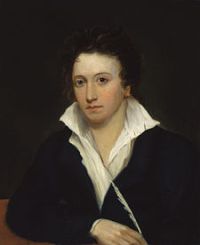
Percy Bysshe ShelleyThis month’s poem analysis is a first for the blog: a reader suggestion! In the comments section for my post on Charlotte Smith’s “Written in the Church Yard at Middleton in Sussex” (which you can read here), Elizabeth of Serial Outlet recommended that I take a look at an English class staple: Percy Bysshe Shelley’s “Ozymandias.” About four months later, and here we are!

I’ve put off diving into this particular poem for two reasons. First, having just covered a sonnet by a Romantic-era poet when I got the suggestion, I didn’t want to pigeonhole myself right out of the gate as someone stuck in that style and time period. Second, and more importantly, I felt a bit overwhelmed by the task. Of all the poem’s I’ve given the close reading treatment, “Ozymandias” is by the far the most famous. People who haven’t read a poem in decades remember this one from high school. As such, while I let the poem stew in my mind, I felt some pressure to do the work justice, to contribute something of value to the conversation surrounding it.

Granted, the way this essay is headed, that pressure may have been misplaced. Let’s jump right in, shall we?

Ozymandias

I met a traveler from an antique land
Who said: Two vast and trunkless legs of stone
Stand in the desert . . . Near them, on the sand,
Half sunk, a shattered visage lies, whose frown,
And wrinkled lip, and sneer of cold command
Tell that its sculptor well those passions read
Which yet survive, stamped on these lifeless things,
The hand that mocked them, and the heart that fed:
And on the pedestal these words appear:
“My name is Ozymandias, king of kings:
Look on my works, ye mighty, and despair!”
Nothing beside remains. Round the decay
Of that colossal wreck, boundless and bare
The lone and level sands stretch far away.

At first glance, this looks like a straightforward account of hubris. The statue of Ozymandias (i.e., Ramesses II of ancient Egypt) boasts of the pharaoh’s grand works, all of which now lie in ruin. Even the highest among us are not immune to the ravages of time; we all are bound to erode into “lone and level sands” (line 14). A simple message, albeit very grandly stated. But I think the poem has more on its mind than that, and it might help to start with how the poem’s account is presented.

Let’s begin by taking the text of the poem as a self-contained unit, like we’ve found it on an ancient sheet of papyrus with no context to guide us. The first word of the poem, “I,” presents us with the voice of some unknown first-person speaker, suggesting that what follows is some personal testament. Having implicitly introduced themselves, the speaker then begins narrating their experience, of how they “met a traveler from an antique land” (line 1). This sounds like the set-up for a story, but this already is the end of the story-present narrative.

In the second line, the poem then shifts into the voice of the traveler, as the first-person speaker relates their description of the sculpture—a description which comprises the remainder of the poem. There is some ambiguity as to whether the description is a direct quotation or a paraphrase, as it lacks the quotation marks which will later bound the inscription, but even in the latter case the speaker’s own voice would be sublimated to the traveler’s original account.

This account then continues uninterrupted up through line 9, at which point the traveler inserts a signal phrase, drawing attention to the coming second shift in perspective: “And on the pedestal these words appear”. It is here that the ruins speak, issuing their challenge to all who behold them. Once the inscription is recited, the poem shifts back into the voice of the traveler, who carries the poem to its conclusion.

But arguably, we are not done breaking down the rhetorical nesting here. On a meta level, we know that the poem is work of one particular author, Shelley, who per traditional analysis of poetry is a separate entity from the first-person speaker. On a diegetic level, we know that the statue of Ozymandias has an artist, who gave the the statue its inscription. And on a speculative level, Ozymandias is unlikely to have made the statue himself; he may have commissioned it, or the artist may adopted the pharaoh’s persona for the inscription.

So to summarize, here’s how deeply this 14-line poem embeds its story:

  1. It is the work of Percy Bysshe Shelley, who in writing it…
  2. …adopts the voice of a lyrical, first-person speaker, who then…
  3. …tells the audience an account he that heard from the traveler, who in turn…
  4. …quotes a statue’s inscription, which…
  5. …was the product of an unknown artist, who finally…
  6. …adopts or quotes the voice of Ozymandias.

That’s six levels of abstraction that Shelley’s poem presents the reader with. I don’t know about you, but that seems like a long way to go just point out the hubris of world leaders. So why bother with all that embedding?

You’ll notice that two of the voices involved in the poem are those of artists: Shelley (the flesh-and-blood person) and whoever sculpted the statue of the Ozymandias. If there’s one group of people that spend more time thinking about their legacies than do pharaohs, then it’s artists. A common sentiment that one finds in poetry about art is the notion that art grants one a kind of immortality. Even after one dies, the thinking goes, their works will outlast them and carry their spirit through the ages.

As “Ozymandias” reminds us, however, this notion borders on wishful thinking. We don’t know the artist behind the sculpture here, and we had to engage in some diegetic speculation to realize that such a person even existed. And their work’s existence is just as tenuous. Now reduced to “vast and trunkless legs of stone” (line 2), “a shattered visage” (line 4), and a pedestal, the statue is only a few steps removed from complete destruction. This is hardly a unique phenomenon: Paintings are lost and damaged, cathedrals crumble from neglect, and sculptures of kings wither in the elements.

One might think that poetry, which is not so tied to the fragile physical world, would be better suited for immortality than the plastic arts. We cannot commit a sculpture to memory, but we can do so with a poem. And this possibility is where I find “Ozymandias” most intriguing.

As mentioned in my throat-clearing introduction above, “Ozymandias” is a sonnet, albeit one with an unconventional rhyme scheme (ababacdcedefef). More so than any other form of poetry, sonnets often concern themselves with the possibility of immortality through art. This is especially true when it comes to romantic love, as the speaker will often promise the object of their affections, whose beauty will naturally fade with time, the chance to live forever in their poetry. A good example, which I will quote in full because of some similarities with “Ozymandias” in terms of imagery, is Edmund Spenser’s Amoretti LXXV (archaic spellings preserved):

Amoretti LXXV

One day I wrote her name upon the strand,
But came the waves and washèd it away:
Agayne I wrote it with a second hand,
But came the tyde, and made my paynes his pray.
Vayne man, sayd she, that doest in vaine assay,
A mortall thing so to immortalize,
For I my selve shall lyke to this decay,
And eek my name bee wypèd out lykewize.”
Not so, (quod I) let baser things devize
To dy in dust, but you shall live by fame:
My verse your vertues rare shall eternize,
And in the hevens wryte your glorious name:
Where whenas death shall all the world subdew,
Our love shall live, and later life renew.”

Spenser’s sonnet is a compelling digression here, because while the poet’s optimism gets the last word, the brief glimpse of the physical world that we’re presented with seems to support the beloved’s skeptical position. If we see how the ocean keeps wrecking the poet’s inscription on the sand, who is to say that a fire or a bookworm might not do the same to an inscription in parchment?

I get the sense that Shelley’s poem would side with Spenser’s beloved on the matter, as it too presents us with a world too fragile for much to persevere. One might suggest that the oral tradition will protect the work from decay. After all, the statue in some sense has survived the six levels of abstraction outlined above. But what, exactly, has survived that process? Certainly not the empire-building magnificence the statue was meant to project. And if Shelley were to recite this poem to us in conversation, which part would we ultimately take away and tell to others: the whole text, the traveler’s account, or the inscription? Even that which survives is prone to mutation through repeated tellings.

“Ozymandias” is not the only sonnet uncertain about the form’s traditional stance on immortality through art—Shakespeare’s Sonnet LXV (“[Since brass, nor stone, nor earth, nor boundless sea]”) is also uneasy on the matter—but I can’t think of many others which make such a depressing case with such verve.

And we must conclude with the unavoidable irony: this poem, which is about what doesn’t survive through the centuries, has in fact survived for two centuries. So far. Knock on wood.

There’s my take. But what are all your thoughts on the poem? If, like Elizabeth, you have a suggestion for a future deep dive, then let me know in the comments!

If you enjoyed this close reading of a poem, perhaps you would also like to read my thoughts on prose. I recently looked at the use of dark humor in George Orwell’s memoir Homage to Catalonia, which you can read here.

Stealing from the Public: On the Carnegie Library’s Rare Books Theft

Back in April 2017, news broke that someone had stolen over 300 items from the rare books room at the main branch of the Carnegie Library of Pittsburgh, ranging from a 17th century map of New York and New England to a first edition of Adam Smith’s The Wealth of Nations. The rare books room has been closed ever since the disclosure of the thefts, and the people responsible have not been identified—until, possibly, this past week.

As Paula Reed Ward reports in the Pittsburgh Post-Gazette, two people have emerged as prime suspects in the case:

The former archivist of the Carnegie Library of Pittsburgh’s rare book collection told investigators he conspired with the owner of an Oakland [a neighborhood in Pittsburgh] bookseller since the 1990s to steal and resell items taken from there.

Gregory Priore, who was terminated from the library on June 28, 2017, and John Schulman, who co-owns Caliban Book Shop, are under investigation for theft, receiving stolen property and criminal mischief, according to hundreds of pages of documents unsealed Thursday in Allegheny County Common Pleas Court.

Recent estimates place the monetary value of the stolen items at over 8,000,000 USD. The cultural cost of the theft is, of course, incalculable.

As someone who spent about four years living in the Oakland neighborhood of Pittsburgh while an undergraduate student at Carnegie Mellon University, this was a surprising and disheartening turn. I didn’t go to Caliban very often, even though it was about a five minute walk from my dorm—I am, shall we say, a tightwad—but I do have some fond book-related memories of the place: finding a cheapo paperback of Ursula K. Le Guin’s The Tombs of Atuan, for instance, or discovering the work of Quebecois poet of Gatien Lapointe. And I’d get a faint feeling of civic pride whenever John Schulman would appear as an appraiser on PBS’s Antiques Roadshow.

Well, there goes that aura of positivity.

I suppose one might hope that a rare and used bookseller, while motivated by the bottom line, might share the library’s interest in making the literary past available to the public. Price is a significant barrier to access, certainly, but shops such as Caliban do provide the service of keeping what’s out-of-print and long-forgotten in circulation, something the likes of Barnes & Noble are less likely to do. But as this case would suggest, the books are merely the means to the end of profit, raw materials for the machine to churn through. How else to explain the allegations that Priore and Schulman cut maps and plates out of several books to sell separately? It’s the logic of the operation, it’s less like vandalism and more like processing.

I know attaching positive feelings to a profit-driven entity is somewhat foolish, as this case well illustrates, but to hear that this beloved institution was involved in some serious cultural theft—and that’s exactly what it is—has rather dampened my mood (and judging from the reaction of my friends from the Steel City, I’m not alone in this). Priore and Schulman took these items of historical and cultural significance, which belonged, however symbolically, to the people as a collective entity, and sold them off for purely private gain. More than the theft itself, it’s the public nature of the stolen goods that bothers me so.

I don’t really have a grander point beyond this. I’m just miffed.

If you’d like a thorough list of the items stolen from the Carnegie Library’s rare books room over the years, this earlier article in the Pittsburgh Post-Gazette will have you covered.

Thomas Moore’s “The Minstrel Boy”: An Analysis

Thomas Moore (1779-1852)In my A-Z Bookish Survey, I mentioned my current project of reading through Kathleen Hoagland’s anthology 1000 Years of Irish Poetry: The Gaelic and Anglo-Irish Poets from Pagan Times to the Present (Devin-Adair, 1947). Recently, I read through the book’s selection of Thomas Moore’s poetry, and though I had not heard the name, I discovered I was familiar with some his work. In popular culture, Moore’s most familiar piece is probably “Believe Me, if All Those Endearing Young Charms,” whose tune appears at the beginning of “Come On Eileen” by Dexys Midnight Runners and is part of a running gag used in Looney Tunes and Merrie Melodies shorts.

However, I found myself more drawn to a different Moore poem, “The Minstrel Boy,” a ballad recounting a young musician’s death in battle. Let’s take a close look at it, shall we?

“The Minstrel Boy”

The minstrel boy to the war is gone,
In the ranks of death you’ll find him,
His father’s sword he has girded on,
And his wild harp slung behind him.
“Land of Song!” said the warrior bard,
“Though all the world betrays thee,
One sword, at least, thy rights shall guard,
One faithful harp shall praise thee!”

The Minstrel fell!—but the foeman’s chain
Could not bring that proud soul under;
The harp he loved ne’er spoke again,
For he tore its chords asunder;
And said, “No chains shall sully thee,
Thou soul of love and bravery!
Thy songs were made for the pure and free,
They shall never sound in slavery!”

First, some context. Born in 1779, Thomas Moore came of age during a period of turmoil in Irish history. He was nineteen-years-old when the Irish Rebellion of 1798 broke out, and was friends with several prominent members of the Society of United Irishmen, such as Robert Emmet and Arthur O’Connor. Moore himself did not take part in the rebellion, instead focusing on his schooling and his literary pursuits.

However, as Kathleen Hoagland notes in the introduction to 1000 Years of Irish Poetry, “It has been the history of literature throughout the ages that in times of social, political, and national upheaval, of war and stress, new creative forces emerge” (p. xliii). Moore was no exception to this supposed trend, and in 1807—in the aftermath of the failed rebellion and the Acts of Union 1800, which brought Ireland into the United Kingdom—he began publishing his Irish Melodies, which, “in one respect at least, lifted the curtain of scorn by which all things native to Ireland were covered” (p. xliv).

“The Minstrel Boy” is one of those Irish Melodies, and it’s difficult not to see the lyrics as a response to the failed rebellion. The title figure calls his country “Land of Song,” which fits rather well with the conceit of Irish Melodies, and his primary instrument is a harp, which had long been a symbol of Ireland and was used in the United Irishmen’s iconography. That the minstrel boy destroys his harp before it falls into enemy hands is tragic, as it signifies a knowing surrender of Irish freedom, yet his final words to it are uplifting: that beautiful music so identified with his country “shall never sound in slavery.” Its return, the poem’s logic seems to imply, will signal the return of Irish liberty.

Granted, there is a metatextual irony here. The success of Moore’s lyrics meant that the music of Ireland, the sort the minstrel boy must mourn the loss of, gained its then-largest audience only after its homeland officially ceased to exist as an independent country. Perhaps we are better off seeing “The Minstrel Boy” as the voice of a subjugated people, rather than the clarion call of a nation. Or perhaps those final lines are not a statement of fact, but of intent—the people will make freedom theirs, and the harp shall be restored.

Beyond its stirring nationalist sentiment, I think “The Minstrel Boys” offers the reader some surprises in terms of form. Specifically, as the poem transitions from the first stanza to the second, it deviates from the established pattern of the ballad in some productive ways.

Now, in everyday usage, “ballad” generally refers to a melodic, slow-tempo song, usually about romantic love. (Back when I was an undergraduate instructor, this was the definition all my students immediately jumped to when I said the word.) However, in the context of literary history, a ballad is a narrative poem set to music, and often uses the structure of common meter: four-line stanzas (quatrains) that rhyme ABXB or ABAB and whose lines alternate between iambic tetrameter and iambic trimeter. For a concrete example, consider the first stanza of Emily Dickinson’s “[Because I could not stop for Death – ]”:

Because | I could | not stop | for Death 
He kind | ly stopped | for me
The Car | riage held | but just | Ourselves
And Im | mortal | ity.

In practice, ballads often stray from a strictly iambic rhythm, inserting extra unstressed syllables to give the piece a more galloping beat. However, the number of stresses in each line generally remains constant, which is why “common meter” is often called 4343. The first four lines of “The Minstrel Boy” demonstrate this nicely:

The min | strel boy | to the war | is gone,
In the ranks | of death | you’ll find | him,
His fath | er’s sword | he has gird | ed on,
And his wild | harp slung | behind | him.

Here we see that while Moore includes some anapests and weak endings, the total number of stresses follows that 4343 pattern. The one possible wobble is in line 4, as we would normally want to stress “harp,” but “wild” is easy enough to elide into one syllable, and so “harp” would be demoted to an unstressed syllable between “wild” and “slung.”

But in the second half of that first stanza, the meter gets trickier. Lines 5-6 scan normally, but lines 7-8 get complicated because of the typography. Without the italics, we’d scan those lines like so:

“One sword, | at least, | thy rights | shall guard,
One faith | ful harp | shall praise | thee!”

Indeed, Moore or his editors could have presented the lines with no annotations, and they’d be among the most regular lines in the poem. But the italics used for One at the start of each line require the reader to stress that word, which would bump the stress totals to 5 and 4, respectively. It might be possible, though unnatural, to demote “sword” to unstressed for purposes of scansion, but the polysyllabic “faithful” needs a stressed syllable, so line 8 is definitely overloaded.

I’ve written about this strategic over-stressing of lines before, when I analyzed Charlotte Smith’s “Written in the Church Yard at Middleton in Sussex,” but I think Moore’s poem offers an even more striking example of how it can be used effectively. Right as the speaker pledges his undying support for the cause, the line can no longer contain the emotion, and is instead overwhelmed with feeling.

And then—the come-down. The next stanza leaps, like all good ballads do, to the minstrel’s boys demise, and here the poem deviates from the established pattern in a different way. “The Minstrel fell” gets doubly punctuated, not only with an exclamation point, as might be expected, but also with a dash, which all but severs the line in two. It is the poem’s most dramatic pause, which only highlights the lack of a pause at the end of the line. Line 9 is the only instance of enjambment in “The Minstrel Boy,” the only place where the poem’s syntax overruns its lineation. As it happens, the image right before the line break is “the foeman’s chain,” which “Could not bring his proud soul under.” Forget about the minstrel’s soul—the oppressors can’t even hold down the verse!

What are your thoughts on Moore’s poem? Do you have any suggestions for other classic poems to tinker with? Let me know in the comments!

If you enjoyed this analysis of “The Minstrel Boy,” you may be interested in some of my other close readings. There’s the Charlotte Smith poem I linked above, or, for a slightly more recent post, a look at Walt Whitman’s “A Noiseless Patient Spider.”

Recent Publication: Amsterdam Quarterly

I’m excited to announce that one of my poems, “Qualia,” is now available to read over at Amsterdam Quarterly, an online literary magazine based in the Netherlands. I’m really happy to see this particular poem get a home; it’s the first one in a long time where I just let myself cut loose with the sound and the subject.

Amsterdam Quarterly

Special thanks to editor Bryan Monte for selecting the poem and for keeping all the contributors up-to-date on the build-up to publication.

You can read “Qualia” at this link, and be sure to check out the other contributors’ works as well!

Recommended Author: Álvaro Enrigue

Álvaro Enrigue first came to my attention while I was assembling materials for my sports literature course. I was looking for a strong piece of fiction to round out the week on tennis, and came across Pooja Makhijani’s list of recommended tennis books at Electric Literature. Both the brief plot description and the strikingly simple cover of Enrique’s novel Sudden Death (trans. Natasha Wimmers, Riverhead, 2016) immediately caught my eye, and as luck would have it the JHU library had a copy in its collection. I checked it out, and was soon transfixed.

Sudden DeathSudden Death is, by design, a difficult novel. The central action of Sudden Death is a fictional tennis match between the Spanish poet Quevedo and the Italian painter Caravaggio. Although, when I say “tennis,” I don’t mean the modern form of the game, the sort we associate with Roger Federer and Serena Williams, but rather the much older game of real tennis, which only passingly resembles the current version of the sport. A major challenge of the novel is figuring out the rules of real tennis; for example, serves had to bound off the roof of the spectator’s gallery to be valid. This fact makes the match itself difficult to follow, but also gives the proceedings the manic energy of a duel—which, we learn as the novel progresses, is exactly what this tennis match is.

But the duel between Quevedo and Caravaggio is really a mechanism for framing various digressions into history and politics, from the execution of Anne Boleyn to Spanish colonial administration in the Americas. It’s a novel that deliberately blurs the boundary between fact and fiction: presenting actual contemporary documents alongside fabricated ones, slowly stretching historical anecdotes before one starts questioning their veracity. For instance, it is true that Jean Rombaud was the executioner summoned from France to behead Anne Boleyn, but it is not true that he had tennis balls made from Anne Boleyn’s hair.

I will admit that, while I admire Sudden Death greatly, it’s a difficult novel to love. The research (and the “research”) can overwhelm the book at points, and the narration tends to distance the reader from the characters. It’s the sort of novel that will inspire you to write a thesis, but it’s not as likely to give you an emotionally transcendent experience. Fortunately, for those wanting a smidgen of sentiment with their stories, a new essay by Enrique will have you covered.

Recently published on ESPN’s website, Enrique’s latest piece explores his ever-changing relationship with baseball, from his childhood in Mexico, when he roots for the Cafeteros de Córdoba but can never see them play at their home park, to his adulthood in the United States, where he takes his son to as many Baltimore Orioles games as possible. While Enrique’s love of baseball never leaves him, what the game means to him evolves as he goes through life. It’s a wonderfully thoughtful exploration of sports fandom.

Though certainly not to the extent as in Sudden Death, history and politics play a role in his newest essay as well. His family’s support of the Cafeteros mark them as provincials in the more cosmopolitan Mexico City, and economic crises compel him to leave Mexico, and Mexican baseball, behind. But in this piece, personal reflections reign supreme, even when they take on some philosophical significance. Consider this passage on the sports fan’s greatest virtue, loyalty:

I think it’s impossible to change teams once one has made a decision: You can admire some generation of players or develop a deep respect or even some care for a franchise, but your team is your team because it becomes fixed in your brain at an age when small things are huge. Once, talking about soccer, the late Argentine writer Ricardo Piglia—an unbiased, philosophical, and quiet man—told me in an unexpected rapture of passion: “Only perverts change teams.”

Or take the essay’s conclusion, after Enrique and his son go to their last O’s game before the latter goes off to college:

Childhood is a planet with a population of one person, but on a very few lucky days, our memories and those of our children cross paths, like in an eclipse. That day I came out of Camden Yards understanding something that took me years to grasp: that loyalty to a team can be a two-direction road. We inherit objects of devotion from our parents, but sons and daughters leave a legacy for us too. The Coffee Drinkers stand untouched in the crystal box of my memory, but the Baltimore Orioles are my team. They are the unexpected bequest of my son.

Erudite and perceptive, bold and direct, Enrigue is a writer I’m glad to have found, and I eagerly await more of his work. I hope this short piece will encourage you to check him out, too.

If, after looking up Enrigue, you want more reading recommendations, I recently discussed Stephen King’s 1990 essay “Head Down,” which, coincidentally, is also about children and baseball.