What an Episode of “Father Brown” Can Teach Us About Literature

Hannah Moxley describing the plot of new novel to Father Brown

Last year, when I wrote about the oddly soothing aspects of the murder mystery genre, I mentioned that I had another post about the show Father Brown that I wanted to write. Well, over a year later, I’ve finally gotten around to doing just that.

For those who aren’t aware, Father Brown is an amateur detective show loosely based on the short stories of G. K. Chesterton. The show follows the title priest (played by Mark Williams) as he solves various crimes—usually murder—around the fictional English town of Kembleford in the post-WWII period. Father Brown is joined by a group of supporting characters, including parish secretary Mrs McCarthy (Sorcha Cusack) and local noblewoman Lady Felicia (Nancy Carroll), and he often butts heads with an ever-changing line of police detectives, such as Inspector Sullivan (Tom Chambers), who rather begrudgingly tolerate the priest’s side hobby of sleuthing.

The episode I would like to look at in particular is “The Kembleford Boggart,” the seventh episode of the show’s third series. This is one of my favorite episodes of the show, not because of the mystery itself, but because of what the episode has to say about writing and about our reactions to it. I’m going to break this little investigation into three parts. In Part I, we’ll talk about the central figure of the episode and her concerns about how her writing will be received. In Part II, we’ll move onto the murder and how it instructs us on the way the artistic process actually works. Finally, in Part III, we’ll unravel the mystery and discuss the audience’s relationship with the author of a work.

Oh, before we begin—normally I find our age’s spoiler-phobia to be pretty obnoxious and a serious impediment to discussing art critically, but since this is a mystery we’re talking about, where half the fun is trying to piece the clues together yourself, consider this a spoiler warning: we’re going to reveal all the twists in this episode, because otherwise the themes are impossible to fully talk about. So, with that out of the way….

I: The Author

At the center of “The Kembleford Boggart”—aside from Father Brown, of course—is Hannah Moxley (Nathalie Buscombe), a 22-year-old woman who seems to be rather nervous about where her life stands. Some of her anxieties are professional. Hannah is a rising star of the British literary world; her debut novel, The Darkest Rose, was something of a sensation in the recent past, and she’s about to read an excerpt from her current manuscript at the home of Lady Felicia. For a writer that young, she could hardly ask for better. Still, she’s not certain that her new novel will find a publisher, even though Father Brown assures her that, from what he hears, “the literary establishment is waiting with bated breath.”

Of course, such anticipation can be its own form of pressure. Every writer who attains even the tiniest bit of artistic success fears that they’ll never be able to recreate that magic, that they’ve spent all their creativity on past works. But Hannah has an additional reason to worry about how her new novel will be received: it’s a significant departure from her previous work. We the audience aren’t told much about The Darkest Rose, but from other characters’ descriptions we glean that it’s an “uplifting” tale filled with “high jinks and espionage”. By contrast, her new book is an atmospheric horror story about a woman terrorized by a boggart. She’s completely shifted genres, and there’s no guarantee that her audience will follow her muse with her.

Judging by the response she gets at the reading, her concerns might not be unfounded. There’s a noticeable silence after Hannah finishes reading the excerpt from her work, before Lady Felicia hurriedly spurs the crowd into applause. Her story has certainly had an effect on Mrs McCarthy; she’s so shocked during the reading that she almost spills her sherry. But she’s more repulsed than enraptured by it, saying afterwards, “If that’s what passes for modern literature, I’ll stick with the Woman’s Weekly.” This is a small sample size, but it at least suggests that she’s right to be worried.

It was a minor miracle, however, that Hannah was able to give a reading at all, which brings us to her second source of worry: her father, Jeremiah (Simon Williams). Although Hannah is an adult already, Jeremiah Moxley exercises a great deal of control over his daughter’s life. He won’t allow her to manage her own finances, and he doesn’t allow her to read the fan mail that she’s received from around the world. Had Father Brown not offered to act as chaperone, Jeremiah would not have let Hannah read at Lady Felicia’s, lest she start socializing with the wrong sort of people. Even then, he expects that she will not leave Father Brown’s sight and that she’ll return home by eight o’clock sharp. Hannah, for her part, does her best to comply with her father’s various restrictions, but when alone with Father Brown she vents about how unreasonable her current situation is.

Indeed, a close look at the first scene after the cold open reveals how her different worries tie into each other. It would appear that her father’s overbearing nature has done a number on Hannah’s confidence as a storyteller. We first see Hannah describing the plot of her new book to Father Brown, who looks a bit puzzled by it. She assumes that he doesn’t like the story, but in fact he’s merely unsure of what a boggart is. Her face lights up at the chance to explain this bit of folklore, but alas Jeremiah enters the room and cuts her off with his own explanation. He then dismisses his daughter’s penchant for such stories right in front of her. “Forgive my daughter,” he says to Father Brown. “She has a fine talent, I’m assured, but her fantasies are a little far-fetched for my taste.” One expects that a writer’s parents would be her biggest cheerleaders; if they’re not on board with the project, why would anyone else be?

Hannah’s got quite a bit on her plate—and we haven’t even gotten to the murder yet.

II: The Mystery

Why don’t we hear a little bit of Hannah’s latest? Here’s the excerpt from her new book that so shocked the crowd at Lady Felicia’s:

Mrs Mallory lay stiff and bloated at Clarissa’s feet. Across her throat a tidy, fine slash, the stinging mark of a whip sharp tail. And all around the room, she saw the messy trail of an uninvited guest. A fresh fall of soot blanketed the hearth, and the floor was marked by jagged claws. As she rushed to the empty cot, she saw the boggart’s promise had been fulfilled. The housekeeper was dead and the baby was gone.

Hannah Moxley, unpublished manuscript, page numbers TBD

This being a murder mystery show, it’s only natural that this excerpt turns into the blueprint for an actual crime. The cinematic language makes it clear that Jeremiah will be the victim, as Hannah starts her reading over footage of her father opening her fan mail. After the reading, Father Brown loses track of Hannah, so he and Mrs McCarthy hustle over to the Moxley house in hopes of meeting her there. When they arrive, they find the door already open, and after some investigation they discover Jeremiah on the floor of an attic room, killed by his letter opener. It’s then that Mrs McCarthy notices that the room is full of soot and the floor is all scratched up, just like the room described in Hannah’s novel.

Father Brown jokes that the perpetrator was the boggart from the story, but no one actually buys into that notion. Mrs McCarthy immediately suspects Alfons (Philip McGinley), an Irish Traveller who got into a spat with Jeremiah that morning, while Inspector Sullivan considers the possibility that this was a burglary gone wrong. Father Brown, however, does think that the secret to the murder lies in Hannah’s story, as he spends all night reading over her manuscript. His initial thought, understandably, is the prospect that someone has re-enacted the scene from the novel, or more disturbing, that the novel is a preemptive confession from a beleaguered daughter. It’s not until later on that Father Brown realizes that he’s gotten the whole thing backwards.

See, we have often think of creativity in limited ways. We imagine inspiration as a sort of epiphany, a sudden blast of the divine. This view has a certain romantic aura to it, but it tends to render the process of creation completely inscrutable and unknowable; one either has the spark, or one doesn’t. More often than not, however, inspiration comes from the synthesis of small details that we experience. It’s not necessarily a veiled autobiography or a confession, but it does come from the world of the concrete, either senses or emotions. It’s only when Father Brown remembers that fact that the mystery starts clarifying itself.

After finishing Hannah’s new book, he takes Mrs McCarthy back to the Moxley house for what he calls “a lesson in perspective.” This is Father Brown’s big lecture for the episode, the step-by-step explanation of what’s been going on. But it’s not an explanation of how the murder happened; he’s not sure who did it at this point. No, it’s an explanation of why the room resembles the one in Hannah’s story:

[N]either of us had ever been in this attic room before. So how would we know that what we saw was unusual? Perhaps it wasn’t unusual. What if soot fell from that chimney every day? For instance, when somebody retrieved something from it…For example [reaches into the hearth and pulls something out], a key. And what if a badly hung door made marks on the floor every time it is opened, makes the scratches of deadly talons. Not life imitating art, Mrs McCarthy, art imitating life. It wasn’t until I finished Hannah’s manuscript that I realised the most significant image of all: the missing child.

Father Brown then unlocks the door, revealing a hidden nursery, where Hannah’s baby is asleep. The implication is clear: Hannah’s novel, the whole story about the boggart and the missing child, comes from her own experiences of having to hide her baby from the world, and the atmospheric details come from the steps she has to take to see him.

This little lecture from Father Brown not only advances the plot, but also further clarifies why Hannah seems especially nervous about her new novel. While on the surface it seems more fantastical than The Darkest Rose, it is in fact far more personal than her first novel. She’s transformed a source of shame into art, and now plans on sharing it with the world. But we’ve still got one mystery left: whodunit?

III: The Killer

As I mentioned in the first section, Hannah’s gotten quite a few fans off the back of The Darkest Rose, and it’s obvious that a number of them have formed parasocial relationships with her. In what might be Jeremiah’s one instance of genuine insight, he notes that the men writing fan letters to Hannah “have not got literature on their minds,” and that the volume and the passion of the fan mail increased after Hannah’s photograph was included in Modern Profile magazine. His daughter has become the object of affection—or obsession—for a great number of men, and that’s not necessarily the sort of attention that a young woman wants.

As it happens, we meet one of Hannah’s admirers at the reading at Lady Felicia’s, a journalist named Harry Grandage (Ben Deery). His work takes him all around the globe, where he seems to cover one tragedy after another. This is why, he tells Father Brown, Hannah’s work means so much to him:

I’ve only just got back from Brussels. I spent two months there before traveling down to Antwerp. I was covering the damage from the North Sea floods…My work always seems to bring me to people in times of grief. It takes its toll. So, when I read The Darkest Rose, I was so happy to lose myself to it. It’s a modern masterpiece.

Naturally, Harry is very excited to meet Hannah in person, but if you pay close attention to his tone and his facial expressions you’ll realize that he’s more than a little perplexed that Hannah’s not already familiar with him. Even worse, when Hannah signs his copy of The Darkest Rose, she makes it out to “Larry”. He laughs it off, saying that it’s “charming”, but he’s clearly a bit stung by their interaction.

It’s sometimes tempting to think that we can know a person through their art and that, by extension, we can form an actual relationship with them through it. We will excitedly praise a work for understanding us in a time of confusion or crisis, even if we know, intellectually, that the work emerged independently of our struggles and that the author wouldn’t know us from Adam. These parasocial bonds that we form with artists can be helpful in certain ways; for example, they can give us the knowledge that we are not alone in our difficulties. But where Harry appears to go wrong is in thinking that this grants him knowledge of the actual person behind the work.

One word that Harry uses a lot when describing Hannah’s writing is “escape”. After Jeremiah’s death, he explains to Father Brown why he’s staying in Kembleford to comfort Hannah: “When I first read her book, I was in the Republic of Korea covering the war, a taste of hell. Her work offered me the chance to escape then, and now I can do the same for her.” It’s clear that Harry needed some way to escape his troubles as a journalist, but note how he’s made the assumption that Hannah needs the same thing. It’s true that by strict definition Harry’s relationship with Hannah is no longer parasocial, but it’s by no means intimate, either. Harry sees himself as a companion, but by any objective measure, he’s just a passing acquaintance.

This being a murder mystery, Harry’s relationship with Hannah turns out to be a bit more complicated than that. Father Brown realizes that Harry’s one of the men who’s been writing fan mail to Hannah, not knowing that her father doesn’t allow her to read such letters. Instead, Jeremiah has been corresponding with Harry, posing as his daughter for the purposes of arranging a marriage. Hence Harry’s confusion at the reading: he’s been duped. Long story short: he confronts Jeremiah at the house and tries to leave to tell Hannah the truth; Jeremiah attacks him with the letter opener, and in the struggle, Harry accidentally stabs him with it. The whole killing was an accident, the result of a tragic misunderstanding.

But even after all that comes out, even after Harry realizes his whole relationship with Hannah was a sham, he still can’t let go of the image of her that he’s created in his head. Father Brown meets Harry in the woods, where he’s planning on leaving Kembleford with Hannah in tow. “She’s desperately in need of escape,” he tells Father Brown, still insisting that his needs are hers as well. Once Hannah arrives on the scene and the whole truth comes out, though, she takes Harry to task for his assumptions:

Harry: All I wanted was to take you away to escape with you. Isn’t that what you wanted?

Hannah: No! You’re no better than [my father] was. You want to control me. Well, I won’t let you. I’ve spent too long locked away. I want a free life. I owe that much to him.

To be clear: Harry is correct in thinking that Hannah would like to escape her current circumstances—we’ve established that much in the build-up to this—but that in no way implies that she wants to escape with him. That’s a major, nigh unresolvable problem with trying to read an artist through the works we enjoy: even if we’re completely accurate in our diagnoses, it’s pure narcissism to think we have anything to do with them.

For the record, Hannah’s actual love, Alfons, also got to know her through her writings: she would head down to the camp of Irish Travellers when they stopped by and read her stories to them. But the context there is completely different than it was for Harry, as Alfons got the chance to know Hannah as a person, not just as a name on a front cover and a photograph in a magazine profile. There were no assumptions to be made, just life to experience.


That was quite a bit from me, but what’s your take on all this? Are there any other films or TV shows that deal with literature in this way? Do have a favorite episode of Father Brown that you’d like to share? Sound off in the comments.

While your here, perhaps you’d like to read more about our relationship with art and our tendency to form parasocial relationships with artists. In that case, check on my post called “On Angst Music,” which might be my favorite blog post that I’ve written here.

And as always, thanks for your time.
Literary Fiction Book Tag

I haven’t done one of those book tags that make the rounds in a good long while, have I? (I haven’t done much of anything on this blog in a good long while, but that’s another story.) Today I’d like to fix that with a post inspired by the YouTube channel Jasmine’s Reads. Jasmine is one of my favorite presenters in the BookTube community, and seeing how she’s just unveiled her first book tag, I thought I’d do my (undoubtedly minuscule) part in spreading it.

It’s called the Literary Fiction Book Tag, and it’s precisely that: eight questions on the subject of literary fiction. I recommend watching the original video below if you’d like to get a sense of the tag’s purpose before diving in.

One confession before getting started: the prompts below all refer to “literary fiction novels,” but for some of my answers I’ve used high-concept short story collections instead, both because short stories could always use more love and because, after reflection, it turns out I read a lot fewer novels of recent vintage than I’d figured. With that out of the way…

#1: How do you define literary fiction?

I have two ways of defining “literary fiction,” and I shift back and forth between them depending on how cynical I happen to be feeling. The more cynical approach is to say that literary fiction is purely a marketing term, that it says nothing about the content of the work and everything about the sort of person that the publishing and book-selling industries think is likely to buy it. You can probably conjure the stereotype of someone who reads these sorts of books: college-educated, financially well-off, probably subscribes to the New York Times and supports their local NPR affiliate. In this view of the term, “literary fiction” is a signal to this demographic that they ought to read this particular book.

I think there’s a lot of truth to this perspective, especially in a world where books are commodities and not just works of aesthetic appreciation. But I can’t deny that, when I hear a book described as “literary fiction,” I do make certain assumptions about the book’s content. As I tend to think of genres as sets of audience expectations about a given work, it would be fair to say that literary fiction is a broad genre, one that’s closer to “young adult” than it is to “western” in terms of specificity. In her video, Jasmine lists off just about every element I’d anticipate: “social, political, or human commentary; introspective character exploration; not being focused or driven by plot; and also, a large focus on language.” So long as a work meets some of those criteria, one has grounds to place it into the genre of literary fiction.

You’ll note that these two definitions are not contradictory, and in fact may support each other. It could be the case that the supply of literary fiction creates its own demand, which in turn reinforces the industry’s decision to market books in such a way. Nothing wrong with shifting back and forth between definitions when they can coexist.

#2: Name a literary fiction novel with a brilliant character study.

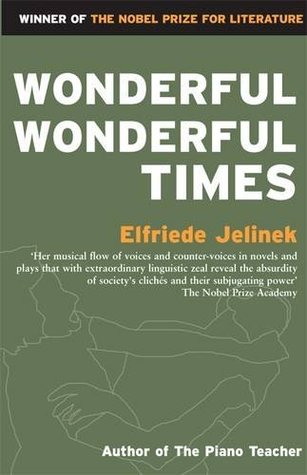
Wonderful, Wonderful Times by Elfriede Jelinek

Wonderful, Wonderful Times follows four young adults in post-WWII Austria who are, by any objective account, monstrous. Their adolescent thrill-seeking takes the form of gratuitous violence, whether that means assaulting people in the park late at night or attempting to drown a cat to reenact a scene from Sartre. But while Jelinek is unrelenting in her depictions of moral rot, she still her has empathy for her creations. I’ve written about these characters before, so I won’t belabor the point here, but the longer the novel goes on, the more that Jelinek pricks at the façade that each of the young adults has constructed. We see, for instance, how Rainer’s obsession with existentialism covers for his own naivete, or how Sepp’s upbringing in a Communist household contextualizes his humiliating and combustible relationship with the aristocratic Sophie. The characters of Wonderful, Wonderful Times may be reprehensible at every turn, but their humanity still glows through all the grime.

#3: Name a literary fiction novel that has experimental or unique writing.

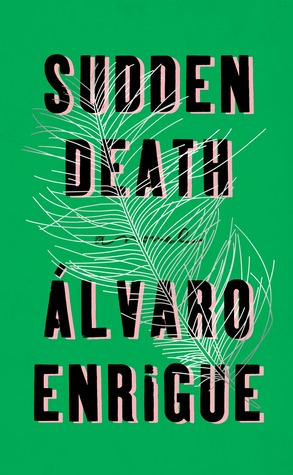
Sudden Death by Álvaro Enrigue

The short version: this book is about a tennis match, in which the Spanish poet Quevedo and the Italian painter Caravaggio trade points in what turns out to be a literal fight to the death. But reading this book bears no resemblance to reading a newspaper write-up of Wimbledon. In Sudden Death, Álvaro Enrigue intersperses his descriptions of rallies with histories of colonialism in the New World, excerpts from historical documents about tennis (both real and fictional), correspondence with his frustrated editor—just about everything that he can serve up. The result is a narrative that is, admittedly, very difficult to follow at times, but the whiplash between sections works surprisingly well in simulating the experience of playing tennis. Sudden Death also has a taste for the bizarre that keeps the novel from getting too self-serious; for instance, the ball that Quevedo and Caravaggio are playing with is made from Anne Boleyn’s hair, and how that ball came to be is a significant early through-line in the novel. This book may not be to everyone’s (anyone’s?) taste, but oh, am I glad that this sort of thing exists.

#4: Name a literary fiction novel with an interesting structure.

Public Library and Other Stories by Ali Smith

Public Library and Other Stories is really two books, which it alternates between. The one book is a fairly convention contemporary short story collection, albeit one with a notable fixation on literary history. The other book, though, is what makes this collection interesting to me. Ali Smith assembled this collection in response to the defunding and closing of libraries in the United Kingdom, and she includes numerous testimonials about the importance of libraries as community institutions. The testimonials not only work to justify public support for libraries, but also work to justify the rest of the collection. Remove all those heartfelt letters and Public Library and Other Stories looks like so much inside baseball, like an author flaunting their deep knowledge of the canon. With those letters, though, it becomes clear why all her literary references are so necessary: literature is embedded deeply into our lives. A world that devalues our storehouses of humanity’s literature must devalue humanity itself. Absent the structure that Smith uses here, I’m not sure the message would come across quite as well.

#5: Name a literary fiction novel that explores social themes.

The Amazing Adventures of Kavalier & Clay by Michael Chabon

Through 600+ pages of first-rate prose, Michael Chabon reveals the Golden Age of Comic Books to be fertile thematic ground for a novel. The Amazing Adventures of Kavalier & Clay follows the title duo of comic book creators across about fifteen years of inspiration and turmoil, touching on a number of social and political questions along the way. What is the value of escapist art in times of crisis? To what extent do capitalist enterprises enable the spread of political works, and to what extent to they stifle it? How do people with marginalized identities maintain their dignity in a world that deems them to be of lesser value? Read the book for the thrilling conclusion! (Sorry, couldn’t resist.) In addition to all these macro-level issues, Kavalier & Clay also finds time to explore more personal quandaries, from Clay’s relationship with his absent father to Kavalier’s devotion to a family facing certain death in Nazi-dominated Europe. This was one of the best books I read last year, and it gets richer and richer the more I think about it.

#6: Name a literary fiction novel that explores the human condition.

The Virgin Suicides by Jeffrey Eugenides

The Virgin Suicides is the story of two tragedies: one extraordinary, the other distressingly common. At the center of the novel are the Lisbon sisters, five isolated girls in suburban Michigan who all take their lives in the span of about a year. That’s the extraordinary tragedy. The distressingly common one comes through in the novel’s narration. In a style reminiscent of William Faulkner’s “A Rose for Emily,” The Virgin Suicides is told in a first-person plural POV, in the collective voice of the neighborhood boys who were obsessed with the Lisbon sisters. But for as authoritative as that POV sounds on the page, for as much information and documentation that the men marshal forth about the girls, it becomes clear by the novel’s end that they never actually understood them. Jeffrey Eugenides casts the narrators as so trapped in their own subjectivities, so caught up on their own perceptions of those mysterious Lisbon sisters, that they were incapable of providing what the girls most needed: somebody who would actually listen. The boys are the perfect embodiment of one of humanity’s most frustrating failures.

#7: Name a brilliant literary-hybrid genre novel.

The Circuit: Stories from the Life of a Migrant Child by Francisco Jiménez

A short story cycle based on Francisco Jiménez’s childhood, The Circuit: Stories from the Life of a Migrant Child follows Panchito, a fictionalized version of the author, as his family of migrant farmers from Mexico moves from town to town in California in search of work. The Circuit is the only book I know of that blurs the line between literary fiction and children’s literature. Jiménez’s language is unadorned and has repetitive quality that suggests a story told both about and by a child, yet the struggles Panchito’s family goes through are relayed with the quiet subtlety that one would expect in a work written for adults. This duality is reflected in the institutions that sell this book. The Circuit is published by the University of New Mexico Press, suggesting an academic audience, but it’s also available through Scholastic, the foremost publisher of children’s books in the United States. It’s designed to teach children empathy for people in Panchito’s position, but especially in today’s political context, this book has value for readers of any age.

#8: What genre do you wish was mixed with literary fiction more?

I’m going to co-sign Jasmine’s answer from the video above and say that literary fiction and fantasy could do with some more co-mingling, if only so I could have a go-to fantasy author not named Ursula K. Le Guin. In particular, I think that the two genres are simpatico in terms of finding language inherently pleasurable, rather than it just being a vehicle for telling the story. I’d love a literary fiction novel that is a fun to read, and to read aloud, as Sir Gawain and the Green Knight is in Middle English, with its wild alliterative meter and wildly complicated chivalric rituals. The challenge, of course, would come from reconciling fantasy’s emphasis on plot and lore with literary fiction’s indifference to those elements.


That wraps things up for me! If you’d like to jump in on this little survey and share your recommendations in literary fiction, then consider this an invitation. Thanks to Jasmine for concocting this tag, and thanks to you for time in reading this. Take care!

My Thoughts on Nicholas Dawidoff’s Edits to Stephen Jay Gould’s Review of Michael Seidel’s Book

As I start writing this post, I’m about halfway through Stephen Jay Gould’s posthumous collection of baseball writings, Triumph and Tragedy in Mudville: A Lifelong Passion for Baseball (W. W. Norton, 2003). At this point the weaknesses of the book have become quite apparent to me: Gould has a habit a reusing the same anecdotes across multiple pieces, the length restrictions of newspaper columns prevent him from fully developing ideas, and the introductory memoir—in fairness, written during the author’s terminal illness—suffers from incredibly stilted syntax.

Nonetheless, Triumph and Tragedy in Mudville shines with Gould’s amateur passion for baseball; I feel the pleasure he gets in taking a break from paleontology to wax rhapsodic about his favorite players. It doesn’t quite work when read straight through, but this seems like a pleasant book to dip into and out of for a few minutes at a time.

I first became aware of Gould’s baseball writing while I was preparing to teach a class on sports literature (something that, in a shamefully Gouldian fashion, I’ve mentioned several times on this blog). His essay on DiMaggio’s 56-game hitting streak during the 1941 season, entitled “The Streak of Streaks,” was included in one of my main source books for the class, Baseball: A Literary Anthology (edited by Nicholas Dawidoff). The essay is among the highlights in Dawidoff’s anthology, and it was one of the last pieces I cut from my syllabus before I had to submit it for approval.

Gould’s focus in “The Streak of Streaks” is on probability, specifically how people have difficulty analyzing things like hitting streaks in probabilistic terms. He cites Amos Tversky’s research on shooting streaks in basketball, which found that the “hot hand” phenomenon doesn’t actually exist: players who make a basket on one shot are no more likely to hit on the next, and players’ “hot” streaks can be predicted entirely based on their overall shooting percentages. Gould doesn’t bring up this research to denigrate athletes’ accomplishments, though. In fact, it serves as the context in which to celebrate DiMaggio’s hitting streak. Gould also cites Ed Purcell’s research on baseball streaks and slumps, and Purcell found that DiMaggio’s hitting streak was the “one sequence so many standard deviations above the expected distribution that it should not have occurred at all” (p. 177).

That revelation honestly shocked me when I first read it, as I had regarded DiMaggio’s streak record as a vulnerable one. Beating it would be mighty difficult, yes, but surely a batter just would need to get “hot” for nine or ten weeks. But if, as Purcell found, baseball would need 52 career .350 hitters for even a 50-game hitting streak to be likely (actual number of such hitters: 3), then DiMaggio’s accomplishment is truly incredible. In his characteristically statistical way, Gould finds a way to place his baseball hero into the realm of the divine. As baseball has become ever more analytic, as launch angles and exit velocities and wins above replacement increasingly dominate discussions of the sport, the fact that DiMaggio’s hitting streak is nigh inexplicable becomes all the more important to me: there is still mystery in this weird little game.

I had gone back to Dawidoff’s anthology to re-read “The Streak of Streaks” multiple times. It was only when I got to that essay in Triumph and Tragedy in Mudville, however, that I learned that the essay was originally a book review. Specifically, “The Streak of Streaks” reviews Michael Seidel’s book Streak: Joe DiMaggio and the Summer of ’41, which purports to cover precisely that. Had I read the acknowledgments section of Dawidoff’s anthology, which mentions that the review portions of the essay had been omitted, this would not have been a surprise to me. But alas I had not, and I could not help but think: why would Dawidoff choose to cut such a significant chunk of the original piece?

It seems especially strange to make such an edit in a book called Baseball: A Literary Anthology, as Gould’s original review makes a point of placing Seidel’s book in the context of baseball’s literary history. Gould sees Streak as part of a trend of “serious, scholarly books treating baseball as something that might even get you tenure at a major university (as something other than an athletic coach)” (pp. 178-179). It’s as though Gould went out of his way to justify Dawidoff’s efforts over a decade before the anthology came out.

One may argue that removing the book review passages from the “The Streak of Streaks” makes the piece more accessible for general audiences, who are statistically unlikely to have read, or even have heard of, Seidel’s book. Better to leave the intertextual elements for the Gould completionists, no? But if that were indeed the goal, Dawidoff doesn’t fully commit to it, because Gould’s review is also a response to an article by John Holway called “A Little Help from his Friends: Hits or Hype in ’41,” which ran in a 1987 issue of Sport Heritage. Readers probably have as much knowledge of Holway’s article as they do of Seidel’s book—less, even, because Gould devotes less time to summarizing it.

Yet, having now read the original version of Gould’s essay, I do think that Dawidoff’s edits make the piece stronger. For one thing, the review portions include some rather self-indulgent quotations from Omar Khayyam and Alexander Pope, in an attempt to link sports streaks to our quest for meaning in a world dominated by chance. I appreciate the effort, but even as a baseball fan I find there’s something bathetic in Gould’s sincerity here. We are still talking about grown men playing a children’s game in oversized pajamas, and I’m not sure the subject can support a straight-faced digression on Absurdism.

More importantly, Gould’s discussion of probability with regards to DiMaggio’s hitting streak has little bearing on his review of Seidel’s book. Seidel, from how Gould describes his work, seems more interested in placing DiMaggio’s streak in the context of then-current events; Gould likens the book’s weaker passages to “reading old newspapers and placing the main events in order” (p. 179). The most Gould can do to make Seidel’s book relevant to his main point is to say that it “will help us to treasure DiMaggio’s achievement by bringing together the details of a genuine legend” (p. 181), which is about the vaguest praise possible. I do get the sense that Gould enjoyed Seidel’s book, but I get a stronger sense that Gould saw this review as an excuse to publish a different article that he was actually excited about writing.

For comparison, I would look at something like “The Cruelest Sport” by Joyce Carol Oates—which, coincidentally, did make the cut for my sports literature syllabus. “The Cruelest Sport” is a review of two books about boxing by Thomas Hauser, but it begins with a gripping discussion of the aesthetics and ethics the sport. Oates is simultaneously entranced and repulsed by the cruelty inherent to boxing. She spends the first six pages of that review exploring the tension between our humanitarian impulse that wants to abolish the deliberate violence of boxing and our spectator’s desire to see a satisfying, consciousness-crushing KO.

That tension is clearly what animates Oates to write that essay, but what makes “The Cruelest Sport” successful as a whole piece is that the opening discussion ties into the books that Oates is reviewing. The first is a biography of Muhammad Ali, an all-time great performer whose well-being boxing devastated; the second is an account of the grimy underbelly of the boxing establishment that belies the Las Vegas glitz surrounding the sport. Whereas Gould’s statistical discussion of DiMaggio’s hitting streak is at most tangential to the book he’s reviewing, Oates makes a persuasive case that her pet interest is central to the works before her. It’s true that someone like Dawidoff could easily excerpt those first six pages as a stand-alone essay, but they would not be improving the piece by subtracting from it.

It’s not as though I’m disappointed that Triumph and Tragedy in Mudville retained the review elements of “The Streak of Streaks”. That book is meant to be a compendium of Gould’s career work on baseball, so the need to accurately reflect his work ultimately trumps aesthetic considerations. Dawidoff’s anthology, meanwhile, is free of such requirements, and so it can tinker with pieces as much as it likes. There may inevitably be some hubris to that endeavor, but at least in this instance, it works out for the best.


I would love to hear your response to my thoughts on Nicholas Dawidoff’s edits to Stephen Jay Gould’s review of Michael Seidel’s book, if only to put as many brackets around this discussion as possible. What do you think about making cuts to essays for inclusion in anthologies? Do you have a favorite piece of baseball writing that you’re dying to share? Let me know in the comments!

If, on the other hand, you’d prefer to read more of my thoughts on Stephen Jay Gould’s work, I have a very old piece about his essay “Dr. Down’s Syndrome” that might interest you.

And as always, thanks for your time.
Some Thoughts on “How the Internet Happened: From Netscape to the iPhone” by Brian McCullough

Writing a history of the Internet is almost a fool’s errand. As an entity it’s so diffuse and diverse as to defy summary, and as a topic it’s so broad as to render any sufficiently comprehensive account incoherent. Furthermore, the Internet changes so rapidly that any attempted history risks becoming outdated by the time of publication. For example, Wendy M. Grossman’s Net.wars (NYU Press, 1997) devotes much of its page count to Usenet newsgroups and relegates search engines, then still an emerging technology, to a few off-hand mentions. Within a few years, Grossman’s version of the Internet would be almost unrecognizable to someone who had just gotten online.

It is perhaps wise, then, that in the introduction to How the Internet Happened: From Netscape to the iPhone (Liveright-W. W. Norton, 2018) Brian McCullough limits the scope of his narrative. “This is not a history of the Internet itself,” he writes, “but rather a history of the Internet Era, that period of time from roughly 1993 through 2008 when computers and technology itself stopped being esoteric and started becoming vital and indispensable” (p. 3). It’s a depiction of an era of the Internet which has come and gone, yes, but one that has the benefit of hindsight. McCullough knows, for example, that Usenet’s direct influence on the Internet Era is minimal, and so he gives it about as much attention as Grossman gives to search engines. The question is what McCullough deems worthy of inclusion.

One could say that How the Internet Happened presents the reader with a twenty-first century update to the great man theory of history, in which tech companies take the place of individuals. Corporations like Google, eBay, and Apple are the ones driving the development of the Internet in this telling of the story, and McCullough lavishes much attention on events such as Netscape’s initial public offering and the immediate reaction to Facebook’s News Feed feature. Given how tech companies can exercise near-governmental control over their platforms, there is more logic in McCullough’s framing than I’d like to admit.

However, a company-centric history of the Internet will necessarily omit many key aspects of the story. Consider the role of the state. While McCullough acknowledges the role of public universities in the development of the first web browsers, the government almost vanishes from the narrative soon afterwards. Beyond the Microsoft antitrust case and the passage of the Digital Millennium Copyright Act, the state appears as bit player in McCullough’s history. Yet governments surely have a much larger role in the plot; just think of the many legal battles that emerged over Congressional attempts to regulate pornography on the Internet, or the political debates over whether to codify network neutrality into law. Neither topic gets much notice in McCullough’s book.

Alternatively, consider the role of the end users. The Internet has been an absolute breeding ground for new communities, but to the extent that How the Internet Happened concerns itself with such communities, it considers them as a general, almost unified mass: “we” now act a certain way thanks to the Internet. But this rather flattens the unique cultures that sprung up in the various corners of the Web; each site has its own customs, mores, language, and so forth. It’s not as though McCullough interviews individual eBay sellers or Redditors to give a sense of the user experience. The reader much be content with the abstract knowledge that such user communities exist.

I could go on about what is missing from How the Internet Happened, but I’m afraid that I’m reading this book in bad faith. It’s unfair to demand a comprehensive history of the Internet from a single work by a single person—I mean, didn’t I say in the first paragraph that such a project would be doomed? And how can I be surprised that this particular person wrote this particular book? McCullough’s background is in the field of tech start-ups, so of course his version of Internet history skews corporate. It’s for the same reason that Grossman, a journalist embedded in early Internet culture, focused on political and cultural issues surrounding the Internet in Net.wars. “Write what you know” doesn’t just apply to fiction.

And, in fairness to McCullough, he’s often insightful as to how various companies have shaped Internet culture. I found his account of eBay’s reputation system especially compelling. The reputation system, which scores buyers and sellers based on other users’ experiences with them, allows people to gauge whether someone they have no relationship with will prove to be a trustworthy transaction partner. According to McCullough, this system has proven to be quite influential:

This is a key evolution. In so many ways, over the last twenty years, the web and the Internet have slowly trained all of us to get comfortable interacting with crowds and, often, crowds of strangers. eBay was one of the first websites to show that a largely anonymous community, carefully constrained by a few guidelines and regulations, but invested in a system of online reputation, could actually work. Today, this key ingredient of ratings and reputation continues on sites like Yelp and Reddit—and especially on sites like Uber and Airbnb. It’s hard to imagine that the current sharing economy could even exist without the reputation template that eBay pioneered.

Brian McCullough, How the Internet Happened: From Netscape to the iPhone, p. 115

McCullough certainly sounds more sanguine about the sharing economy than I am. Airbnb’s history of enabling racial discrimination, for example, shows that the sharing economy only “actually works” in the limited sense of successfully facilitating transactions, not necessarily in the broader sense of benefiting all users. (Again, the author’s background explains quite a bit here.) But at least in a descriptive sense, McCullough’s account seems accurate: we’ve become more willing to trust some rando with a weird username, and there is something inevitably unifying about that.

I feel that’s a microcosm for How the Internet Happened as a whole. It achieves what it sets out to do, and that is to document how tech companies shaped the Internet between the rise of web browsers and the rise of social media. It’s only fair to commend the book for accomplishing that goal. But, at the same time, it’s only fair to ask whether that’s the best goal to begin with.


That’s enough from me on the matter. What are your thoughts on How the Internet Happened? Are there other aspects of the history of the Internet that you believe deserve their own book? Let me know in the comments!

If you’d like to read more of my thoughts on historical works, consider checking out this piece I wrote on Blanche Wiesen Cook’s biography of Eleanor Roosevelt, which examines how much biographers should speculate on the psychology of their subjects. And as always, thank you for reading!