The Art of Losing Isn’t Hard to Master: Suffering in Games

Existential Comics is a weekly webcomic created by Corey Mohler that has been running since late 2013, with each strip humorously exploring a different aspect of philosophy. Generally, a strip places a number of famous philosophers in some contrived situation, one that will cause each philosopher to bring forth their signature arguments as part of the discussion. Such is the case for the strip published on October 12, 2015, entitled “Sorry! And the Nature of Suffering”.

The strip is one of many in the series that takes place during game night. Four philosophers—Friedrich Nietzsche, Epictetus, Buddha, and Arthur Schopenhauer—have gathered to play Sorry!, and through their discussion over the game the reader learns the basics of each philosopher’s approach to the question of suffering. Nietzsche attempts to exert his will on the board, Epictetus accepts that the punishments of the game are beyond his control, Buddha argues that the desire to win is the source of suffering, and Schopenhauer…well, to skip right to the punchline:

Schopenhauer: "We suffer because we were born."

Nietzsche: "What made you like this, Schopenhauer? You ruin the vibe at every game night."

Epictetus: "I've been imagining that he would the ruin the vibe this whole time."

As a vehicle for exploring approaches to suffering, I think Sorry! is an inspired choice. The game is a variation on the ancient Indian game pachisi, from which Parcheesi and Ludo also derive. All these games feature the mechanic of sending opponents’ pieces back to the starting position, but Sorry! is unique in that the name positions that mechanic (rather than, say, the race itself or the role of chance) as the game’s defining feature. In the supplemental text in which he expands on the concepts presented in the strip, Mohler writes that while in Sorry! “the goal is technically to get all your pieces to the ‘home’ area…most of the enjoyment comes from inflicting suffering on your opponents by knocking them back to the start at the last possible moment.” Of course, for every time someone like Nietzsche gloats at the chance to shout a sarcastic “Sorry!” there’s some like Epictetus suffering the indignity of restarting their journey.

One may wonder, given the likelihood that players will suffer at some point or another, why anyone would wish to play—not just Sorry!, but any game at all. Other games don’t necessarily make suffering as central to the experience as Sorry! does, but in theory the four philosophers of the comic strip could have had their discussion while playing innumerably many different games. Failure and frustration are features of just about any game that you can think of: being forced to pay rent in Monopoly, allowing the other team score a touchdown in American football, losing a life in Pac-Man, etc. We can expect to experience pain while playing all these games, yet we gladly keep playing them for pleasure. In fact, if these games never inflicted pain on us, we’d likely lose interest in them. That seems at least a little counterintuitive, right?
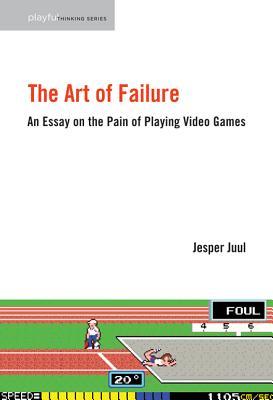
That apparent contradiction is the subject of Jesper Juul’s 2013 book The Art of Failure: An Essay on the Pain of Playing Video Games, published as part of MIT Press’s Playful Thinking series. Juul is interested in what is called the paradox of failure, a specific instance of the paradox of painful art. In the same way that the better known paradox of tragedy captures the oddity of us seeking out works of art that cause us sadness, the paradox of failure encapsulates the weird reality of us playing games when they bring us suffering. Juul lays out the paradox as follows:

1. We generally avoid failure.

2. We experience failure when playing games.

3. We seek out games, although we will experience something that we normally avoid.

Jesper Juul, The Art of Failure, p. 2

Juul does not find a resolution to this paradox by the end of the book, which is hardly a strike against him. The paradox of painful art has puzzled philosophers from Aristotle to David Hume all the way up to the present day; I found myself running up against it when I wrote about how I find murder mysteries relaxing. Rather than seeking a definitive answer, Juul instead approaches the paradox through the lens of different fields, from philosophy to psychology to game design, to uncover what each field can tell us about the paradox.

Those discussions are all interesting in their own right, even if Juul goes about them with a rather repetitive prose style. But what really struck me while reading The Art of Failure is something Juul only gets at indirectly: the importance of a player’s attitude toward failure when playing a game. This comes up a bit whenever notions of sportsmanship enter the discussion; few things are less enjoyable during a game than dealing with a sore loser. But thinking more broadly, games seem to present us with unusual sets of social expectations. Early on in the book, Juul draws a contrast between two scenarios, an unhelpful guest at dinner and an unhelpful opponent in a board game:

Imagine that you are dining with some people you have just met. You reach for the saltshaker, but suddenly one of the other guests, let’s call him Joe, looks at you sullenly, then snatches the salt away and puts it out of your reach. Later, when you are leaving the restaurant, Joe dashes ahead of you and blocks the exit door from the outside. Joe is being rude—when you understand what another person is trying to do, it is offensive, or at least confrontational, to prevent that person from doing it.

However, if you were meeting the same people to play the board game Settlers, it would be completely acceptable for the same Joe to prevent you from winning the game. In the restaurant as well as in the game, Joe is aware of your intention, and Joe prevents you from doing what you are trying to do. At the restaurant, this is rude. In the game, this is expected and acceptable behavior. Apparently, games give us a license to engage in conflicts, to prevent others from achieving their goals. When playing a game, a number of actions that would regularly be awkward and rude are recast as pleasant and sociable (as long as we are not poor losers, of course).

Jesper Juul, The Art of Failure, p. 10 (footnote omitted)

We can see this contrast at work in the comic strip mentioned earlier. In the first panel, when Nietzsche draws a Sorry! card and sends Epictetus’s piece back to the start, there’s nothing malicious about the act. Mohler even draws Nietzsche with a playful expression to show that the punishment here is all in good fun. It’s not until the subsequent panels that Nietzsche’s actions go from “pleasant and sociable” to “awkward and rude”: throwing Epictetus’s piece against the board, calling him an idiot, etc. In both phases, Nietzsche intends to inflict pain on his opponent, but only in the second phase do his actions read as unacceptable.

Now, saying that actions that cause suffering in games are acceptable is not the same as saying that they are desirable. We might think that Epictetus tolerates the punishment of returning to the start because it accompanies a fun night with friends or a stimulating challenge, but that he would prefer a hypothetical version of the game that did not include that mechanic. Indeed, a later panel reveals that Epictetus has been playing the game in a way that minimizes the suffering central to Sorry!

Epictetus: The only thing you can control is your own virtue, and the most virtuous thing to do is fulfill your civic responsibilities, which is why I select moves that best help all the players.

Nietzsche: You were doing that on purpose?! I thought you were just an idiot.

We might think that Nietzsche’s response is another example of his being a jerk, but I think his frustration with Epictetus is understandable here. Epictetus confesses that he has not been playing the game in the proper spirit. Even though such a cooperative approach to Sorry! is not exactly prohibited by the rules, it’s also clearly not what the game’s designers consider to be optimal play (again, the game is called Sorry!). Epictetus’s subversive approach is an extreme case, but it does remind me of one passage from The Art of Failure in which Juul discusses how designers often need to push players toward failure:

The contribution of failure [to growth] becomes even more clearly visible when it is absent. It is not that growth cannot happen without failure, but that failure concretely pushes us toward personal improvement, and players often need to be pushed because they, as game designer David Jaffe has said, are fundamentally lazy. Designer Soren Johnson of the Civilization series describes it as a general problem that players seek out the optimal path to play a game but stick to it even when they find it fundamentally uninteresting.

Jesper Juul, The Art of Failure, p. 59 (footnotes omitted, emphasis in original)

That optimal path that Johnson mentions is designed to avoid the prospects of failure and suffering; players who take that path are likely to succeed in an absolute sense but rob themselves of the game’s actual pleasures in the process. In the case of a round of Civilization played against computer-controlled opponents, perhaps such players will only inconvenience themselves. But when other human players are involved, we may expect something like Nietzsche’s frustration to emerge.

To draw an example from my own experience: I was once invited to play a board game that simulated air combat maneuvering, with each player having the goal of shooting down their opponents’ fighter planes. My friends approached the game in the intended fashion, looking for opportunities to engage their foes in a dog fight. I, on the other hand, did no such thing. Instead, I simply circled my planes around the fray, avoiding combat at all costs because I did not want to risk getting fired upon. You might think that I was aiming to win the game by just waiting out the madness, as though I were Foxface during the Hunger Games. But really, I was just worried about the possibility of failure, and so I found a strategy that eliminated that possibility.

The friend who had invited me was not amused. “If you don’t start fighting,” he told me, “I’m going to find you derelict of duty.” I then realized that my strategy for avoiding suffering violated the social contract of the game; it deprived my opponents of opportunities to fight and therefore made the game less enjoyable for everyone. Whether it’s my friends and I pretending to have dog fights or four philosophers arguing over Sorry!, the only way for us to have fun while playing a game is to embrace the suffering that comes our way.


That seems like as good a place as any to leave off. I’d love to hear your thoughts on this whole discussion. Do you have a preferred way of resolving the paradox of failure? Can you think of any games that don’t involve failure? Let me know in the comments!

I’d like to tip my cap to Chris Franklin of Errant Signal, whose video on Getting Over It with Bennett Foddy introduced me to Juul’s book. I think it’s one of Franklin’s best, and you can watch it below.

Similes and Emotion in S. E. Grove’s “The Waning Age”

The premise of S. E. Grove’s most recent novel, The Waning Age (Viking-Penguin Random House, 2019)—a world in which people lose their capacity to feel emotion during adolescence—presents the author with a challenge regarding the tone of the prose: how to narrate the story without conveying emotion? One might expect that Grove would employ a detached third-person point-of-view, the sort of fly-on-the-wall narration that one associates with Ernest Hemingway. Certainly that would be the advice I would give to a student who wished to write such a story.

But that is not the strategy on display here. Instead, Grove uses a first-person narrator, telling the story through the voice of her protagonist, Natalia Peña. Writing in first-person may well be expected for a young adult novel, but it undoubtedly makes Grove’s task more difficult. Natalia may not have emotion, but she does have subjectivity; to experience the world through her eyes must feel like something. Grove must somehow craft a narrative voice that conveys subjectivity while excluding emotion—no easy feat.

In this post, I’d like to examine one technique that Grove uses to achieve the required narrative voice, the simile. The use of similes in The Waning Age accomplishes two things regarding emotion. First, similes remind the reader that whatever emotions that characters who have waned are expressing are simulations of emotions rather than genuinely felt experiences. The act of simulating emotion is a constant in the novel, and the simile is the literary device best suited to highlighting that fact. Second, in specifically emulating the style of Raymond Chandler, the similes in The Waning Age make humor a central feature of Natalia’s voice and suggest that her subjective experiences are more complicated than her ostensibly emotionless society would have one believe.

The Art of Simulating Emotion

Although the world of The Waning Age is defined by the loss of the capacity to feel emotion, it is not the case that emotion—or at least the appearance of it—is absent from society. What we might call “true” or “natural” emotion may wane around the age of ten, but the characters have various methods for simulating emotion when the occasion calls for it or when the desire strikes them. Foremost among these methods are synthetic affects, or as everyone calls them, “synaffs”: chemicals that allow one to experience emotions, particularly the physiological effects that accompany them. Pharmaceutical companies like RealCorp earn immense profits from manufacturing synaffs, which only the wealthy can afford with any regularity. Indeed, RealCorp’s presence in this field instigates the plot: it kidnaps Natalia’s ten-year-old brother Calvino, who shows no signs of waning, so it can conduct experiments on his brain.

For those in the lower classes, however, one must simulate emotion from within. Body language and gestures are a go-to device. For example, one of Natalia’s foster parents, Tabby, is an actress who does not use synaffs for performances; Natalia calls her “one of those purists who thinks it’s about remembering emotion and cultivating that memory, then channeling it when you act” and says that “she is very good at feigning emotions when she wants to” (p. 39). Conversely, Natalia is adept reading other people’s body language, even if she thinks that it’s “a major drag…having to the study the angle of a person’s nostril to figure out what they’re feeling” (p. 15). Such a skill is especially useful living with someone as emotional as Calvino, for it allows Natalia to respond in a manner appropriate to the situation, even without experiencing the attendant emotion.

One might then expect that Grove would lean into Natalia’s perception of body language, peppering the narration with small details about the other characters. And it’s true, Grove does exactly that, and on occasion effectively so. There’s something very uncanny in how the receptionist at RealCorp abruptly switches from looking “briefly crestfallen” to giving a “reassuring smile” (p. 64), and her inability to interpret the mix of signals from Dr. Glout during the boardroom confrontation (“Knotted eyebrows, tight lips. His papery skin was blotchy; his arms rested unnaturally on the table as if he had to hold himself in place” [p. 286]) does well in creating a tense atmosphere. But Grove tends to rely on the same handful of gestures, such as eye rolls and raised eyebrows, so those details gradually lose distinctiveness and, therefore, effectiveness.

This is where Grove’s use of similes comes into play. Whereas her examples of body language get repeated to the point of meaninglessness, her similes consistently find fresh material to work with. Figurative language is already a vital tool for describing emotion, as it can link an abstract, subjective experience to a concrete vehicle. Furthermore, one can account for nuances in the tenor by changing the vehicle. There is a difference, for example, between saying that something is “as white as snow” (which makes it sound soft) and that it is “as white as salt” (which makes it sound harsh). The more specific the vehicle, the more nuanced the reader’s understanding of the tenor.

To see an example of how Grove uses similes, consider this early example in which Natalia describes how children look when they’re in the midst of waning: “Almost all of [Calvino’s] classmates are looking the way I did at that age, dull and kind of mystified, like they can’t figure out who stole all the Halloween candy” (p. 13). There are a number of emotions and attitudes at work here. A kid who “can’t figure out who stole all the Halloween candy” would be confused, certainly, but in a way that suggests sadness and innocence; it’s different from how someone seems when they can’t solve a crossword puzzle, or when they can’t find their car keys. This particular simile also suggests that Natalia sees them with a sympathetic eye, or at least knows that one ought to; she has, after all, been in that same situation.

Let’s look at one more example. This one concerns Hoffman, who is a preacher and Calvino’s birth father. When he sees Natalia for the first time, she realizes that he has mistaken her for her mother; when he recognizes his mistake, she says that “he crumpled like a sheet falling from a clothesline” (p. 226). This is a sudden shift in perception, rather than a gradual dawning; otherwise he may have been likened to a deflating bouncy castle. And while Hoffman is obviously disheartened, he’s not angry about it, or else Natalia may have compared him to a collapsing wall. Coupled with the strong verb “crumpled,” and one gets the sense of exaggerated disappointment that the author is going for. All that is contained within the image of the falling sheet.

Based on this discussion, one may think about figurative language in the same way that Tabby thinks about acting: one searches through their history and their knowledge for the proper experience, then channels that experience when they write. Also like acting: it is always a simulation, never a reality. The vehicle may share important qualities with the tenor, but it is not identical to it. This is why I think that Grove’s preference for similes over other forms of figurative language, such as metaphor or personification, is so appropriate. Similes make explicit both the act of comparison and the artificial nature of that comparison. In a simile, A is like B, but not B itself. In most contexts, this distancing makes similes weaker than metaphor, but in The Waning Age, their use reinforces the novel’s world building: people experience something like emotion, but not emotion itself.

The Influence of Raymond Chandler

The first simile in The Waning Age that caught my attention occurs in the first paragraph of the novel, wherein Natalia describes the hotel where she works a cleaner: “Inside, the walls are white marble, the lobby chairs are rose damask, and the carpet looks like the polar bear population of the Arctic, scythed and steamrolled” (p .1) The nature of that simile—on the surface incongruous but upon reflection deadly accurate—immediately calls to mind the style of Raymond Chandler, whose writing is famous for bizarre and witty similes. Chandler will say that someone is “about as inconspicuous as a tarantula on a slice of angel food” or has “a face like a collapsed lung,” and one will simultaneously laugh at the joke and marvel at the precision of the image. In The Waning Age, Grove tries to give Natalia the same sort of voice found in Chandler’s novels.

Just in case one thinks that this is speculation, I would note that Natalia explicitly models herself on Chandler’s most famous protagonist, Philip Marlowe. She believes that Marlowe demonstrates how one can get by in an increasingly emotionless society:

[Marlowe] comes as close as I’ve seen to our emotionless future. Maybe Chandler had a nightmare, and Marlowe’s world was in it, or maybe, prophet-like, he could see the slow decline approaching in the cold hearts and callous faces of 1930s Los Angeles. However it happened, his Marlowe does it—even in a world still premised on the availability and influence of emotion, Marlowe moves through it, calm and unflappable, making it seem plausible that one might survive in a hard, sordid, unfair world without the soaring ecstasies and raptures of triumph and true loves that seem to carry every other character ever written.

S. E. Grove, The Waning Age, p. 37

Natalia does not merely admire Marlowe’s cool affect in the face of an unfeeling world; she puts that influence into practice. Indeed, she later remarks that latching onto a fictional character as a sort of life guide is quite common in her society:

Lots of us witty people do it. Books and old screen dramas are like disorganized bargain stores where you hunt for an angle; someone memorable, someone to imitate, someone who gives you a usable script. Someone behaving with emotional coherence so that you can follow along, seeming both emotional and coherent without being either.

S. E. Grove, The Waning Age, p. 118

In addition to borrowing survival tactics from Chandler’s novels, she also borrows their language, their penchant for similes, as a way of understanding the world around her. For instance, in observing how a liberal arts education fails to instill a sense of morality in children who have waned, she reasons that “nowadays serving up Shakespeare to a bunch of untrained adolescents is like handing a serial killer a pack of gum” (p. 78). It may distract them for a moment, but it will not get to the root of the problem: their incapacity for true empathy. It is that particular simile that allows Natalia to see the flaw in that system.

Going into the paratext of Chandler work, one may discover another way in which Grove’s similes are Chandler-esque: they show a speaker grappling with a language they are not fully fluent in. This is a point that Stephen L. Tanner brings up in his article “The Function of Simile in Raymond Chandler’s Novels” (paywalled), in discussing the relationship between Chandler, who grew up in England, and American vernacular:

Chandler once said, “I had to learn American just like a foreign language.” And in learning it, he fell in love with it. “I’m an intellectual snob who happens to have a fondness for the American vernacular,” he wrote in a letter, “largely because I grew up on Latin and Greek. As a result, when I use slang, solecisms, colloquialisms, snide talk or any kind of off-beat language, I do it deliberately.” Elsewhere he said, “If I hadn’t grown up on Latin and Greek, I doubt if I would know so well how to draw the line between what I call a vernacular style and what I should call an illiterate or faux naif style. That’s a hell of a lot of difference to my mind.” Chandler thought of himself primarily as a stylist, and his distance from American English allowed him to do what he did with it. In this respect, as Frederic Jameson has remarked, his situation was similar to that of Nabokov: “the writer of an adopted language is already a kind of stylist by force of circumstance.”

Stephen L. Tanner, “The Function of Simile in Raymond Chandler’s Novels,” Studies in American Humor, vol. 3, no. 4, 1984, p. 340 (internal citations omitted)

Whereas Chandler uses humorous similes to approach the language of another country, Natalia uses the same technique to approach the language of emotion. Unavoidably, every instance of figurative language will carry some connotation, some emotional charge, that colors how one views the situation. Even if Natalia cannot access a feeling through direct experience, she can still be conversant in emotion, as it were, by adopting this humorous style.

Granted, according to the internal logic of The Waning Age, humor is not exactly an emotion. In one of the essays that Calvino writes as part of Dr. Glout’s testing regimen, he presents the case that humor is not an emotion but rather an instinct. “Humor,” he writes, “is achieved by the intellect, which is part of reason. If you laugh at a joke it is not the same as laughing because you are happy. Just as crying because you are sad is not the same as crying because someone broke your leg” (p. 71). (It may be odd to treat a ten-year-old boy as an authority, especially when he is is talking to an actual academic, but as the only major character who still experiences natural emotion Calvino has more firsthand knowledge on the subject that anyone else.) But because they share some behaviors, one could say that humor is adjacent to emotion, in the way that Chandler’s classically educated perspective on American vernacular is adjacent to the genuine article.

Indeed, as Tanner goes on to suggest, humor can be useful in concealing emotion, in addition to approaching it. He says that Chandler’s similes “often consist of a self-deflating wit that disguises the sentimental note in Marlowe and his knight-
errantry” (p. 343). Natalia is well aware of this tendency: “I know he’s not actually emotionless. Sometimes his face gets red. Sometimes he even gets mad” (p. 37). Might I suggest, given the reveal near the end of the novel that Natalia is regaining the capacity to feel emotion, that the similes in Grove’s book achieve a similar effect? Might I suggest that we’re not wrong in inferring sadness from child without Halloween candy, or disappointment from the crumpled sheet? Natalia has always been capable, physically, of having true emotion; she merely lacked the awareness to process her thoughts as such.

A Brief Concluding Note

At this point, we seem to have reached two contradictory conclusions. In the first part, we found that Grove use similes because Natalia cannot feel true emotion, while in the second part we found that Grove uses similes because Natalia secretly can feel true emotion. So which is it? Surely it can’t be both—that would be a contradiction, right?

In a certain sense, yes, this is a contradiction in the novel, one which is never resolved. But this appears to be a contradiction that the novel is fine with—encourages, even. On multiple occasions, Calvino questions Dr. Glout when the researcher appears to express remorse regarding the the child’s situation (e.g., “I’m afraid [Natalia] can’t be here right now” [p. 73], “Sorry, I’m trying to keep things calm in there for you, and having people go in and out wouldn’t help” [p. 101]). After all, Calvino reasons, if Dr. Glout has waned, then he can’t be afraid of or sorry about anything. Dr. Glout explains that he’s using figures of speech, but Calvino is right to point out the oddity of using the language of emotional for emotionless purposes.

I feel that Grove is inviting the reader to take on the role of Calvino while reading The Waning Age, to question whether anything in the novel is truly without emotion. I will admit that at times, this posture feels like an escape hatch for the author, a way to preemptively brush aside any critique of the world-building: “Oh, that there? That’s an intentional inconsistency. You’re supposed to find that fishy.” But I’ll also admit that such moments got me to reflect on what I thought counted as emotion, and to consider those preconceptions more critically. Perhaps that’s worth some internal inconsistency.


I’ve said a lot more on this book than I’d predicted when I started, but I’d still love to hear your thoughts on The Waning Age. How do you think it handles writing an emotionless perspective in a first-person voice? Are there any techniques that you think exemplify its success or failure in that regard? Let me know in the comments!

Special thanks to Krysta of Pages Unbound, whose review of The Waning Age brought it to my attention. I can’t say that enjoyed it quite as much as she did; I found that beyond its main themes and this particular literary technique that the book seemed rather rote. But I did enjoy thinking and writing about it, which I do believe is more important.

And, as always, thanks for your time!

A Top 5 List: Books Under 300 Pages

It’s time for another list game, this one courtesy of Shanah, a.k.a. the Bionic Book Worm: top 5 books under 300 pages. In theory, this should be a very easy list for me to compile. I read a lot of poetry collections and dramatic works, both formats where even 100 pages would be considered on the long side. But I feel that to include those sorts of books would be violating the spirit of the theme: books whose short lengths are noteworthy. As such, I’m going to restrict myself to works of nondramatic prose, i.e., works of fiction and nonfiction.

That still leaves us with a wide variety of books to examine, and I hope the list is eclectic enough that at least one book here will sound appealing. We’ll be looking at experimental essays and straightforward criticism, postmodern literature and classic fantasy. Should be a fun diversion. So, without further delay: the list.

5) The Crying of Lot 49, by Thomas Pynchon (152 pages)

Let’s begin with a book I would described less as “short” than as “truncated.” The Crying of Lot 49 follows Oedipa Maas, who has been tasked with managing the estate of her ex-boyfriend. In the process of untangling his complicated assortment of assets, she stumbles upon evidence of an age-old conflict between two rival mail delivery services: Thurn und Taxis, the established corporate giant, and Trystero, the underground competitor. At least, she thinks she’s found evidence of such a conflict. For while she keeps running into signs of Trystero’s existence, Oedipa is never certain that she’s not hallucinating the whole conspiracy.

This book has all the makings of an engaging thriller, albeit one with some idiosyncratic cultural references—a working knowledge of Jacobean drama is helpful for understanding the plot, for example. But what makes The Crying of Lot 49 interesting (or, if you’re less charitable, infuriating) is that Oedipa never even comes close to uncovering the truth. Instead, it abruptly ends before the title “crying,” an auction of rare postage stamps that Oedipa believes might lead her closer to confirming Trystero’s existence. Imagine a mystery show that ended right as the detectives made their first breakthrough, and you have a good idea of how The Crying of Lot 49 operates. It’s not to everyone’s taste, of course, but if you like characters with rising, unrelieved paranoia, then this is the story for you. (Alternatively, if you like A Series of Unfortunate Events, which is clearly inspired by this book.)

4) Let’s Talk About Love: A Journey to the End of Taste, by Carl Wilson (176 pages)

This is music critic Carl Wilson’s contribution to 33 1/3, a series in which writers analyze one album in great depth. This book is ostensibly about Let’s Talk About Love, the 1997 Céline Dion album featuring “My Heart Will Go On,” but Wilson has much broader ambitions here. He’s interested in how an artist like Dion can be so critically loathed yet so popular and beloved, and he will not be satisfied with so simple an answer as, “People have bad taste.” Wilson spends a year immersed in all things Céline, and in doing so questions the prejudices of the critical establishment.

Books in the 33 1/3 series are pocket-sized by design, and in his book Wilson doesn’t waste a single sentence. He places Dion’s work in the context of Quebecois music history, considers critics’ traditional distaste for schmaltz and sentimentality, interviews fans of Dion from all over the world—it’s a veritable greatest hits album of sociological analysis. I enjoyed Let’s Talk About Love in much the same way that I enjoyed Andy Greenwald’s exploration of emo subculture, Nothing Feels Good, in that it’s a sympathetic but still critical account of a genre of music I have little personal taste for. It’s less important that readers and critics come away thinking someone like Dion is a great artist than that they understand what others hear in her work.

3) Chroma, by Derek Jarman (160 pages)

I said at the top that I deliberately excluded poetry collections from consideration, but that doesn’t mean I can’t sneak some lyrical prose onto the list. Derek Jarman is a towering figure in the history of queer cinema, with films such as Sebastiane and his adaptation of Christopher Marlowe’s Edward II addressing queer themes in an era of heavy social stigma. But he also wrote several books, the last of which was Chroma, a series of freewheeling essays on color. Jarman, with a tight yet expressive prose style, explores all possible avenues into the concept of color: scientific, historical, cultural, and personal.

Indeed, while Jarman’s writing often resembles the fragmentary style of pre-Socratic philosophers, Chroma is an intensely personal work for Jarman: he began writing these essays on color as he was going blind from AIDS-related complications. There’s a sense of both urgency and resignation behind all of these essays, for he must enjoy the sensation of color while he can, while still accepting the inevitable with dignity. These themes come to a head in the essay “Into the Blue,” which includes a tender tribute to his past lovers who have lost their lives to AIDS, and which served as the basis for the narration in Jarman’s final film, Blue. In part because it’s the most obscure book on this list, Chroma is the book I most recommend.

2) The Tombs of Atuan, by Ursula K. Le Guin (146 pages)

So far, the books I’ve included on this list have have been dense affairs, compressing a lot of themes, motifs, and ideas into a small package. The Tombs of Atuan, the sequel to Ursula K. Le Guin’s fantasy classic A Wizard of Earthsea, goes in the opposite direction. It tells the story of Tenar, a girl who was taken from her family at young age to serve as a priestess to dark gods in the Tombs of Atuan. When Ged, the protagonist from the first book, breaks into the tombs to steal a piece of a magical amulet, Tenar traps him in the underground labyrinth and contemplates how best to dispose of him. But slowly, she forges a personal connection with Ged, which allows her to start recovering her past identity.

The Tombs of Atuan is such a pleasant swerve as a sequel. Whereas A Wizard of Earthsea takes Ged across countless islands across Le Guin’s fictional world, The Tombs of Atuan almost completely confines itself to one location. And that setting suits the novel perfectly, as Le Guin is aiming for a work of great psychological insight. The cavernous, intricate layout of the tombs is symbolic of Tenar’s journey of self-realization, and on a logistical level it works well in literally trapping two characters in conflict together. The Tombs of Atuan also holds the distinction of being the only novel I can remember reading in one sitting, so if that’s not an endorsement, I don’t know what is.

1) Silas Marner, by George Eliot (230 pages)

Let’s close this list with a real classic, shall we? Like The Tombs of Atuan, this is another story of intense personal transformation. The title figure of George Eliot’s Silas Marner is a miserly old weaver living in rural England. He has little contact with broader society until two life-changing events happen in quick succession. First, someone steals all the gold he’s been hoarding; second, a blond-haired infant wanders into his little cabin. Silas resolves to raise the child himself, and in doing so slowly finds happiness greater than all his lost wealth.

In one sense, Silar Marner is a proudly unsubtle story: the connection between Silas’s gold and Eppie (as he names the girl) is so obvious that Silas literally mistakes Eppie for the gold when she first crawls into his hut. But there’s actually lot going on underneath the surface here. Eliot uses this fable-like story to explore a number of social themes relevant to Victorian England, from the vagaries of religion to the effects of industrialization of rural English life to the public and private foibles of the aristocracy. In short order, Silar Marner stirs up the sentiments, then spurs one into thought—exactly what one is looking for in a book by Eliot. It’s almost like reading Middlemarch in miniature.


Thus endeth the list. What are your thoughts on these picks? Anything that sounds especially enticing, or am I completely off-base with these? Let me know in the comments! If you’re still looking for book recommendations, then check out my response to the Literary Fiction Book Tag.

And, as always, thanks for your time.

Recent Publication: Third Coast

I happy to announce that I have a poem in the most recent issue of Third Coast, the literary magazine housed at Western Michigan University. It’s called “Retaliation,” and it’s a poem that I’ve been particularly excited about, because of how it channels a whole bunch of my personal obsessions into a single work. Perhaps you’ll indulge me if I elaborate for a little bit. (That, and since the poem is in print I feel bad about not having anything to link to.)

First, there’s the subject matter. “Retaliation” is addressed to Todd Bertuzzi, a former hockey player who was the assailant in one of the most brazen instances of in-game violence that I can remember. On March 8, 2004, in the third period of lopsided game between the Vancouver Canucks and the Colorado Avalanche, Bertuzzi grabbed Colorado center Steve Moore from behind, punched him in the back of the head, and drove him head-first onto the ice, breaking several of Moore’s neck vertebrae. Moore would never play hockey again, and Bertuzzi faced criminal charges for his actions.

The incident has stuck with ever since, largely because I saw a lot of replays of Bertuzzi’s sucker punch while watching SportsCenter; the footage became by version of the Zapruder film. But I was also haunted by the reactions of the broadcasters and the crowd. If you watch the footage of the incident, the moment that Bertuzzi punches Moore you’ll hear the play-by-play announcer’s voice perk up excitedly and the crowd begin to cheer. It takes good while for everyone involved to realize the extent of Moore’s injuries, and then the mood shifts drastically; the whole game, as it were, crashes into a wall.

That brings me to the thematic content of the poem, which revolves around the concept of the magic circle. “Magic circle” is a term appropriated from Johan Huizinga’s book Homo Ludens: A Study of the Play-Element in Culture to describe the constructed world in which a game takes place, where the rules of the everyday world are set aside and in-game actions are, by and large, metaphorical. While this notion of the magic circle goes back to the work of game designers Eric Zimmerman, Frank Lantz, and Katie Salen, I first became aware of it from an episode of the YouTube series Errant Signal discussing a video game called, appropriately, The Magic Circle.

Now, everyone agrees that, if games exist within a magic circle, the boundary between the game world and the everyday world is very porous. But Bertuzzi’s actions did not merely represent a crossing of that boundary; it came close to erasing that boundary completely. All play came to a halt, spectators became eyewitnesses, and both men would enter a years-long legal process as a direct result. This was no longer a game; it was a current event and a moral crisis.

Lastly, we come to the form. I’d had this basic idea for a poem—tying the Bertuzzi incident to the magic circle concept—stuck in my head for a good while, but I could never get it down on paper in a way that remotely satisfied me. That is, until I decided to show my students “Lake Sonnet” by Anne Marie Rooney (which you can read here) as an example of how poets play with the sonnet form. In this poem, and several other by Rooney, she follows a Petrarchan rhyme scheme but only uses “identical rhymes” (i.e., rhyming words with themselves or with homophones). It works especially well in “Lake Sonnet,” as the repetition of end words highlights the speaker’s monotonous sexual encounters: “I,” “men,” “our,” “breaks”.

I had personally done imitation exercises based on Rooney’s poems in the past, but it was only after teaching it that I realized that this structure—an identically rhymed sonnet—might be a good fit for the poem I’d been trying to write. Hearing the same words over and over again could be used to trap the poem in a particular moment, and there’s something wonderfully “circular” about all this repetition. A few hours later I had a draft; a few months worth of tweaks later and I had the poem in its current shape.

At time of writing there is no link to purchase the latest issue of Third Coast, but hopefully that will change in the near future. In the meantime, you can purchase back issues of Third Coast via their website.