Displacing Anxiety: Thoughts on Jill Bialosky’s “Driving Lesson”

Whenever I’m reading a poetry collection and I come across a piece that immediately captures my imagination, I like to flip to the acknowledgments page and see where that poem was originally published. Sometimes it’s out of idle curiosity, sometimes it’s because I’m looking for promising places to submit my own work, and sometimes it’s just to see if I can send someone a link to the poem without having to find a copy machine. Most often, the source is one of the usual suspects: Poetry, AGNI, The Kenyon Review. Every once in a while, though, the acknowledgements page gives an unexpected answer.

Such a surprise came to me while I was reading Jill Bialosky’s The Players (Knopf, 2015), as I learned that my favorite poem in the collection, “Driving Lesson,” was originally published in, of all places, The Chronicle of Higher Education, under the similar but more intimate title of “Teaching My Son to Drive.”

I’m not certain how the piece was originally published, but I was able to find the text of that earlier version of the poem on the Chronicle website. In what is an otherwise wholly digressive moment in her essay “Poetry and Suicide” (which, fair warning, discusses exactly that), Lisa Russ Spaar highlights “the ways in which Bialosky gives the antic world agency and displaces onto the careening trees, racing squirrels, and wild thrashers all of the mother’s anxiety about her son’s rite of passage.” On the whole, I find Spaar’s connection between the topic of suicide (which, in fairness, has touched Bialosky’s life greatly) and the argument of the poem to be rather tenuous. But that notion of displacing anxiety does, I think, fit nicely with how the poem handles ambiguous language.

Reading the poem, we understand that the speaker, a mother confronting the fact that her teenage son is growing more independent and that there is nothing she can do to prevent it, is projecting her dread onto the world around her. When she looks down at the speedometer and tells the reader, “I want him to slow down” (line 20), we understand that the speaker means two things simultaneously. First, on a literal level: she wants her son, who’s learning how to drive, to ease up on the gas. Second, on a metaphorical level: she wants her son, who’s approaching adulthood, to stop growing up.

That latter desire is, of course, impossible to satisfy; time simply doesn’t work like that. By using the external material of the speedometer as a point of reference, as a object onto which she can displace her anxiety, the speaker pulls off a nifty substitution: an impossible desire gives way to an attainable one. Her son cannot slow down the passage of time, but he can slow down the car. Perhaps, one may speculate, that would be good enough for the mother in these circumstances.

In terms of the how speaker displaces anxiety, the speedometer example is easy to pick out because the two elements of the process, the feeling and the object, come in quick succession. More interesting, however, are the places where those two elements are displaced from each other within the text of the poem. To read “Driving Lesson” involves coming across quasi-universal statements along the lines, “I want him to slow down,” without having their immediate context. There’s a consistent ambiguity at work here; the reader must keep asking themselves, “How am I supposed to take this?”

Let’s take two examples to get the idea. Consider the passage in which the speaker observes some horses as they drive past:

Horse farm on the side of the street
where we encounter a field
of young English riders with crops
preparing to mount the hurdles.
It won’t be easy. (9-13)

At first glance, this looks a lot like the speedometer example later on in the poem. After all, it certainly “won’t be easy” for the riders to leap over the hurdles. But, well, this poem isn’t called “Horse Riding Lesson.” It seems overly digressive for the speaker, who’s already using the driving lesson as a metaphor for her son growing up, to start likening her situation to the riders they happen upon. Furthermore, the riders’ situation actually seems dissimilar to the speaker’s, as their task is entirely physical, not emotional. While the horse imagery may suggest the line, “It won’t be easy,” through associative logic, what the image accomplishes is to displace the sentiment from the situation that occasioned it, namely, the driving lesson. Rendered more abstract, the thought becomes more bearable.

Let’s close things here by looking to the poem’s conclusion, which this time invokes the memory of a nature image rather than the image itself:

When I turn to look
I see the pensive boy in the backseat
strapped in his seat belt
watching two red squirrels run up a tree
and back down. (29-33)

It’s this finish that fully won me over to the poem. In terms of displacing anxiety, the speaker does so across so many dimensions. First, as in the previous examples, the speaker turns from the uncomfortable truth that her son is growing up to the youthful imagery of the frantic squirrels. But there’s so much more to this one, for the image is further displaced in terms of perspective (the son is the one watching the squirrels, not the speaker), time (he’s a “pensive boy,” not a teenager), and space (he’s in the backseat, not behind the wheel). The speaker has all but created a alternate reality of eternal motherhood within this moment.

Furthermore, the syntax of the final sentence manages to effectively displace the meaning of the poem. Look at that last line: “and back down.” The phrase “back down” can be taken two ways. In this context, the obvious way is as a parallel to “up a tree”: they run “up a tree / and back down [the tree].” They return to the start in the same way the speaker has mentally returned to an earlier state in her relationship with her son. But “back down” can also act as a verb phrase, meaning a kind of surrender—in this case, to the inevitable passage of time. That second meaning completes the speaker’s arc towards understanding and, as it happens, would fit the syntax of the sentence: if we add in the elided pronoun, then the phrase “and [I] back down” has a parallel structure with the preceding verb phrase, “I see.” “I see / … / and I back down.” The speaker understands the facts of life, however reluctant she may be to accept them.

As an exercise, read through Bialosky’s poem a few times and see if you can find any further moments of the sort of displacement that Spaar and I have discussed. Let me know your thoughts on the poem in the comments.

If you want to read more analyses of contemporary poetry, you might take a look at this post I wrote last year about the syntactical fireworks in Edward Mullany’s collection If I Falter at the Gallows.
Percy Bysshe Shelley’s “Ozymandias”: An Analysis

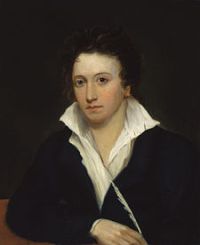
Percy Bysshe ShelleyThis month’s poem analysis is a first for the blog: a reader suggestion! In the comments section for my post on Charlotte Smith’s “Written in the Church Yard at Middleton in Sussex” (which you can read here), Elizabeth of Serial Outlet recommended that I take a look at an English class staple: Percy Bysshe Shelley’s “Ozymandias.” About four months later, and here we are!
I’ve put off diving into this particular poem for two reasons. First, having just covered a sonnet by a Romantic-era poet when I got the suggestion, I didn’t want to pigeonhole myself right out of the gate as someone stuck in that style and time period. Second, and more importantly, I felt a bit overwhelmed by the task. Of all the poem’s I’ve given the close reading treatment, “Ozymandias” is by the far the most famous. People who haven’t read a poem in decades remember this one from high school. As such, while I let the poem stew in my mind, I felt some pressure to do the work justice, to contribute something of value to the conversation surrounding it.

Granted, the way this essay is headed, that pressure may have been misplaced. Let’s jump right in, shall we?

Ozymandias

I met a traveler from an antique land
Who said: Two vast and trunkless legs of stone
Stand in the desert . . . Near them, on the sand,
Half sunk, a shattered visage lies, whose frown,
And wrinkled lip, and sneer of cold command
Tell that its sculptor well those passions read
Which yet survive, stamped on these lifeless things,
The hand that mocked them, and the heart that fed:
And on the pedestal these words appear:
“My name is Ozymandias, king of kings:
Look on my works, ye mighty, and despair!”
Nothing beside remains. Round the decay
Of that colossal wreck, boundless and bare
The lone and level sands stretch far away.

At first glance, this looks like a straightforward account of hubris. The statue of Ozymandias (i.e., Ramesses II of ancient Egypt) boasts of the pharaoh’s grand works, all of which now lie in ruin. Even the highest among us are not immune to the ravages of time; we all are bound to erode into “lone and level sands” (line 14). A simple message, albeit very grandly stated. But I think the poem has more on its mind than that, and it might help to start with how the poem’s account is presented.

Let’s begin by taking the text of the poem as a self-contained unit, like we’ve found it on an ancient sheet of papyrus with no context to guide us. The first word of the poem, “I,” presents us with the voice of some unknown first-person speaker, suggesting that what follows is some personal testament. Having implicitly introduced themselves, the speaker then begins narrating their experience, of how they “met a traveler from an antique land” (line 1). This sounds like the set-up for a story, but this already is the end of the story-present narrative.

In the second line, the poem then shifts into the voice of the traveler, as the first-person speaker relates their description of the sculpture—a description which comprises the remainder of the poem. There is some ambiguity as to whether the description is a direct quotation or a paraphrase, as it lacks the quotation marks which will later bound the inscription, but even in the latter case the speaker’s own voice would be sublimated to the traveler’s original account.

This account then continues uninterrupted up through line 9, at which point the traveler inserts a signal phrase, drawing attention to the coming second shift in perspective: “And on the pedestal these words appear”. It is here that the ruins speak, issuing their challenge to all who behold them. Once the inscription is recited, the poem shifts back into the voice of the traveler, who carries the poem to its conclusion.

But arguably, we are not done breaking down the rhetorical nesting here. On a meta level, we know that the poem is work of one particular author, Shelley, who per traditional analysis of poetry is a separate entity from the first-person speaker. On a diegetic level, we know that the statue of Ozymandias has an artist, who gave the the statue its inscription. And on a speculative level, Ozymandias is unlikely to have made the statue himself; he may have commissioned it, or the artist may adopted the pharaoh’s persona for the inscription.

So to summarize, here’s how deeply this 14-line poem embeds its story:

  1. It is the work of Percy Bysshe Shelley, who in writing it…
  2. …adopts the voice of a lyrical, first-person speaker, who then…
  3. …tells the audience an account he that heard from the traveler, who in turn…
  4. …quotes a statue’s inscription, which…
  5. …was the product of an unknown artist, who finally…
  6. …adopts or quotes the voice of Ozymandias.

That’s six levels of abstraction that Shelley’s poem presents the reader with. I don’t know about you, but that seems like a long way to go just point out the hubris of world leaders. So why bother with all that embedding?

You’ll notice that two of the voices involved in the poem are those of artists: Shelley (the flesh-and-blood person) and whoever sculpted the statue of the Ozymandias. If there’s one group of people that spend more time thinking about their legacies than do pharaohs, then it’s artists. A common sentiment that one finds in poetry about art is the notion that art grants one a kind of immortality. Even after one dies, the thinking goes, their works will outlast them and carry their spirit through the ages.

As “Ozymandias” reminds us, however, this notion borders on wishful thinking. We don’t know the artist behind the sculpture here, and we had to engage in some diegetic speculation to realize that such a person even existed. And their work’s existence is just as tenuous. Now reduced to “vast and trunkless legs of stone” (line 2), “a shattered visage” (line 4), and a pedestal, the statue is only a few steps removed from complete destruction. This is hardly a unique phenomenon: Paintings are lost and damaged, cathedrals crumble from neglect, and sculptures of kings wither in the elements.

One might think that poetry, which is not so tied to the fragile physical world, would be better suited for immortality than the plastic arts. We cannot commit a sculpture to memory, but we can do so with a poem. And this possibility is where I find “Ozymandias” most intriguing.

As mentioned in my throat-clearing introduction above, “Ozymandias” is a sonnet, albeit one with an unconventional rhyme scheme (ababacdcedefef). More so than any other form of poetry, sonnets often concern themselves with the possibility of immortality through art. This is especially true when it comes to romantic love, as the speaker will often promise the object of their affections, whose beauty will naturally fade with time, the chance to live forever in their poetry. A good example, which I will quote in full because of some similarities with “Ozymandias” in terms of imagery, is Edmund Spenser’s Amoretti LXXV (archaic spellings preserved):

Amoretti LXXV

One day I wrote her name upon the strand,
But came the waves and washèd it away:
Agayne I wrote it with a second hand,
But came the tyde, and made my paynes his pray.
Vayne man, sayd she, that doest in vaine assay,
A mortall thing so to immortalize,
For I my selve shall lyke to this decay,
And eek my name bee wypèd out lykewize.”
Not so, (quod I) let baser things devize
To dy in dust, but you shall live by fame:
My verse your vertues rare shall eternize,
And in the hevens wryte your glorious name:
Where whenas death shall all the world subdew,
Our love shall live, and later life renew.”

Spenser’s sonnet is a compelling digression here, because while the poet’s optimism gets the last word, the brief glimpse of the physical world that we’re presented with seems to support the beloved’s skeptical position. If we see how the ocean keeps wrecking the poet’s inscription on the sand, who is to say that a fire or a bookworm might not do the same to an inscription in parchment?

I get the sense that Shelley’s poem would side with Spenser’s beloved on the matter, as it too presents us with a world too fragile for much to persevere. One might suggest that the oral tradition will protect the work from decay. After all, the statue in some sense has survived the six levels of abstraction outlined above. But what, exactly, has survived that process? Certainly not the empire-building magnificence the statue was meant to project. And if Shelley were to recite this poem to us in conversation, which part would we ultimately take away and tell to others: the whole text, the traveler’s account, or the inscription? Even that which survives is prone to mutation through repeated tellings.

“Ozymandias” is not the only sonnet uncertain about the form’s traditional stance on immortality through art—Shakespeare’s Sonnet LXV (“[Since brass, nor stone, nor earth, nor boundless sea]”) is also uneasy on the matter—but I can’t think of many others which make such a depressing case with such verve.

And we must conclude with the unavoidable irony: this poem, which is about what doesn’t survive through the centuries, has in fact survived for two centuries. So far. Knock on wood.

There’s my take. But what are all your thoughts on the poem? If, like Elizabeth, you have a suggestion for a future deep dive, then let me know in the comments!

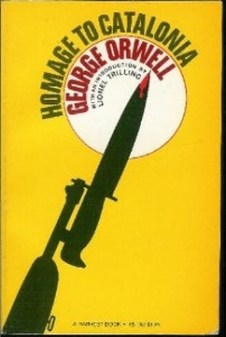
If you enjoyed this close reading of a poem, perhaps you would also like to read my thoughts on prose. I recently looked at the use of dark humor in George Orwell’s memoir Homage to Catalonia, which you can read here.

The Dark Comedy of George Orwell’s “Homage to Catalonia”

Until recently, if you had asked to me summarize the mood of George Orwell’s writings in one word, that word would be “terrifying.” In his two best-known works, Animal Farm (1945) and Nineteen Eighty-Four (1949),  Orwell’s depictions of totalitarian regimes are so plainly stated, with his prose possessing the bare minimum of ornament, that each spirit-crushing event in those novels comes across as inevitable. One leaves those books with a dull pain all around the heart, even if it’s accompanied by the urge to resist the coming catastrophe.

Homage to CataloniaRecently, though, I’ve started to revise that assessment, now that I’ve read through what is probably his third best-known book: Homage to Catalonia.

First published in the United Kingdom in 1938 and in the United States in 1952, Homage to Catalonia is Orwell’s personal account of his time spent fighting against the Fascists in the Spanish Civil War. Given the dire subject matter, I assumed that the mood of the work would match that of Animal Farm and Nineteen Eighty-Four. And indeed, Homage to Catalonia often leaves me despondent and feeling brutalized by the progress of history.

But it also shows, somehow, that Orwell is also quite adept at dark comedy.

I don’t want to say that Animal Farm and Nineteen Eighty-Four are entirely devoid of humor. The former in particular has some nice comical moments—I mean, it is a satire, after all. In particular, I’m thinking of Squealer’s justifications for the privileges the pigs seize for themselves, which read as though he’s crossed Pravda with Pangloss. But that humor takes place on the level of language; there’s not much humor on the level of situation. And, one may ask, how can there be? Those situations are rather deathly.

Yet in Homage to Catalonia, Orwell finds exactly that: scenarios which, by their sheer absurdity, get the reader to chuckle, though perhaps with a deep, doubtful sigh right afterward. I first noticed this fairly early on, near the end of Chapter III, where Orwell recounts a few instances where, by carelessness or miscommunication, he and his comrades almost die from friendly fire. Each near-miss merits a muted trumpet in the mind’s ear. The last sentence of the chapter neatly summarizing things: “In this war everyone always did miss everyone else, when it was humanly possible” (p. 37).

Now, in a war narrative, the presence of dark comedy is not exactly a revelation; the literature of war is riddled with spots of black humor, with the jokes soldiers tell as temporary relief from the strain of duty. What makes Homage to Catalonia interesting, I think, is how it uses that humor for more than just comic relief or satiric commentary. These moments of dark comedy are pivotal to understanding Orwell’s personal journey in the book.

To that end, I’d like to look at a passage from near the midpoint of the work, just before the turning point of Orwell’s fortunes. In Chapter VII (or Chapter VI in later editions which turned Chapter V into Appendix I), Orwell recounts a significant military operation he participated in, a mission to attack and raid a Fascist redoubt as part of the effort to capture the city of Huesca. After Orwell’s party manages to break through, Orwell spots a “shadowy figure,” one of the Fascists, and gives chase:

I started after him, prodding my bayonet ineffectually into the darkness. As I rounded the corner of the hut I saw a man—I don’t know whether or not it was the same man I had seen before—fleeing up the communication-trench that led to the other Fascist position. I must have been very close to him, for I could see him clearly. He was bareheaded and seemed to have nothing on except a blanket which he was clutching round his shoulders. If I had fired I could have blown him to pieces. But for fear of shooting one another we had been ordered to use only bayonets once we were inside the parapet, and in any case I never even thought of firing. Instead, my mind leapt backwards twenty years, to our boxing instructor at school, showing me in vivid pantomime how he had bayoneted a Turk at the Dardanelles. I gripped my rifle by the small of the butt and lunged at the man’s back. He was just out my reach. Another lunge: still out of reach. And for a little distance we proceeded like this, he rushing up the trench and I after him on the ground above, prodding at his shoulder-blades and never quite getting there—a comic memory for me to look back upon, though I suppose it seemed less comic to him. (p. 92)

First, let’s consider this passage in isolation. Even if you don’t find this scene especially humorous, one can still see the elements of solid farce here: Orwell bumbling about with his bayonet, the possibility of mistaken identity, and the fact that the man Orwell is chasing “seemed to have nothing on except a blanket.” And the chase itself, with the two men running on different levels as Orwell keeps coming oh-so-close to stabbing his target, wouldn’t feel out of place is a silent slapstick movie. Throw on the understatement at the very end of the paragraph—no kidding “it seemed less comic” to fleeing Fascist—and the result is a sustained moment of comic relief. It’s the sort of anecdote one could whip out at a party without causing much consternation in the audience.

Within the context of the narrative as a whole, though, the humor of this passage is less relieving than it is deflating. On multiple occasions leading up to this sequence, Orwell states that one of his desires in fighting for the Republican side in the Spanish Civil War is to kill a Fascist. In Chapter IV, after he realizes that in his first three weeks in Catalonia he’s fired a grand total of three shots, he remarks: “They say it takes a thousand bullets to kill a man, and at this rate it would be twenty years before I killed my first Fascist” (p. 41). He’s less contemplative there than impatient, an impatience that reappears near the end of Chapter V/Appendix I: “When I joined the militia I had promised myself to kill one Fascist—after all, if each of us killed one they would soon be extinct—and I had killed nobody yet, had hardly had the chance to do so” (p.70).

So here finally comes Orwell’s chance to do his part in the anti-Fascist cause: no more waiting around in the trenches, no more risking enemy fire just to gather firewood. He’s part of an assault on a Fascist redoubt, he finds an enemy combatant ripe for the gutting…and it’s a guy who appears to be fleeing from him half-naked. I obviously can’t know how exactly Orwell envisioned his first chance to kill a Fascist, but I’m fairly certain that running around like a farmer chasing a fox off his property with a pitchfork was not part of the fantasy.

But that implication of the passage is merely disappointing. There’s another aspect to it that strikes me foreboding, perhaps even tragic. Up to this point, I haven’t touched on that peculiar flashback Orwell has before he begins his thrusting campaign in earnest, the one where he remembers his boxing teacher telling war stories. On first read-through, I wasn’t sure what to make of that little diversion, but after thinking through the context some more, I think I have an angle on it.

First, there’s something trivializing about that flashback. At the moment Orwell has a chance to capture some military glory, his thoughts turn not to, say, the heroes of ancient mythologies, or to some iconography from war propaganda, but rather to a memory of schooling. Instead of going high and noble, he turns low and common. Further, the flashback represents how most people encounter combat: in abstractions, either secondhand through testimony (the war story), or in ritualized, rule-bound contests (the boxing lesson).

Second, the boxing instructor’s war story, while framed as a personal triumph, comes in the context of ultimate failure. The instructor tells (or rather, pantomimes) of “how he had bayoneted a Turk at the Dardanelles,” referring to the Gallipoli Campaign of 1915-1916, which was a notable exercise in futility for the Allied forces in World War I. They spent almost a year attempting to seize control of the Dardanelles, the strategically-important strait connecting the Mediterranean to the Sea of Marmara, en route to capturing the Ottoman capital of Istanbul, before giving up after having gained virtually no ground following the landing at Gallipoli. One can see a parallel between Orwell’s situation and the instructor’s: while the raid on the Fascist redoubt is a minor success, the greater anti-Fascist cause will prove a bloody calamity.

Bringing up the Gallipoli campaign also highlights the tragicomic irony of war. As Paul Fussell writes in The Great War and Modern Memory, “Every war is ironic because every war is worse than expected” (p.7). The Gallipoli campaign was supposed to be easy—aren’t all such operations?—as the battle would be waged against Ottoman forces that UK leadership believed were wildly inferior to British might. The result was a costly, diseased-ridden quagmire. By the same token, Orwell enters the Spanish Civil War with such simple purpose: he’s going to kill a Fascist and help defeat Fascism. Only after living with the conflict for some time, after enduring the bitter cold nights and the injuries of war and the Communist Party’s sabotage of the anti-Fascist effort, does Orwell learn the complexity beneath that simple purpose.

It is not for nothing that Chapter VIII, a summary reflection following the successful raid on the Fascist redoubt, ends with the bleak sentiment: “And after that the trouble began” (p. 107). In the subsequent chapters, Orwell will live through the street-war for the Telephone Exchange in Barcelona, the suppression of the P.O.U.M. and the mass arrests of its members, and a bullet through his throat that almost robs him of the ability to speak.

Yet for how bleak this all sounds—and is—the mere presence of dark comedy in Homage to Catalonia suggests one final thing about Orwell’s work here: there is still room for hope. This isn’t Nineteen Eighty-Four, where one suspects Newspeak is a language incapable of intentional comedy as well as political dissent. That Orwell can find humor in such dire circumstances feels like a testament to human freedom. Indeed, while Orwell grows disillusioned with the Communist Party as an institution, his time spent in the P.O.U.M. camp makes his “desire to see Socialism established much more actual than it had been before” (p. 105). Even when the fight is hopeless, a cause may still be worth pursuing.

If you enjoyed this look into the literature of war, you may also be interested in my analysis of Thomas Moore’s Irish melody, “The Minstrel Boy.”

Thomas Moore’s “The Minstrel Boy”: An Analysis

Thomas Moore (1779-1852)In my A-Z Bookish Survey, I mentioned my current project of reading through Kathleen Hoagland’s anthology 1000 Years of Irish Poetry: The Gaelic and Anglo-Irish Poets from Pagan Times to the Present (Devin-Adair, 1947). Recently, I read through the book’s selection of Thomas Moore’s poetry, and though I had not heard the name, I discovered I was familiar with some his work. In popular culture, Moore’s most familiar piece is probably “Believe Me, if All Those Endearing Young Charms,” whose tune appears at the beginning of “Come On Eileen” by Dexys Midnight Runners and is part of a running gag used in Looney Tunes and Merrie Melodies shorts.

However, I found myself more drawn to a different Moore poem, “The Minstrel Boy,” a ballad recounting a young musician’s death in battle. Let’s take a close look at it, shall we?

“The Minstrel Boy”

The minstrel boy to the war is gone,
In the ranks of death you’ll find him,
His father’s sword he has girded on,
And his wild harp slung behind him.
“Land of Song!” said the warrior bard,
“Though all the world betrays thee,
One sword, at least, thy rights shall guard,
One faithful harp shall praise thee!”

The Minstrel fell!—but the foeman’s chain
Could not bring that proud soul under;
The harp he loved ne’er spoke again,
For he tore its chords asunder;
And said, “No chains shall sully thee,
Thou soul of love and bravery!
Thy songs were made for the pure and free,
They shall never sound in slavery!”

First, some context. Born in 1779, Thomas Moore came of age during a period of turmoil in Irish history. He was nineteen-years-old when the Irish Rebellion of 1798 broke out, and was friends with several prominent members of the Society of United Irishmen, such as Robert Emmet and Arthur O’Connor. Moore himself did not take part in the rebellion, instead focusing on his schooling and his literary pursuits.

However, as Kathleen Hoagland notes in the introduction to 1000 Years of Irish Poetry, “It has been the history of literature throughout the ages that in times of social, political, and national upheaval, of war and stress, new creative forces emerge” (p. xliii). Moore was no exception to this supposed trend, and in 1807—in the aftermath of the failed rebellion and the Acts of Union 1800, which brought Ireland into the United Kingdom—he began publishing his Irish Melodies, which, “in one respect at least, lifted the curtain of scorn by which all things native to Ireland were covered” (p. xliv).

“The Minstrel Boy” is one of those Irish Melodies, and it’s difficult not to see the lyrics as a response to the failed rebellion. The title figure calls his country “Land of Song,” which fits rather well with the conceit of Irish Melodies, and his primary instrument is a harp, which had long been a symbol of Ireland and was used in the United Irishmen’s iconography. That the minstrel boy destroys his harp before it falls into enemy hands is tragic, as it signifies a knowing surrender of Irish freedom, yet his final words to it are uplifting: that beautiful music so identified with his country “shall never sound in slavery.” Its return, the poem’s logic seems to imply, will signal the return of Irish liberty.

Granted, there is a metatextual irony here. The success of Moore’s lyrics meant that the music of Ireland, the sort the minstrel boy must mourn the loss of, gained its then-largest audience only after its homeland officially ceased to exist as an independent country. Perhaps we are better off seeing “The Minstrel Boy” as the voice of a subjugated people, rather than the clarion call of a nation. Or perhaps those final lines are not a statement of fact, but of intent—the people will make freedom theirs, and the harp shall be restored.

Beyond its stirring nationalist sentiment, I think “The Minstrel Boys” offers the reader some surprises in terms of form. Specifically, as the poem transitions from the first stanza to the second, it deviates from the established pattern of the ballad in some productive ways.

Now, in everyday usage, “ballad” generally refers to a melodic, slow-tempo song, usually about romantic love. (Back when I was an undergraduate instructor, this was the definition all my students immediately jumped to when I said the word.) However, in the context of literary history, a ballad is a narrative poem set to music, and often uses the structure of common meter: four-line stanzas (quatrains) that rhyme ABXB or ABAB and whose lines alternate between iambic tetrameter and iambic trimeter. For a concrete example, consider the first stanza of Emily Dickinson’s “[Because I could not stop for Death – ]”:

Because | I could | not stop | for Death 
He kind | ly stopped | for me
The Car | riage held | but just | Ourselves
And Im | mortal | ity.

In practice, ballads often stray from a strictly iambic rhythm, inserting extra unstressed syllables to give the piece a more galloping beat. However, the number of stresses in each line generally remains constant, which is why “common meter” is often called 4343. The first four lines of “The Minstrel Boy” demonstrate this nicely:

The min | strel boy | to the war | is gone,
In the ranks | of death | you’ll find | him,
His fath | er’s sword | he has gird | ed on,
And his wild | harp slung | behind | him.

Here we see that while Moore includes some anapests and weak endings, the total number of stresses follows that 4343 pattern. The one possible wobble is in line 4, as we would normally want to stress “harp,” but “wild” is easy enough to elide into one syllable, and so “harp” would be demoted to an unstressed syllable between “wild” and “slung.”

But in the second half of that first stanza, the meter gets trickier. Lines 5-6 scan normally, but lines 7-8 get complicated because of the typography. Without the italics, we’d scan those lines like so:

“One sword, | at least, | thy rights | shall guard,
One faith | ful harp | shall praise | thee!”

Indeed, Moore or his editors could have presented the lines with no annotations, and they’d be among the most regular lines in the poem. But the italics used for One at the start of each line require the reader to stress that word, which would bump the stress totals to 5 and 4, respectively. It might be possible, though unnatural, to demote “sword” to unstressed for purposes of scansion, but the polysyllabic “faithful” needs a stressed syllable, so line 8 is definitely overloaded.

I’ve written about this strategic over-stressing of lines before, when I analyzed Charlotte Smith’s “Written in the Church Yard at Middleton in Sussex,” but I think Moore’s poem offers an even more striking example of how it can be used effectively. Right as the speaker pledges his undying support for the cause, the line can no longer contain the emotion, and is instead overwhelmed with feeling.

And then—the come-down. The next stanza leaps, like all good ballads do, to the minstrel’s boys demise, and here the poem deviates from the established pattern in a different way. “The Minstrel fell” gets doubly punctuated, not only with an exclamation point, as might be expected, but also with a dash, which all but severs the line in two. It is the poem’s most dramatic pause, which only highlights the lack of a pause at the end of the line. Line 9 is the only instance of enjambment in “The Minstrel Boy,” the only place where the poem’s syntax overruns its lineation. As it happens, the image right before the line break is “the foeman’s chain,” which “Could not bring his proud soul under.” Forget about the minstrel’s soul—the oppressors can’t even hold down the verse!

What are your thoughts on Moore’s poem? Do you have any suggestions for other classic poems to tinker with? Let me know in the comments!

If you enjoyed this analysis of “The Minstrel Boy,” you may be interested in some of my other close readings. There’s the Charlotte Smith poem I linked above, or, for a slightly more recent post, a look at Walt Whitman’s “A Noiseless Patient Spider.”

The Hampden Horns: How Stephen King Finds the Uncomfortable in the Everyday

In an excerpt from America’s Dark Theologian: The Religious Imagination of Stephen King (NYU Press, 2018) recently reprinted over at Literary Hub, Douglas E. Cowan observes that King’s body of work, which encompasses a wide range of genres but not contemporary literary fiction, is often dismissed by the critical establishment a bit too easily. Setting aside simple matters of taste—critics are free not to enjoy King’s writing or his chosen genres—Cowan marvels that such critics don’t “seem to realize that many of King’s readers seek their escape in his sinister storyworlds precisely because of the plain, unremarkable, yet profoundly disturbing ‘us’ he presents.”

Let me begin with a confession: I’ve never read a Stephen King novel. He’s one of those writers I keep meaning to get to, and yet keep putting off. Still, I have little doubt regarding his ability to present the reader with a “plain, unremarkable, yet profoundly disturbing ‘us'” within the context of horror, fantasy, crime or what-have-you. Why? Because he manages to do just that in the one piece of his writing I have read, and that comes in the context of one of the most mundane subjects possible: youth baseball.

“Head Down,” originally published in the April 16, 1990 issue of The New Yorker (available, albeit paywalled, here) and later included in Nightmares and Dreamscapes (Viking, 1993), is an essay King wrote about the Bangor West Little League team—that is, his son’s team—which won the Maine state championship in 1989. It’s a well-written and empathetic piece about the 12-year-old boys who take the field and the middle-aged men who help organize the game. Indeed, as if to illustrate Cowan’s point about the reception of King’s work, when I mentioned “Head Down” to a former colleague a few weeks ago, he praised the essay and then cited it as evidence that King has “wasted his talent.”

So how does that haunting perceptiveness that Cowan finds in King’s work show up in an essay about middle-schoolers playing baseball?

Let’s set the scene.

Bangor West is on the road against Hampden, their arch-rival in the first half of the essay, the team they’ll later play against in the district final. It’s getting late in the game. Bangor West leads 2-0 in the fifth inning—Little League only plays six innings—when the wheels start coming off. Pitcher Matt Kinney hits a batter, and then second baseman Casey Kinney (no relation) boots what should be a double play ball, freezing up out of fear he’ll get stung in the face. The coaches try to calm the team down, but then this long passage happens:

Casey begins to relax, begins to get back into the game, and then, beyond the outfield fences, the Hampden Horns begin to blow. Some of them belong to late-model cars—Toyotas and Hondas and snappy little Dodge Colts with U.S. OUT OF CENTRAL AMERICA and SPLIT WOOD NOT ATOMS stickers on the bumpers. But most of the Hampden Horns reside within older cars and pick-up trucks. Many of the pick-ups have rusty doors, FM converters wired up beneath the dashboards, and Leer camper caps built over the truck beds. Who is inside these vehicles, blowing the horns? No one seems to know—not for sure. They are not the parents or relatives of the Hampden players; the parents and relatives (plus a generous complement of ice-cream-smeared little brothers and sisters) are filling the bleachers and lining the fence on the third-base side of the diamond, where the Hampden dugout is. They may be local guys just off work—guys who have stopped to watch some of the game before having a few brewskis at the VFW hall next door—or they may be the ghosts of Hampden Little Leaguers Past, hungry for that long-denied State Championship flag. It seems at least possible; there is something both eerie and inevitable about the Hampden Horns. They toot in harmony—high horns, low horns, a few foghorns powered by dying batteries. Several Bangor West players look uneasily back toward the sound.

For me, this paragraph is where “Head Down” goes from merely interesting to engrossing. Just considered in isolation, the prose here sparkles: the perfectly chosen details for the trucks, the dashed-off asides that stretch on and on, the question halfway through the reader didn’t know needed asking, etc. And to end the paragraph with the main kids looking on is just so ominous. If King applies this same level of craft to rabid dogs and rabid fans, then I want in.

The Hampden Horns, these mysterious and passionate fans, are a striking image in themselves, but when considered in context they approach the “profoundly disturbing.” After all, what kicks them into gear is a rally born of children suffering. There’s the hit batsman, which hurts the hitter’s body and the pitcher’s psyche, and the fielding error, which King describes as “an act of naked self-preservation.” The Hampden Horns sound like a fun group on paper, but are we comfortable with their antics when we know the source of inspiration? They’re really just an exaggerated example of how sports fandom works, right? I know the Yankees fan in me sure gets dark pleasure from watching that grounder skip beneath Bill Buckner’s glove.

What’s more, King doesn’t pass these people off as pure others. Their origins are unknown, sure, but King tries his best to imagine them within the local community, as familiar figures in an unfamiliar context. And the cultural signifiers he finds on their trucks are telling. The Hampden Horns are not reducible to a single stereotype, with the red-blooded sharing parking spaces with the latter-day hippies. Neither experiencing a war nor opposing it makes one immune to cheering children’s mistakes. The more I think about them, the more the Hampden Horns become both human, and menacing.

In sum: it may well be that Stephen King can find the uncomfortable aspects of humanity in a fantastical environment. But “Head Down” shows he’s capable of finding such darkness in the actual world as well.

If, instead of whetting your appetite for Stephen King, I’ve made you crave some more baseball writing, you may want to check out my recommended readings in sports literature, inspired by a short course I taught on the subject.

Voice-Over Narration in Book-to-Film Adaptations

As a companion to PBS’s ongoing The Great American Read project, video essayist Lindsay Ellis will be presenting a series of short videos on literary topics for PBS Digital Studios. The first such piece, released on June 4, covers the evergreen topic of book-to-film adaptations:

If Ellis’s video has a central thesis, it’s that “adaptation isn’t just about changing a story. It is translating the story to a totally different language: the language of film.” Literary language and film language have different sets of advantages and disadvantages that make translating a narrative from the one language to the other difficult. For instance, a film can rely on an actor’s delivery to elevate the dialogue, while a book can set its story wherever it wants to without regard to cost.

One of the most difficult aspects of literary language to translate to film, according to Ellis, is interior monologue. In fact, I’d say interior monologue is an aspect of text that doesn’t translate to film at all, at least not directly. It may perhaps be rendered as dialogue, or better yet, its tone and meaning may be implied through the actor’s performance, the cinematography, the editing, etc. But whenever the interior monologue is simply recited through voice-over narration, I start groaning, and think less of the film for effectively cheating.

The Picture of Dorian Gray filmAn aversion to such narration has been a feature of film criticism for some time now. James Agee, for example, shares his frustrations with the use of voice-over narration in book-to-film treatments in his March 10, 1945 column for The Nation, wherein he reviews an adaptation of Oscar Wilde’s The Picture of Dorian Gray (dir. Albert Lewin, 1945). Now, voice-over narration drove Agee up the wall regardless of context—see his writings on World War II propaganda films for more examples of that—but his remarks on Lewin’s film feel like the culmination of his bile towards this thoroughly uncinematic technique:

I wish somebody would take book lovers like Mr. Lewin aside and explain to them, once for all, that to read from the text of a novel—not to mention interior monologues—when people are performing on the screen, while it may elevate the literary tone of the production, which I doubt, certainly and inescapably plays hell with it as a movie…I can understand least of all why Mr. Lewin and his associates passed up the best movie chance of all: to let the portrait change before your eyes, rather than bringing it on, changed, at set intervals.

In Agee’s view, films like Lewin’s err in using film as a medium for delivering a novel’s text, when they should be using the text as inspiration for playing with and advancing the emerging art of cinema. Case in point: perhaps rendering the portrait’s transformation in a convincing fashion would have been difficult given the film techniques available in 1945, but that is the very challenge a filmmaker should embrace when adapting such a story.

(A brief aside: Agee also identified the slavish recital of a novel’s words with the moralist’s preference for movies that are good-for-you rather than good. In a later column—September 14, 1946—he imagined that such people would love nothing more than “a good faithful adaptation of Adam Beade in sepia, with the entire text read offscreen by Herbert Marshall.” This is, of course, of no relevance to the discussion currently at hand; I just find that quote amusing.)

My Sister's Keeper filmOn a personal level, I can think of no more infuriating an example of a film abusing voice-over narration than My Sister’s Keeper (dir. Nick Cassavetes, 2009), based on Jodi Picoult’s novel of the same name. Cassavetes’s film not only inserts narration where it is not welcome, getting in the way of the actors’ attempts to convey the family’s many crises, but also early on attempts to simulate the novel’s use of multiple perspectives by just throwing establishing text with a character’s name onto the screen, before abruptly giving up on the idea about a third of the way through. Blessedly, when I saw the film in theaters, the sound at our screening was inaudible for the first few minutes, so I at least was spared the verbatim recitation of the novel’s prologue. (My poor grandmother thought she had finally gone deaf.)

Near the end of the video, Ellis notes that when reading a book, “your brain is essentially acting as director, casting agent, cinematographer.” This fact, as Ellis says, explains why any adaptation tends to prove disappointing—the filmmaker’s vision almost certainly differs a great deal from yours—but I think it also explains why the use of voice-over narration bothers me so. Just as readers exercise a large amount of control over their mental image of a novel’s events, filmmakers adapting novels for the screen have a large amount of control over their final products. To include voice-over narration of a book’s internal monologue is an artistic choice, sure. But I think it also represents a relinquishing of power back to the original author, an admission of defeat and a throwing up of hands. It’s the distressingly safe move.

One Flew Over the Cuckoo's Nest filmGranted, I’m also the sort of person who doesn’t place much value on an adaptation’s strict fidelity to the source material. For example, Ken Kesey’s 1962 novel One Flew Over the Cuckoo’s Nest is one of my all-time favorite reads, and Chief Bromden’s scattered yet illuminating narration is at the heart of my enjoyment of it. The film version (dir. Miloš Forman, 1975), as it happens, is one of my all-time favorite watches, and it not only ditches Chief Bromden’s narration, but also greatly reduces his role in the story; he goes from the co-protagonist to at most a side character. Yet because of the film’s strong performances, cinematography, décor, and score, I don’t mind that change, or any of the other myriad alterations, one bit.
What do you all think? Do recitations of internal monologues enrage you or enliven you? Are there examples of films that use their source materials’ internal monologues in interesting or productive ways? Let me know in the comments.

Walt Whitman’s “A Noiseless Patient Spider”: An Analysis

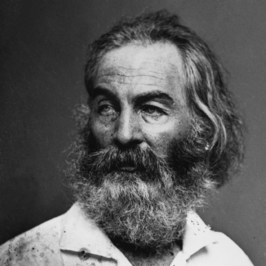
Walt WhitmanI’ve indirectly talked about Walt Whitman on this blog before, when I applied his introduction to the original, 1855 edition of Leaves of Grass to the 1938 film If I Were King. But I’ve never discussed any of his actual poetry. Much like John Dryden, the last poet whose work I analyzed, most of Whitman’s best-known poems are both long and dense. Think “Song of Myself” or “I Sing the Body Electric.” As such, he doesn’t lend himself to the casual blog treatment.

Still, I think it’s time I give this central figure in American verse his due. As such, let’s take a quick dive into one of his shorter gems, “A Noiseless Patient Spider.” The text is as follows:

A Noiseless Patient Spider

A noiseless patient spider,
I mark’d where on a little promontory it stood isolated,
Mark’d how to explore the vacant vast surrounding,
It launch’d forth filament, filament, filament, out of itself,
Ever unreeling them, ever tirelessly speeding them.

And you O my soul where you stand,
Surrounded, detached, in measureless oceans of space,
Ceaselessly musing, venturing, throwing, seeking the spheres to connect them,
Till the bridge you will need be form’d, till the ductile anchor hold,
Till the gossamer thread you fling catch somewhere, O my soul.

“A Noiseless Patient Spider” provides us with a perfect example of what’s called an emblem structure. A poem using an emblem structure builds an argument in two parts. In the first part, the speaker describes an object in some detail; in the second part, they reflect on the meaning, the significance, of that object. What starts out like a still life soon becomes a metaphor.

Now, unlike the octave-sestet structure of a Petrarchan sonnet, say, there’s no rule dictating where the shift in an emblematic poem will occur. However, in the case of Whitman’s poem, the two parts of the argument are very easy to spot. The first stanza gives us the description of the object (a spider spinning its web), and the second stanza gives us the speaker’s reflection on the object (how his soul is like the spider). The first lines of each stanza even act as signposts, introducing the subject of each stanza so the reader can track the speaker’s thought progression.

So how is the soul like the spider? Let’s look at how Whitman presents the spider. Before the creature even appears in the body of the poem, we learn that our subject is both “noiseless” and “patient,” which is a calming pair of adjectives, and though accurate, perhaps not the first things we think of when we hear “spider.” In the second line, the speaker gives us the spider’s situation: “on a little promontory it stood isolated.” There’s our starting premise: a spider, all alone, sitting calmly on the ledge.

From here, though, things start moving. Line 3 presents us with a syntactical ambiguity. “Mark’d how to explore the vacant vast surrounding” is parallel to the previous line, so we instinctively make the speaker the agent of everything in the phrase. In this case, that would mean the speaker is considering “how to explore the vacant vast surrounding.” But the subsequent line clarifies the agent here is the spider, not the speaker. The spider “launch’d forth filament” with goal of confronting the emptiness before it.

Whitman has put the still life into literal motion, and if line 5 is any indication, it’s a perpetual motion at that: “[e]ver unreeling…ever tirelessly speeding.” It’s also a motion the spider itself generates, for it launches the filament “out of itself.” Here we have all the material needed for a metaphor. All Whitman needs to do is to make the target of that metaphor explicit.

Indeed, the parallels between the first stanza spider and the second stanza soul are extensive. The “measureless oceans of space” that the speaker’s soul is “[s]urrounded, detached” within recall the “vacant vast surrounding” that the spider faced, as does “ceaselessly” bring us back to “tirelessly”: neither being’s efforts will end anytime soon. And of course, the soul’s actions are those of the spider as well. Just as the spider spews out its silk, the soul is always “musing, venturing, throwing, seeking the spheres to connect them.” The soul’s efforts are even likened to the spider’s material: it shoots out a “ductile anchor,” a “gossamer thread.” Just what the soul is seeking to achieve may be nebulous—and what great metaphysical mystery isn’t?—but we at least have a sense of what the soul’s actions are like. And that’s probably more than we could say going in.

Something else I’d highlight is how Whitman’s musicality perfectly reflects the actions of both the spider and the soul. Now, Whitman is of course famous as a pioneer in free verse, but free verse doesn’t reject meter, merely the rigidity of fixed forms. It embraces the flexibility of everyday speech while still elevating it to the level of verse.

Specifically, the first stanzas’s use of falling rhythms, of trochees (a stressed syllable followed by an unstressed syllable) and dactyls (a stressed syllable followed by two unstressed syllables), embodies how the spider must reach out into the unknown emptiness before it. The repetition of “filament,” of the spider’s instrument of exploration, is the most overt instance of this: “filament, | filament, | filament, | out of it | self.” But it continues into the subsequent line: “Ever un | reeling them, | ever | tire | lessly | speeding them.” The switch to trochees is a nice touch here, tightening the rhythm right at that most determined phrase: “ever tirelessly.”

As an exercise, you might go through the second stanza of the poem, and see if Whitman uses the same musical underscoring for the soul as he does for the spider. If so, then we have a consistent “pattern” (however unpatterned it actually is) for soundplay in the poem. If it’s different, what does that change tell us about how Whitman sees the soul in comparison to the spider?

What are your thoughts on “A Noiseless Patient Spider”? Feel free to share your opinions and analyses, or to suggest more classic poems to give this sort of treatment to, in the comments.

John Dryden’s “To the Memory of Mr. Oldham”: An Analysis

Kneller, Godfrey, 1646-1723; John Dryden (1631-1700), Playwright, Poet Laureate and CriticI’ve talked about John Dryden on this blog before, way back in 2016, in a look at his poem “Astræa Redux.” But for today, I’m not interested in 17th-century English politics or lovely descriptions of Dover’s cliffs. Nor am I interested in tackling any of Dryden’s extended satires and allegories—no point trying to condense “Absalom and Achitophel” into a blog post. Instead, I’d like to highlight a short delight of his, one which I envy for its tight control of tone and language: “To the Memory of Mr. Oldham.”

The “Mr. Oldham” of the title refers to John Oldham, a 17th-century satirist whom Dryden greatly admired and who died in 1683 at the age of thirty. Published the following year, “To the Memory of Mr. Oldham” is both a tribute to a talent gone too soon and a showcase for Dryden’s own skills as a poet. Like a great number of Dryden’s poems, it’s written in heroic couplets: rhyming, self-contained and balanced pairs of iambic pentameter lines.

Let’s have a look at the text, shall we?

“To the Memory of Mr. Oldham”

Farewell, too little and too lately known,
Whom I began to think and call my own;
For sure our souls were near ally’d; and thine
Cast in the same poetic mould with mine.
One common note on either lyre did strike,
And knaves and fools we both abhorr’d alike:
To the same goal did both our studies drive,
The last set out the soonest did arrive.
Thus Nisus fell upon the slippery place
While his young friend perform’d and won the race.
O early ripe! to thy abundant store
What could advancing age have added more?
It might (what nature never gives the young)
Have taught the numbers of thy native tongue.
But satire needs not those, and wit will shine
Through the harsh cadence of a rugged line.
A noble error, and but seldom made,
When poets are by too much force betray’d.
Thy generous fruits, though gather’d ere their prime
Still showed a quickness; and maturing time
But mellows what we write to the dull sweets of rhyme.
Once more, hail and farewell; farewell thou young,
But ah too short, Marcellus of our tongue.
Thy brows with ivy, and with laurels bound;
But fate and gloomy night encompass thee around.

The great challenge Dryden faces in writing “To the Memory of Mr. Oldham” lies in its very concept: it is an elegy written to honor a satirist. The poem cannot be entirely mournful, as that would not fit the person of John Oldham. But it cannot be entirely playful, either; neither the dictates of the genre nor basic respect for the dead would allow for it. No, Dryden must balance these two disparate moods, which requires some finely-tuned craft.

One way Dryden successfully negotiates these mixed moods is through his choice of allusions. In lines 9-10, he invokes the friendship between Nisus and Euryalus, two figures who appear in Virgil’s Aeneid. Specifically, Dryden refers to an episode in Book V, a footrace that Nisus and Euryalus partake in during the funeral games for Anchises. The text of Dryden’s poem lays out a solemn treatment of the event: Nisus loses his footing (“fell upon the slippery place”), which allow Euryalus, who had been trailing, to come from behind and win. This is of course a parallel for the relationship between Oldham and Dryden: Oldham’s great satires predated Dryden’s, but Dryden lived longer and would achieve much greater fame (“The last set out the soonest did arrive”).

However, looking into the full context of the allusion reveals a comic, almost absurd dimension to it. Nisus doesn’t merely trip; he sets off a chain of events befitting a gross-out slapstick comedy, complete with animal viscera. I’ll quote the full sequence from Dryden’s own translation of the Aeneid, which he’d publish a full fourteen years after Oldham’s death:

Now, spent, the goal they almost reach at last,
When eager Nisus, hapless in his haste,
Slipp’d first, and, slipping, fell upon the plain,
Soak’d with the blood of oxen newly slain.
The careless victor had not mark’d his way;
But, treading where the treach’rous puddle lay,
His heels flew up; and on the grassy floor
He fell, besmear’d with blood and holy gore.
Not mindless, then, Euryalus, of thee,
Nor of the sacred bond of amity,
He strove th’ immediate rival’s hope to cross,
And caught the foot of Salius as he rose.
So Salius lay extended on the plain;
Euryalus springs out, the prize to gain,
And leaves the crowd: applauding peals attend
The victor to the goal, who vanquish’d by his friend. (5.426-441)

In other words: Nisus slips in a pool of sacrificial blood, getting absolutely soaked in it; then, he grabs the second-place runner, Salius, by the foot, so that his good friend Euryalus can cross the finish line first. Not the most dignified conclusion to a sporting event. One can see why Dryden would leave out certain parts of that anecdote in his elegiac poem, at least explicitly. But the context for the allusion is still there, and the informed reader could get a little chuckle from that knowledge.

Beyond the content of the poem, Dryden also uses its form to balance its serious and comic aspects. After spending the first ten lines establishing the close connection he felt with Oldham, Dryden wonders what “could advancing have added more” to his friend (line 12). It’s at this point that Dryden brings up a common criticism of Oldham’s verse: it’s rough and lacking in polish. Dryden, though himself a paragon of Restoration sophistication, doesn’t hold Oldham’s rugged poetry against him—at least, not beyond some lighthearted ribbing.

That Oldham apparently required schooling in “the numbers of [his] native tongue” (i.e., the meter of English poetry) certainly sounds like a diss (14). And Dryden is more than capable of taking inferior poets to task; just read “Mac Flecknoe” for proof. But that one line is as pointed a Dryden’s pen gets. If anything, he is apologetic for Oldham’s technical deficiencies.

First off, the “native tongue” quip is preceded by the parenthetical qualifier, “(what nature never gives the young)” (13). Meter takes time to master, and Oldham alas was robbed of so much time. Second, Dryden insists that Oldham’s chosen field, satire, “needs not those” strictly metrical lines, and that “wit will shine / Through the harsh cadence of a rugged line” (15-16). Indeed, that line is self-demonstrating: leading with a two deviant metrical feet, full of sibilants, stops, and weak central vowels. It’s not quite Pope’s Essay on Criticism, but it’s still pretty clever. Finally, Dryden elevates Oldham’s esteem by tacking a swipe at their poetic rivals: rough meter is “a noble error” in a time “When poets are by too much force betray’d” (17-18).

Now, at this juncture, Dryden is at risk of drifting too far into satire. In a 25-line poem, there isn’t that much room for digressions on poetic fashions. This is why I find lines 18-21 so crucial in the poem’s overall construction. On a formal level, these lines bear all the marks of a turning point in a poem of heroic couplets: a triplet rhyme ending with an alexandrine (i.e., a line of iambic hexameter). On a content level, these lines return our attention to Oldham himself, to his “generous fruits…gathered ere their prime”. Those poems Oldham wrote, Dryden says, “showed a quickness,” one which “maturing time” may not have aided, for it “mellows what we write to the dull sweets of rhyme.”

Yet this is the exact moment the poem itself “mellows,” use the “dull sweets” of the triplet and the extra foot of the alexandrine to slow the pace, to wind the reader down into an appropriately reflective mood. From this point on, the satirical aspects of the poem recede, giving ground entirely to elegy. Dryden goes on to call Oldham the “Marcellus of our tongue” (referring to the great but short-lived Roman general), bestowing his spirit “with ivy, and with laurels,” while the reality of death, “fate and gloomy night,” “encompass” his friend (24-25). If the poem has lost some of the tonal complexity seen in the Nisus and Euryalus allusion or the riffs on numbers, it’s only because the world has lost, in Dryden’s eyes, an unappreciated source of humor.

What do you think of Dryden’s poem? If you have thoughts you’d like to share, or suggestions more classic poems to give the old close reading, let me know in the comments.

Charlotte Smith’s “Written in the Church Yard at Middleton in Sussex”: An Analysis

Charlotte SmithLet’s take a deep dive into a poem, shall we?

I first became aware of Charlotte Smith’s poetry during the first semester of my MFA, when, for reasons I won’t bore you with, I had to recite her “Ode to Death” for workshop. I distinctly remember its accepting attitude towards its subject—not quite Dickinson’s friendly relationship with it in “[Because I could not stop for death],” but still cordial, curious even.

Recently I decided to look through more of her work, and lo and behold, the first of her poems in The Norton Anthology of Poetry deals with a similar theme:

“Written in the Church Yard at Middleton in Sussex”

Pressed by the moon, mute arbitress of tides,
While the long equinox its power combines,
The sea no more its swelling surge confines,
But o’er the shrinking land sublimely rides.
The wild blast, rising from the western cave,
Drives the huge billows from their heaving bed,
Tears from their grassy tombs the village dead,
And breaks the silent sabbath of the grave.
With shells and seaweed mingled, on the shore
Lo! their bones whiten in the frequent wave;
But vain to them the winds and waters rave;
They hear the warring elements no more:
While I am doomed, by life’s long storm oppressed,
To gaze with envy on their gloomy rest.

There’s a lot we can, and will, talk about here, but this being a sonnet, why don’t we start with the turn in the final couplet?

The ending of this poem is somewhat odd, even unsettling. After three quatrains of detached observations of a coastal graveyard, the speaker turns to her own, morbid concerns: she is “doomed” to “envy…their gloomy rest.” Not only is this turn emotionally dispiriting, but it also seems to rest on a false premise: what “gloomy rest” is there in this graveyard?

In “The Sonnets of Charlotte Smith” (published in Critical Survey 4.1, pp. 9-21, 1992), Stella Brooks focuses on the poem’s diction to get to the heart of the apparent contradiction. Although the speaker

longs for their oblivion for herself…the preceding violation of the “silent sabbath” of the graves, the shock of the “village dead” being “torn” from their tombs by the “huge billows,” the “raving” of the “winds and waters” have suggested anything but the claimed oblivion; the graves have been disturbed, there is no “gloomy rest” for their inmates. (p. 14)

Of course, Brooks does not see this discrepancy between the speaker’s description of the graveyard and her interpretation of it as a flaw in the poem. Rather, that discrepancy is emblematic of a “turbulent Romantic fantasy” (p. 14). The speaker has a need to express her heightened emotions, in spite of the constraints placed upon her.

I’d like to push Brooks’ reading a bit further, for the poem strains against more than just the facts of the case. The formal elements of a poem, after all, are another kind of constraint. In case of this sonnet, elements that would ordinarily suggest calm and composure in fact hold back an uncontrolled force of emotion.

To start, let’s continue talking about endings: line-endings. A quick glance reveals that of the sonnet’s 14 lines, 13 of them end with some form of punctuation, from the brief pause of a comma to the heavy stop of a period. End-paused lines are famous for slowing the pace at which one reads a poem, as they represent both the end of a unit of syntax (a phrase or a clause) and a unit of verse (a line). Further, when end-paused lines occur with such regularity, they give the poem another measured music in addition to the meter (more on which later).

There’s only one line in Smith’s sonnet, line 9, which lacks end-pausing punctuation, and naturally this moment represents a turning point in the poem: “on the shore / Lo! their bones whiten”. It’s an awkward line-ending, as the next line all but starts with terminal punctuation, with that exclamation point coming just one syllable in. The poem’s rhythm staggers right as the speaker confronts the full extent of the graveyard’s damage. The speaker has mentioned how the sea has degraded the graveyard prior to this, but those descriptions tend towards abstraction: “village dead,” “the silent sabbath of the grave.” Here, though, death is rendered concrete: whitened bones “with shells and seaweed mingled.”

Now, line 9 may be the point where the poem’s composure completely dissolves, but Smith has been building up to this moment throughout the first two quatrains.  The apparent calm in the lead-up is illusory. For one thing, the sound-play in the first eight lines is incredibly emphatic. The first two rhymes are on the similar-sounding [aɪdz] (“tides”/”rides”) and [aɪnz] (“combines”/”confines”), with either sound amplifying the other. Internally, the lines are super-charged with repeated sounds: “Pressed”/”arbitress” and “moon”/”mute” in line 1, the double alliteration of “huge billows” and “heaving bed” in line 5, the sibilance of “breaks the silent sabbath” in line 8, and so forth.

It’s difficult to read this poem aloud without feeling a bit pompous, the sound-play is so heavy and the lines so measured. One imagines Smith declaiming this piece to the decay before her, arms raised to the heavens like a capital-R Romantic heroine, trying to convey her emotions to the spirits. But behind all that power, there’s also strain, and that strain comes through in the poem’s meter.

The first quatrain scans pretty regularly for a sonnet, with no line straying too far from iambic pentameter. Line 1 has an authoritative initial trochee (“Pressed by | the moon…”) and line 2 starts with a double iamb (“While the | loud e | quinox…”), but beyond those two substitutions, it’s four lines of forceful iambs. (Even if we give “power” its modern two-syllable scansion, the stresses stay on the same syllables in the line; the anapest changes very little.) What’s more, the stresses keeps accentuating words relating to strength: “pressed,” “loud,” “power” “swelling surge.”  If not for the rhyme, I could almost see King Lear reciting these lines on the stormy heath.

But the second quatrain does not scan so easily. Consider lines 5 and 6:

The wild blast, rising from the western cave,
Drives the huge billows from their heaving bed

Forcing these lines to fit the mold of iambic pentameter is a challenge. The mid-line comma and the possibility of pronouncing “wild” as two syllables suggest we scan the first three words as two iambs (“The wi | ld blast“). The rest of line 5, meanwhile, has a fairly intuitive cadence: “ris | ing from | the wes | tern cave.” Putting both parts together, though, we end up with six stresses instead of five. We can either demote “from” to an unstressed syllable, which maintains the semantic emphases but producing an ungainly scansion (“The wi | ld blastrising | from the wes|tern cave“), or we can elide “wild” into one syllable and demote either it or “blast,” which makes for a better-scanning line but is unsatisfying semantically. Who says “wild” or “blast” weakly?

Line 6 presents a similar problem, with a natural reading producing a six-stress line. Demoting “from,” as it did before, makes for an even worse scansion than before: “Drives the | huge bil | lows from | their hea | ving bed.” The other option, demoting “drives” or “huge,” as it did before, forces us to de-emphasize a strength-related word, exactly what the poem encouraged us to do in the first quatrain. Gone are the forceful declamations; uncertainty now reigns. The poem may get back on song in the next two lines, with just the initial trochee in line 7, but it does so just in time for the bodies to start surfacing.

All of the above may be interesting, but how does it factor in to the poem’s conclusion? Well, it justifies how the speaker could possibly see “gloomy rest” in this scene. The disturbed dead are numb to the chaos around them, unable “to hear the warring elements.” But more than that, the dead cannot think or feel, whereas the speaker is compelled to contemplate their fate, with all that loud language and emotion discussed above bouncing about in her head. The one thing someone in such a position could envy is quiet. But in the Romantic world of Smith’s poetry, that is impossible. The speaker can only “gaze with envy” at the possibility.

To end on a (slightly) cheerier note: Lit Brick has an amusing summation of the poem in webcomic form, so enjoy that!

What do you think of Smith’s sonnet? Have any suggestions for more classic poems to dissect? Feel free to share in the comments.