I haven’t done one of those book tags that make the rounds in a good long while, have I? (I haven’t done much of anything on this blog in a good long while, but that’s another story.) Today I’d like to fix that with a post inspired by the YouTube channel Jasmine’s Reads. Jasmine is one of my favorite presenters in the BookTube community, and seeing how she’s just unveiled her first book tag, I thought I’d do my (undoubtedly minuscule) part in spreading it.
It’s called the Literary Fiction Book Tag, and it’s precisely that: eight questions on the subject of literary fiction. I recommend watching the original video below if you’d like to get a sense of the tag’s purpose before diving in.
One confession before getting started: the prompts below all refer to “literary fiction novels,” but for some of my answers I’ve used high-concept short story collections instead, both because short stories could always use more love and because, after reflection, it turns out I read a lot fewer novels of recent vintage than I’d figured. With that out of the way…
#1: How do you define literary fiction?
I have two ways of defining “literary fiction,” and I shift back and forth between them depending on how cynical I happen to be feeling. The more cynical approach is to say that literary fiction is purely a marketing term, that it says nothing about the content of the work and everything about the sort of person that the publishing and book-selling industries think is likely to buy it. You can probably conjure the stereotype of someone who reads these sorts of books: college-educated, financially well-off, probably subscribes to the New York Times and supports their local NPR affiliate. In this view of the term, “literary fiction” is a signal to this demographic that they ought to read this particular book.
I think there’s a lot of truth to this perspective, especially in a world where books are commodities and not just works of aesthetic appreciation. But I can’t deny that, when I hear a book described as “literary fiction,” I do make certain assumptions about the book’s content. As I tend to think of genres as sets of audience expectations about a given work, it would be fair to say that literary fiction is a broad genre, one that’s closer to “young adult” than it is to “western” in terms of specificity. In her video, Jasmine lists off just about every element I’d anticipate: “social, political, or human commentary; introspective character exploration; not being focused or driven by plot; and also, a large focus on language.” So long as a work meets some of those criteria, one has grounds to place it into the genre of literary fiction.
You’ll note that these two definitions are not contradictory, and in fact may support each other. It could be the case that the supply of literary fiction creates its own demand, which in turn reinforces the industry’s decision to market books in such a way. Nothing wrong with shifting back and forth between definitions when they can coexist.
#2: Name a literary fiction novel with a brilliant character study.
Wonderful, Wonderful Times by Elfriede Jelinek
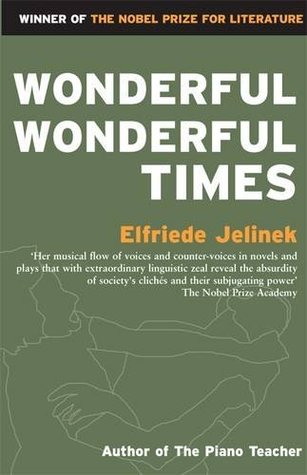
Wonderful, Wonderful Times follows four young adults in post-WWII Austria who are, by any objective account, monstrous. Their adolescent thrill-seeking takes the form of gratuitous violence, whether that means assaulting people in the park late at night or attempting to drown a cat to reenact a scene from Sartre. But while Jelinek is unrelenting in her depictions of moral rot, she still her has empathy for her creations. I’ve written about these characters before, so I won’t belabor the point here, but the longer the novel goes on, the more that Jelinek pricks at the façade that each of the young adults has constructed. We see, for instance, how Rainer’s obsession with existentialism covers for his own naivete, or how Sepp’s upbringing in a Communist household contextualizes his humiliating and combustible relationship with the aristocratic Sophie. The characters of Wonderful, Wonderful Times may be reprehensible at every turn, but their humanity still glows through all the grime.
#3: Name a literary fiction novel that has experimental or unique writing.
Sudden Death by Álvaro Enrigue
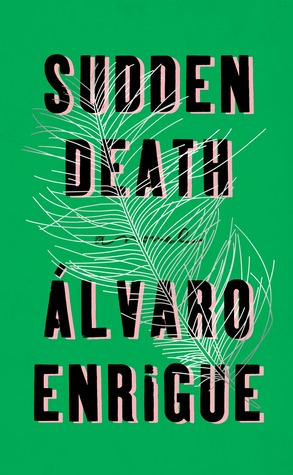
The short version: this book is about a tennis match, in which the Spanish poet Quevedo and the Italian painter Caravaggio trade points in what turns out to be a literal fight to the death. But reading this book bears no resemblance to reading a newspaper write-up of Wimbledon. In Sudden Death, Álvaro Enrigue intersperses his descriptions of rallies with histories of colonialism in the New World, excerpts from historical documents about tennis (both real and fictional), correspondence with his frustrated editor—just about everything that he can serve up. The result is a narrative that is, admittedly, very difficult to follow at times, but the whiplash between sections works surprisingly well in simulating the experience of playing tennis. Sudden Death also has a taste for the bizarre that keeps the novel from getting too self-serious; for instance, the ball that Quevedo and Caravaggio are playing with is made from Anne Boleyn’s hair, and how that ball came to be is a significant early through-line in the novel. This book may not be to everyone’s (anyone’s?) taste, but oh, am I glad that this sort of thing exists.
#4: Name a literary fiction novel with an interesting structure.
Public Library and Other Stories by Ali Smith

Public Library and Other Stories is really two books, which it alternates between. The one book is a fairly convention contemporary short story collection, albeit one with a notable fixation on literary history. The other book, though, is what makes this collection interesting to me. Ali Smith assembled this collection in response to the defunding and closing of libraries in the United Kingdom, and she includes numerous testimonials about the importance of libraries as community institutions. The testimonials not only work to justify public support for libraries, but also work to justify the rest of the collection. Remove all those heartfelt letters and Public Library and Other Stories looks like so much inside baseball, like an author flaunting their deep knowledge of the canon. With those letters, though, it becomes clear why all her literary references are so necessary: literature is embedded deeply into our lives. A world that devalues our storehouses of humanity’s literature must devalue humanity itself. Absent the structure that Smith uses here, I’m not sure the message would come across quite as well.
#5: Name a literary fiction novel that explores social themes.
The Amazing Adventures of Kavalier & Clay by Michael Chabon

Through 600+ pages of first-rate prose, Michael Chabon reveals the Golden Age of Comic Books to be fertile thematic ground for a novel. The Amazing Adventures of Kavalier & Clay follows the title duo of comic book creators across about fifteen years of inspiration and turmoil, touching on a number of social and political questions along the way. What is the value of escapist art in times of crisis? To what extent do capitalist enterprises enable the spread of political works, and to what extent to they stifle it? How do people with marginalized identities maintain their dignity in a world that deems them to be of lesser value? Read the book for the thrilling conclusion! (Sorry, couldn’t resist.) In addition to all these macro-level issues, Kavalier & Clay also finds time to explore more personal quandaries, from Clay’s relationship with his absent father to Kavalier’s devotion to a family facing certain death in Nazi-dominated Europe. This was one of the best books I read last year, and it gets richer and richer the more I think about it.
#6: Name a literary fiction novel that explores the human condition.
The Virgin Suicides by Jeffrey Eugenides

The Virgin Suicides is the story of two tragedies: one extraordinary, the other distressingly common. At the center of the novel are the Lisbon sisters, five isolated girls in suburban Michigan who all take their lives in the span of about a year. That’s the extraordinary tragedy. The distressingly common one comes through in the novel’s narration. In a style reminiscent of William Faulkner’s “A Rose for Emily,” The Virgin Suicides is told in a first-person plural POV, in the collective voice of the neighborhood boys who were obsessed with the Lisbon sisters. But for as authoritative as that POV sounds on the page, for as much information and documentation that the men marshal forth about the girls, it becomes clear by the novel’s end that they never actually understood them. Jeffrey Eugenides casts the narrators as so trapped in their own subjectivities, so caught up on their own perceptions of those mysterious Lisbon sisters, that they were incapable of providing what the girls most needed: somebody who would actually listen. The boys are the perfect embodiment of one of humanity’s most frustrating failures.
#7: Name a brilliant literary-hybrid genre novel.
The Circuit: Stories from the Life of a Migrant Child by Francisco Jiménez

A short story cycle based on Francisco Jiménez’s childhood, The Circuit: Stories from the Life of a Migrant Child follows Panchito, a fictionalized version of the author, as his family of migrant farmers from Mexico moves from town to town in California in search of work. The Circuit is the only book I know of that blurs the line between literary fiction and children’s literature. Jiménez’s language is unadorned and has repetitive quality that suggests a story told both about and by a child, yet the struggles Panchito’s family goes through are relayed with the quiet subtlety that one would expect in a work written for adults. This duality is reflected in the institutions that sell this book. The Circuit is published by the University of New Mexico Press, suggesting an academic audience, but it’s also available through Scholastic, the foremost publisher of children’s books in the United States. It’s designed to teach children empathy for people in Panchito’s position, but especially in today’s political context, this book has value for readers of any age.
#8: What genre do you wish was mixed with literary fiction more?
I’m going to co-sign Jasmine’s answer from the video above and say that literary fiction and fantasy could do with some more co-mingling, if only so I could have a go-to fantasy author not named Ursula K. Le Guin. In particular, I think that the two genres are simpatico in terms of finding language inherently pleasurable, rather than it just being a vehicle for telling the story. I’d love a literary fiction novel that is a fun to read, and to read aloud, as Sir Gawain and the Green Knight is in Middle English, with its wild alliterative meter and wildly complicated chivalric rituals. The challenge, of course, would come from reconciling fantasy’s emphasis on plot and lore with literary fiction’s indifference to those elements.
That wraps things up for me! If you’d like to jump in on this little survey and share your recommendations in literary fiction, then consider this an invitation. Thanks to Jasmine for concocting this tag, and thanks to you for time in reading this. Take care!
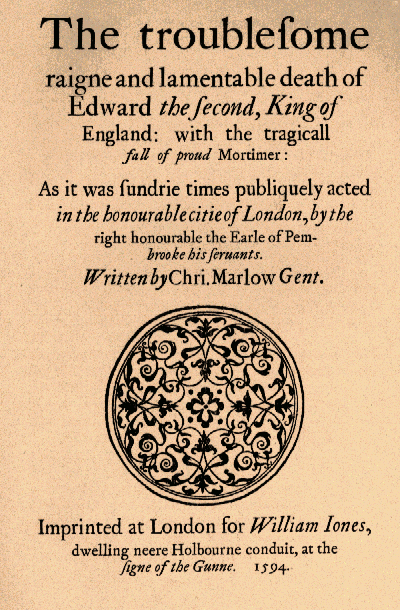 English classes have an odd relationship with early-modern English drama. Shakespeare is all but mandatory as part of the curriculum, but his contemporaries hardly get mentioned, let alone read: none of Ben Jonson’s intricate city comedies, none of Thomas Middleton’s tragic bloodbaths. But I feel Shakespeare’s dominance is especially a shame when it comes to Christopher Marlowe, whose work not only influenced the Bard’s but also matches it in pure, visceral pleasure. Marlowe’s characters are larger than life, always scheming, and elicit viewer sympathy despite their many, many vices.
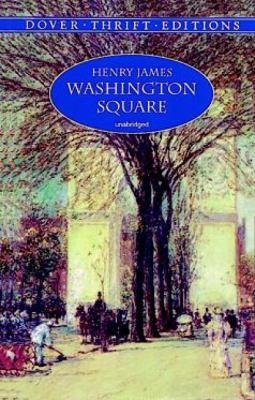 There are some writers whose works, while critically lauded and oft-studied at the university level, rarely make their way onto high school reading lists because of their perceived difficulty. I’m thinking of authors such as William Faulkner, Virginia Woolf, and the dean of this odd school, Henry James. Untangling James’s syntax is a true challenge that every student of literature must eventually face, but Washington Square is an exception in his bibliography. Indeed, it reads less like James and more like that mainstay of English classes, Jane Austen. (Apparently this was much to James’s chagrin, but what does he know?)
 One of the best literature courses I took as an undergraduate was called Capital Fictions, which was an exploration of economic themes in late 19th- and early 20th-century American literature. I was tempted to try shoehorning half the syllabus onto this list—ooh, people should actually read The Jungle! ooh, McTeague is a masterpiece of literary naturalism! ooh, “The Tenth of January” is a fantastic short story!—but in the end, I exercised something resembling disciplined and settled on the one book that I found the most eye-opening.
 Don DeLillo writes the accessible sort of “weird” books that I’m certain would have totally blown my mind when I was in high school. White Noise isn’t “funny,” exactly, but there’s a lot in the book to quietly snort at, and unlike, for instance, Thomas Pynchon’s The Crying of Lot 49, one doesn’t need to be well versed in Jacobean revenge tragedies to get the joke. The fact that the protagonist, Jack Gladney, is a leading scholar of Hitler studies (snort) who doesn’t speak a lick of German (snort) is amusing no matter one’s stage of cultural awareness.
 Poetry tends to get short shrift in English classes, with maybe a few weeks dedicated to the entire tradition. A Brit lit class might touch on the Romantics, an American lit class on Whitman and Dickinson, but not much beyond that. Still, most students graduate with at least some understanding of what a sonnet is, or at least an understanding that they exist and that Shakespeare wrote a whole bunch of them. The sonnet has proven to be an enduring form, and if anyone’s work demonstrates the power of a well-turned sonnet, then it’s Edna St. Vincent Millay.
 Of course, what high school English classes really need is more contemporary poetry, and by “contemporary,” I mean “anyone after Robert Frost.” Students come away from their secondary education with the notion that poetry is a dead art that only deals with archaic subject matter and must sound like the mad ravings of a pantalooned troubadour. And, to be sure, a lot of contemporary poetry is unintelligible to the uninitiated reader. But just as much is plain-spoken, personal, and relevant to the world outside academia, like the work of Yusef Komunyakaa.
 To round out this accidental trio of poetry collections, here’s a book that straddles the line between Millay’s formalist magic and Komunyakaa’s deeply detailed free verse. Rita Dove’s Mother Love is a long sequence of loose sonnets, and part of the fun of reading it is figuring out which aspects of the tradition (length, rhyme, meter, subject, volta) is Dove employing in a given poem and which she is ignoring. In purely practical terms, it’s a great way to gauge students’ understanding of the tradition’s formal requirements.
 When I was first composing this list, I thought about including some more works of history, such as Stephen Schlesinger and Stephen Kinzer’s Bitter Fruit or John W. Dower’s Embracing Defeat. But while books like those cover topics which often go undiscussed in high school history classes (the CIA-backed coup in Guatemala, post-WWII Japan), as texts they tend to be dry and rather conventional. The material that these writers tackle is vital to understand, but their particular expression is not necessarily as compelling.
 Before, I said that poetry needed more presence in high school curricula, but short stories could probably make the same claim. At least in my experience, short stories were either used as supplementary material for a novel (like reading Kate Chopin’s “The Story of an Hour” alongside The Awakening), or as a means of chewing up class time after hitting all the syllabus material. And as for contemporary short stories, the sort that would fill out an issue of The New Yorker, well, those simply didn’t exist; I didn’t realize people still wrote short stories until undergrad. So why not at least give students some Alice Munro to chew over?
 I fear this list has become too academic, so let’s close things out with a book that’s a bit more fun. I’ve raved about Brenda Shaughnessy a couple of times on this blog before (e.g.,
  Michael Mingo's Blog