Percy Bysshe Shelley’s “Ozymandias”: An Analysis

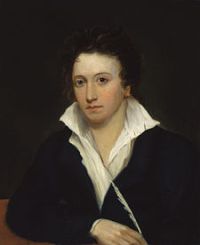
Percy Bysshe ShelleyThis month’s poem analysis is a first for the blog: a reader suggestion! In the comments section for my post on Charlotte Smith’s “Written in the Church Yard at Middleton in Sussex” (which you can read here), Elizabeth of Serial Outlet recommended that I take a look at an English class staple: Percy Bysshe Shelley’s “Ozymandias.” About four months later, and here we are!

I’ve put off diving into this particular poem for two reasons. First, having just covered a sonnet by a Romantic-era poet when I got the suggestion, I didn’t want to pigeonhole myself right out of the gate as someone stuck in that style and time period. Second, and more importantly, I felt a bit overwhelmed by the task. Of all the poem’s I’ve given the close reading treatment, “Ozymandias” is by the far the most famous. People who haven’t read a poem in decades remember this one from high school. As such, while I let the poem stew in my mind, I felt some pressure to do the work justice, to contribute something of value to the conversation surrounding it.

Granted, the way this essay is headed, that pressure may have been misplaced. Let’s jump right in, shall we?

Ozymandias

I met a traveler from an antique land
Who said: Two vast and trunkless legs of stone
Stand in the desert . . . Near them, on the sand,
Half sunk, a shattered visage lies, whose frown,
And wrinkled lip, and sneer of cold command
Tell that its sculptor well those passions read
Which yet survive, stamped on these lifeless things,
The hand that mocked them, and the heart that fed:
And on the pedestal these words appear:
“My name is Ozymandias, king of kings:
Look on my works, ye mighty, and despair!”
Nothing beside remains. Round the decay
Of that colossal wreck, boundless and bare
The lone and level sands stretch far away.

At first glance, this looks like a straightforward account of hubris. The statue of Ozymandias (i.e., Ramesses II of ancient Egypt) boasts of the pharaoh’s grand works, all of which now lie in ruin. Even the highest among us are not immune to the ravages of time; we all are bound to erode into “lone and level sands” (line 14). A simple message, albeit very grandly stated. But I think the poem has more on its mind than that, and it might help to start with how the poem’s account is presented.

Let’s begin by taking the text of the poem as a self-contained unit, like we’ve found it on an ancient sheet of papyrus with no context to guide us. The first word of the poem, “I,” presents us with the voice of some unknown first-person speaker, suggesting that what follows is some personal testament. Having implicitly introduced themselves, the speaker then begins narrating their experience, of how they “met a traveler from an antique land” (line 1). This sounds like the set-up for a story, but this already is the end of the story-present narrative.

In the second line, the poem then shifts into the voice of the traveler, as the first-person speaker relates their description of the sculpture—a description which comprises the remainder of the poem. There is some ambiguity as to whether the description is a direct quotation or a paraphrase, as it lacks the quotation marks which will later bound the inscription, but even in the latter case the speaker’s own voice would be sublimated to the traveler’s original account.

This account then continues uninterrupted up through line 9, at which point the traveler inserts a signal phrase, drawing attention to the coming second shift in perspective: “And on the pedestal these words appear”. It is here that the ruins speak, issuing their challenge to all who behold them. Once the inscription is recited, the poem shifts back into the voice of the traveler, who carries the poem to its conclusion.

But arguably, we are not done breaking down the rhetorical nesting here. On a meta level, we know that the poem is work of one particular author, Shelley, who per traditional analysis of poetry is a separate entity from the first-person speaker. On a diegetic level, we know that the statue of Ozymandias has an artist, who gave the the statue its inscription. And on a speculative level, Ozymandias is unlikely to have made the statue himself; he may have commissioned it, or the artist may adopted the pharaoh’s persona for the inscription.

So to summarize, here’s how deeply this 14-line poem embeds its story:

  1. It is the work of Percy Bysshe Shelley, who in writing it…
  2. …adopts the voice of a lyrical, first-person speaker, who then…
  3. …tells the audience an account he that heard from the traveler, who in turn…
  4. …quotes a statue’s inscription, which…
  5. …was the product of an unknown artist, who finally…
  6. …adopts or quotes the voice of Ozymandias.

That’s six levels of abstraction that Shelley’s poem presents the reader with. I don’t know about you, but that seems like a long way to go just point out the hubris of world leaders. So why bother with all that embedding?

You’ll notice that two of the voices involved in the poem are those of artists: Shelley (the flesh-and-blood person) and whoever sculpted the statue of the Ozymandias. If there’s one group of people that spend more time thinking about their legacies than do pharaohs, then it’s artists. A common sentiment that one finds in poetry about art is the notion that art grants one a kind of immortality. Even after one dies, the thinking goes, their works will outlast them and carry their spirit through the ages.

As “Ozymandias” reminds us, however, this notion borders on wishful thinking. We don’t know the artist behind the sculpture here, and we had to engage in some diegetic speculation to realize that such a person even existed. And their work’s existence is just as tenuous. Now reduced to “vast and trunkless legs of stone” (line 2), “a shattered visage” (line 4), and a pedestal, the statue is only a few steps removed from complete destruction. This is hardly a unique phenomenon: Paintings are lost and damaged, cathedrals crumble from neglect, and sculptures of kings wither in the elements.

One might think that poetry, which is not so tied to the fragile physical world, would be better suited for immortality than the plastic arts. We cannot commit a sculpture to memory, but we can do so with a poem. And this possibility is where I find “Ozymandias” most intriguing.

As mentioned in my throat-clearing introduction above, “Ozymandias” is a sonnet, albeit one with an unconventional rhyme scheme (ababacdcedefef). More so than any other form of poetry, sonnets often concern themselves with the possibility of immortality through art. This is especially true when it comes to romantic love, as the speaker will often promise the object of their affections, whose beauty will naturally fade with time, the chance to live forever in their poetry. A good example, which I will quote in full because of some similarities with “Ozymandias” in terms of imagery, is Edmund Spenser’s Amoretti LXXV (archaic spellings preserved):

Amoretti LXXV

One day I wrote her name upon the strand,
But came the waves and washèd it away:
Agayne I wrote it with a second hand,
But came the tyde, and made my paynes his pray.
Vayne man, sayd she, that doest in vaine assay,
A mortall thing so to immortalize,
For I my selve shall lyke to this decay,
And eek my name bee wypèd out lykewize.”
Not so, (quod I) let baser things devize
To dy in dust, but you shall live by fame:
My verse your vertues rare shall eternize,
And in the hevens wryte your glorious name:
Where whenas death shall all the world subdew,
Our love shall live, and later life renew.”

Spenser’s sonnet is a compelling digression here, because while the poet’s optimism gets the last word, the brief glimpse of the physical world that we’re presented with seems to support the beloved’s skeptical position. If we see how the ocean keeps wrecking the poet’s inscription on the sand, who is to say that a fire or a bookworm might not do the same to an inscription in parchment?

I get the sense that Shelley’s poem would side with Spenser’s beloved on the matter, as it too presents us with a world too fragile for much to persevere. One might suggest that the oral tradition will protect the work from decay. After all, the statue in some sense has survived the six levels of abstraction outlined above. But what, exactly, has survived that process? Certainly not the empire-building magnificence the statue was meant to project. And if Shelley were to recite this poem to us in conversation, which part would we ultimately take away and tell to others: the whole text, the traveler’s account, or the inscription? Even that which survives is prone to mutation through repeated tellings.

“Ozymandias” is not the only sonnet uncertain about the form’s traditional stance on immortality through art—Shakespeare’s Sonnet LXV (“[Since brass, nor stone, nor earth, nor boundless sea]”) is also uneasy on the matter—but I can’t think of many others which make such a depressing case with such verve.

And we must conclude with the unavoidable irony: this poem, which is about what doesn’t survive through the centuries, has in fact survived for two centuries. So far. Knock on wood.

There’s my take. But what are all your thoughts on the poem? If, like Elizabeth, you have a suggestion for a future deep dive, then let me know in the comments!

If you enjoyed this close reading of a poem, perhaps you would also like to read my thoughts on prose. I recently looked at the use of dark humor in George Orwell’s memoir Homage to Catalonia, which you can read here.

Thomas Moore’s “The Minstrel Boy”: An Analysis

Thomas Moore (1779-1852)In my A-Z Bookish Survey, I mentioned my current project of reading through Kathleen Hoagland’s anthology 1000 Years of Irish Poetry: The Gaelic and Anglo-Irish Poets from Pagan Times to the Present (Devin-Adair, 1947). Recently, I read through the book’s selection of Thomas Moore’s poetry, and though I had not heard the name, I discovered I was familiar with some his work. In popular culture, Moore’s most familiar piece is probably “Believe Me, if All Those Endearing Young Charms,” whose tune appears at the beginning of “Come On Eileen” by Dexys Midnight Runners and is part of a running gag used in Looney Tunes and Merrie Melodies shorts.

However, I found myself more drawn to a different Moore poem, “The Minstrel Boy,” a ballad recounting a young musician’s death in battle. Let’s take a close look at it, shall we?

“The Minstrel Boy”

The minstrel boy to the war is gone,
In the ranks of death you’ll find him,
His father’s sword he has girded on,
And his wild harp slung behind him.
“Land of Song!” said the warrior bard,
“Though all the world betrays thee,
One sword, at least, thy rights shall guard,
One faithful harp shall praise thee!”

The Minstrel fell!—but the foeman’s chain
Could not bring that proud soul under;
The harp he loved ne’er spoke again,
For he tore its chords asunder;
And said, “No chains shall sully thee,
Thou soul of love and bravery!
Thy songs were made for the pure and free,
They shall never sound in slavery!”

First, some context. Born in 1779, Thomas Moore came of age during a period of turmoil in Irish history. He was nineteen-years-old when the Irish Rebellion of 1798 broke out, and was friends with several prominent members of the Society of United Irishmen, such as Robert Emmet and Arthur O’Connor. Moore himself did not take part in the rebellion, instead focusing on his schooling and his literary pursuits.

However, as Kathleen Hoagland notes in the introduction to 1000 Years of Irish Poetry, “It has been the history of literature throughout the ages that in times of social, political, and national upheaval, of war and stress, new creative forces emerge” (p. xliii). Moore was no exception to this supposed trend, and in 1807—in the aftermath of the failed rebellion and the Acts of Union 1800, which brought Ireland into the United Kingdom—he began publishing his Irish Melodies, which, “in one respect at least, lifted the curtain of scorn by which all things native to Ireland were covered” (p. xliv).

“The Minstrel Boy” is one of those Irish Melodies, and it’s difficult not to see the lyrics as a response to the failed rebellion. The title figure calls his country “Land of Song,” which fits rather well with the conceit of Irish Melodies, and his primary instrument is a harp, which had long been a symbol of Ireland and was used in the United Irishmen’s iconography. That the minstrel boy destroys his harp before it falls into enemy hands is tragic, as it signifies a knowing surrender of Irish freedom, yet his final words to it are uplifting: that beautiful music so identified with his country “shall never sound in slavery.” Its return, the poem’s logic seems to imply, will signal the return of Irish liberty.

Granted, there is a metatextual irony here. The success of Moore’s lyrics meant that the music of Ireland, the sort the minstrel boy must mourn the loss of, gained its then-largest audience only after its homeland officially ceased to exist as an independent country. Perhaps we are better off seeing “The Minstrel Boy” as the voice of a subjugated people, rather than the clarion call of a nation. Or perhaps those final lines are not a statement of fact, but of intent—the people will make freedom theirs, and the harp shall be restored.

Beyond its stirring nationalist sentiment, I think “The Minstrel Boys” offers the reader some surprises in terms of form. Specifically, as the poem transitions from the first stanza to the second, it deviates from the established pattern of the ballad in some productive ways.

Now, in everyday usage, “ballad” generally refers to a melodic, slow-tempo song, usually about romantic love. (Back when I was an undergraduate instructor, this was the definition all my students immediately jumped to when I said the word.) However, in the context of literary history, a ballad is a narrative poem set to music, and often uses the structure of common meter: four-line stanzas (quatrains) that rhyme ABXB or ABAB and whose lines alternate between iambic tetrameter and iambic trimeter. For a concrete example, consider the first stanza of Emily Dickinson’s “[Because I could not stop for Death – ]”:

Because | I could | not stop | for Death 
He kind | ly stopped | for me
The Car | riage held | but just | Ourselves
And Im | mortal | ity.

In practice, ballads often stray from a strictly iambic rhythm, inserting extra unstressed syllables to give the piece a more galloping beat. However, the number of stresses in each line generally remains constant, which is why “common meter” is often called 4343. The first four lines of “The Minstrel Boy” demonstrate this nicely:

The min | strel boy | to the war | is gone,
In the ranks | of death | you’ll find | him,
His fath | er’s sword | he has gird | ed on,
And his wild | harp slung | behind | him.

Here we see that while Moore includes some anapests and weak endings, the total number of stresses follows that 4343 pattern. The one possible wobble is in line 4, as we would normally want to stress “harp,” but “wild” is easy enough to elide into one syllable, and so “harp” would be demoted to an unstressed syllable between “wild” and “slung.”

But in the second half of that first stanza, the meter gets trickier. Lines 5-6 scan normally, but lines 7-8 get complicated because of the typography. Without the italics, we’d scan those lines like so:

“One sword, | at least, | thy rights | shall guard,
One faith | ful harp | shall praise | thee!”

Indeed, Moore or his editors could have presented the lines with no annotations, and they’d be among the most regular lines in the poem. But the italics used for One at the start of each line require the reader to stress that word, which would bump the stress totals to 5 and 4, respectively. It might be possible, though unnatural, to demote “sword” to unstressed for purposes of scansion, but the polysyllabic “faithful” needs a stressed syllable, so line 8 is definitely overloaded.

I’ve written about this strategic over-stressing of lines before, when I analyzed Charlotte Smith’s “Written in the Church Yard at Middleton in Sussex,” but I think Moore’s poem offers an even more striking example of how it can be used effectively. Right as the speaker pledges his undying support for the cause, the line can no longer contain the emotion, and is instead overwhelmed with feeling.

And then—the come-down. The next stanza leaps, like all good ballads do, to the minstrel’s boys demise, and here the poem deviates from the established pattern in a different way. “The Minstrel fell” gets doubly punctuated, not only with an exclamation point, as might be expected, but also with a dash, which all but severs the line in two. It is the poem’s most dramatic pause, which only highlights the lack of a pause at the end of the line. Line 9 is the only instance of enjambment in “The Minstrel Boy,” the only place where the poem’s syntax overruns its lineation. As it happens, the image right before the line break is “the foeman’s chain,” which “Could not bring his proud soul under.” Forget about the minstrel’s soul—the oppressors can’t even hold down the verse!

What are your thoughts on Moore’s poem? Do you have any suggestions for other classic poems to tinker with? Let me know in the comments!

If you enjoyed this analysis of “The Minstrel Boy,” you may be interested in some of my other close readings. There’s the Charlotte Smith poem I linked above, or, for a slightly more recent post, a look at Walt Whitman’s “A Noiseless Patient Spider.”

Recent Publication: Amsterdam Quarterly

I’m excited to announce that one of my poems, “Qualia,” is now available to read over at Amsterdam Quarterly, an online literary magazine based in the Netherlands. I’m really happy to see this particular poem get a home; it’s the first one in a long time where I just let myself cut loose with the sound and the subject.

Amsterdam Quarterly

Special thanks to editor Bryan Monte for selecting the poem and for keeping all the contributors up-to-date on the build-up to publication.

You can read “Qualia” at this link, and be sure to check out the other contributors’ works as well!

The A-Z Bookish Survey

Here’s a fun little survey of sorts that I discovered by way of Lauren Roland, the blogger behind Books are Only the Beginning, whose post you can read here. And you should read it: it’s fun, and I don’t think any of our answers overlap, so Lauren’s will be a different (and far less verbose) experience than mine.

Anyhow, that’s enough preamble. Onto the survey (which, for some reason, lacks prompts for the letters U and X. C’mon, mysterious originator of the meme…)!

*      *      *

Author You’ve Read the Most Books From

A while back, I wrote up a list of my Top 5 most-read authors, so if you want the full details, you can go check that out. The late Ursula K. Le Guin remains in the top slot, with nine books. I’m hoping to start soon on The Complete Orsinia (ed. Brian Attebery, Library of America, 2017), a collection of lesser-known stories and songs set in a fictional Central European country, so she may perhaps hit double-digits in the near future.

I try to enforce a degree of variety into my reading habits, so I have a rule about returning to favorite authors: after finishing a book by Author X, I must read 15 books by other writers before reading another of Author X’s works. I think that helps prevent particular writers’ styles from getting stale for me. Maybe the whirlwind digressions in Larry Levis’s poetry, for instance, would get tiresome if I binged through his bibliography one collection after another. Since I space these readings out over months if not years, each revisit feels refreshing.

Best Sequel Ever

I’ll be returning to this below, but I’m not one for book series. For one thing, most of my readings in the past few years have been in contemporary poetry collections, so the notion of a book series may as well be a foreign concept to me. For another, I find that my patience for serialized storytelling is quite thin. I’ll take the small, self-contained story of one-and-done most any day.

Still, I have in fact read sequels. And in terms of improvement over the previous volumes, a good marker of a sequel’s quality, it’s hard to think of a better example than Richard III. The final installment of Shakespeare’s minor tetralogy, the play comes on the heels of the trio of Henry VI plays, and the jump in quality is vast. The Henry VI plays are among Shakespeare’s first, and boy, does it show. The plotting is aimless, the verse stiff, and the characters forgettable. As I write this I literally can’t remember a single event from 3 Henry VI, beyond what I know happened historically. That’s a horrible sign.

But then the cycle comes alive in its fourth and final production. Richard III may not be peak Shakespeare (it’s way too long, and Shakespeare hasn’t figured out the right way to use ghosts yet), but the title character is a solid variant on the Marlovian over-reacher, a scheming and rhetorically dextrous villain who completely owns the stage every second of the play. A forum poster once likened watching such a character to watching a Godzilla movie, because who doesn’t want to witness all the destruction they’re going to bring? I like that reading. A lot.

Currently Reading

I’m working my way through three books at the moment:

  • 1000 Years of Irish Poetry: The Gaelic and Anglo-Irish Poets from Pagan Times to the Present, ed. Kathleen Hoagland (Devin-Adair, 1947)
  • Agee on Film, Vol. 1: Reviews and Comments by James Agee (Beacon, 1958)
  • The Ninth Hour by Alice McDermott (Farrar, Straus and Giroux, 2017)

I always have multiple books on my currently-reading shelf, just in case one of them starts to drag. Generally I try to pull from a variety of forms: a poetry collection, a work of fiction, a non-fiction book, etc. Given that poetry collections are often under 100 pages, I end up cycling books out of the poetry slot much quicker than I do for the prose slots.

Although, given the sheer length of 1000 Years of Irish Poetry, and my insistence on reading all poetry aloud, that one’s going to be on my currently-reading shelf for some time. Someone in my dad’s girlfriend’s family, who are all Irish, found the book at a yard sale and remembered that I liked poetry, so that was a thoughtful gift. I will say, reading the intro was a trip. The anthology is so old that 1) William Butler Yeats had only recently died, and 2) James Joyce was still considered a controversial writer in some academic circles.

The other two books I’ve obliquely mentioned on this blog before, so I won’t prattle on about them here. I quoted some of James Agee’s columns in The Nation for my discussion of voice-over in book-to-film adaptations, and I mentioned seeing Alice McDermott discuss The Ninth Hour at the National Book Festival in my write-up of the event.

Drink of Choice While Reading

I imagine the originator of this survey had something cozy and comforting in mind, some semi-obscure flavor of tea, say. Or if you would rather adopt a hipster level of self-conscious performance: absinthe. For me, though, a bottle of Coke will do just fine. It’s what I drink on most occasions regardless, over the well-founded advice of the dentist and my body’s sleep system.

E-reader or Physical Book

I remember this being a much more contentious discussion several years ago, when e-readers were first bursting onto the market. I really don’t have a preference between the two when it comes to works of prose. The portability and lower cost of e-books is about worth the subjective experience of holding a physical work in my hands, so the format matters very little.

Poetry is another discussion altogether: hard copy all the way. Back in 2011, I made the mistake of purchasing The Complete Works of W. B. Yeats as an e-book from Amazon, and the formatting was abysmal. Infuriating. A foul rag-and-bone shop. It was so difficult, if not at times impossible, to tell when a line broke because Yeats intended for a hard enjambment, and when it broke because the e-reader’s dimensions were too narrow to fit the line as written. Perhaps things have gotten better for poetry e-books since 2011, but I’d rather not get burned again. Give me the fixed arrangement of the page, thank you very much.

Fictional Character You Probably Would Have Actually Dated in High School

Me, dating in high school? Good one.

Glad You Gave This Book a Chance

This is a tough one for me to answer, because I take “giving a book a chance” to mean that I had negative expectations going in. Most books I read, especially poetry collections, I have no expectations when I start. I often just pull volumes semi-randomly from library shelves, just to overcome the weight of possibility overload. And when that’s not the case, I’m reading something that a friend or a critic has recommended, so there’s not much initial skepticism involved.

Looking over my “read” shelf on Goodreads (who needs a memory when we have social cataloging?), perhaps this one fits the spirit best: The War Is Over: Selected Poems by Evgeny Vinokurov (trans. Anthony Rudolf and Daniel Weissbort, International Writing Program, 1976). I found this volume secondhand, in a very coffee-stained quality, and had it not had the backing of the University of Iowa behind it, I’d have passed it over completely. (In fact, as of now I’m literally the only one on Goodreads to have rated the book.) It’s not a great volume, but I do admire Vinokurov’s poem “The Swans,” in which the speaker imagines birds emerging from his homework. “No one would ever guess they’d flown,” the final lines tell us, “From the pages of a mathematics textbook.” That sounds about true.

Hidden Gem Book

Again, a surprisingly difficult one to get a handle on. I suppose that, despite the reported growth in its readers of late, any contemporary poet not named Rupi Kaur would fit the bill. But most of my favorites, such as Brenda Shaughnessy and Andrew Hudgins, are somewhat sizeable names within the poetry community, so to call them “hidden gems” seems disingenuous.

If I have to stick my neck out on one hidden gem book, I’ll go with Labor by Jill Magi (Nightboat, 2014), a collection that blurs the lines between poetry, fiction, and archival employee handbook. It hooked me in a way that few works of that nature do, in part because its politics are simultaneously heartfelt and direct. I mean, the book is called Labor, after all. At the moment, it only has ten ratings on Goodreads, so I think that counts as obscure enough for present purposes.

Important Moment in Your Reading Life

After ninth-grade English, I’d convinced myself that I hated Shakespeare. We read Julius Caesar about halfway through the year, and the experience was beyond frustrating. Not because I couldn’t understand the text, but because I couldn’t see how anyone could enjoy the text. As it was taught, Julius Caesar was a series of literary devices stitched together: some anaphora there, a hamartia there, a few puns sprinkled in for flavor. Completely lost in all that: the intense personal and political drama of the story, and the aesthetic beauty of the language. You know, the parts that make Shakespeare transcendent instead of testable.

In tenth-grade, for reasons I can’t quite recall, I decided to give the Bard another go, and I picked up Hamlet. It was dense, certainly, but I powered through it, reading the text aloud just to get lost in the music of verse. (If you’re wondering where that insistence on reading poetry aloud that I mentioned above comes from, it’s here.) The tense atmosphere and Hamlet’s constant waffling drew me in, and the soliloquies were as gripping as I’d been promised. I don’t think a single work has changed my mind about an author so quickly as that first read-through of Hamlet did with the Bard.

Not long after I finished Act III or so, I had my wisdom teeth removed, and couldn’t speak clearly for about a week afterward. There were many problems with being in that state, of course, but the worst at the time? Having to postpone the play.

Seriously. If you haven’t read Hamlet, go read Hamlet. I made it unofficial homework in my sports literature class, for God’s sake.

Just Finished

The last book I polished off was Ms. Marvel Volume 3: Crushed (written primarily by G. Willow Wilson, Marvel, 2015). I liked it quite a bit, even if the trade’s last issue (S.H.I.E.L.D. #2) was a bit on the grossly absurd side: it involves monsters made of regurgitated pizza dough.

Ms. Marvel is a rarity for me: a comic book I’ve read outside of an academic context. I’m fairly certain that for more people, the exception and the rule would be reversed, but that’s me for you. My first semester of undergrad, my mandatory expository writing class was themed around whether comic books counted as art (answer: yes), so I’ve read an odd smattering of titles: some World War II propaganda, the last issue of Grant Morrison’s run on Animal Man, Art Spiegelman’s Maus, etc. And in another class, we were assigned a graphic novel adaptation of (no joke) the 9/11 Commission Report. But Ms. Marvel is the first comic series that I’ve read for fun. Knowing me I’ll never catch up, but that’s fine by me.

Kinds of Books You Won’t Read

Empirically, there are plenty of kinds of books that I don’t read. I haven’t read any romance novels, for example, or James Patterson-style thrillers. But I’m reluctant to categorically rule out a genre, both as a check on potential prejudices and as an admission that one’s tastes and identifications change over time.

That said: I’d probably rule out a book described as “New Age” or “spiritual.” At least at the moment, they about sound the opposite of my personality.

Longest Book You’ve Read

Having just said that: according to Goodreads, the longest book that I’ve read is the King James Bible, which comes in at around 1600 pages. I’m an atheist, but more importantly I love literature, and the Bible’s influence on Anglophone literature and the English language is, of course, enormous. Back in 2014 I made it a project to finish the KJV by the end of the year, which is manageable if you go 3-4 chapters per day.

I’d say the experience was worth it, although I’m not sure I’d recommend going to the Bible for an aesthetically complete experience. Books like Leviticus and Chronicles are famously dull, of course, but I’m also no fan of the Pauline epistles, which are also far too doctrine-heavy for my speed. But at the same, I still go back and read the parables, which remain masterworks of condensed, nuanced storytelling. How about a combined collection of Jesus’s parables and Aesop’s fables? That’d be subversively lovely.

Major Book Hangover Because of…

So, I had to look up what the phrase “book hangover” meant, and I can’t say I’ve experienced one. Perhaps I just have very fast book metabolism.

Number of Bookcases You Own

Me, owning furniture? Really, you ought to try stand-up.

One Book You Have Read Multiple Times

The last book that I reread was Life on Mars by Tracy K. Smith (Graywolf, 2011). It’s just a solid collection, and it demonstrates Smith’s comfort with both free verse and received forms. “Solstice,” for example, is a perfectly natural villanelle about reading the morning news. Actually, this book almost counts, in a spiritual sense, as a “Best Sequel.” My last semester of undergrad, we read two of Smith’s collections. First was Duende (Graywolf, 2007), which left me completely cold. Second was Life on Mars, which I fell in love with. Writing poems about David Bowie will make that happen, I suppose.

Preferred Place to Read

I can’t be there with any regularity, obviously, but I’ve realized my most productive reading comes on long distance trains, which is to say, Amtrak. I’m pretty sure I knocked out the entirety of Silas Marner that way. Not much else to say about that, so I’ll just note that the Amtrak magazine, The National, is actually quite entertaining. They even get major poets like Yusef Komunyakaa to contribute pieces to it.

Quote that Inspires You/Gives You All the Feels from a Book You’ve Read

I first came across Philip Larkin’s “Aubade” in his Collected Poems (ed. Anthony Thwaite, Farrar, Straus and Giroux, 2004), and the poem has haunted me since. In Larkin’s last masterpiece, he takes the poetic tradition of lovers parting at dawn and twists into a reflection on encroaching mortality. I once showed it to my students as an example of elegiac poetry, and the third stanza in particular caught everyone’s attention. I shall now quote that stanza in full:

This is a special way of being afraid
No trick dispels. Religion used to try,
That vast moth-eaten musical brocade
Created to pretend we never die,
And specious stuff that says No rational being
Can fear a thing it will not feel, not seeing
That this is what we fear—no sight, no sound,
No touch or taste or smell, nothing to think with,
Nothing to love or link with,
The anaesthetic from which none come round.

That last line hits me about as hard as Hamlet’s “The undiscover’d country from whose bourn / No traveller returns.”

Reading Regret

I desperately wish I had read more contemporary poetry—hell, even just post-WWII poetry—before I fancied that I could write any. I wish it hadn’t taken me until junior year of undergrad for Larry Levis to open my eyes to how poetry could be written. Not even how it should be written, just the possibility. Because where I came from at least, you’d think poetry ended with Robert Frost.

Series You Started and Need to Finish (All Books are Out in Series)

As mentioned above, I don’t generally go in for book series. But as with many things, Le Guin is someone I make exceptions for. Curiously, while I’ve read the entirety of her mid-2000s Annals of the Western Shore series, I’ve only read the first two books in her most famous world: Earthsea.

In my experience, at least, libraries are weird when it comes to the Earthsea books. Every one I’ve been to seems to have the later books in the series, but none of the original trilogy. You’d think it’d be the other way around. Hell, the reason I read Annals of the Western Shore in the first place was that my local library actually had all the books. Availability is  a limiting factor on what one can read, after all.

At a certain point, I’ll have to just buy The Farthest Shore and be done with it. I doubt it’ll fall into my lap, the way a cheapo paperback of The Tombs of Atuan did the one time I went to Caliban back in Pittsburgh.

Three of Your All-Time Favorite Books

This post is already short-story length, so I’m just going to list three without comment:

  • Bitter Fruit: The Story of the American Coup in Guatemala by Stephen Schlesinger and Stephen Kinzer (Harvard University Press, 1982)
  • M-80 by Jim Daniels (University of Pittsburgh Press, 1993)
  • One Flew Over the Cuckoo’s Nest by Ken Kesey (Viking, 1962)

Very Excited for This Release More than All the Others

Honestly, I don’t really look forward to releases. I’ll get to a book when I get to it.

Worst Bookish Habit

I am really bad about taking notes when reading, whether that means underlining passages, scribbling out marginalia, even just making note of page numbers. That’s come back to haunt when, say, writing posts for this blog. “Wait, when did Agee complain about voice-over again? Which one of these scores of columns was that? Was he talking about literary adaptations or war propaganda? Or was it both? Why didn’t you mark it down, past me?”

Your Latest Book Purchase

The last time I was back in the New Jersey hinterlands, after losing to my younger brother in a bowling series for the first time ever, I consoled myself by finally picking up a copy of John Hersey’s Hiroshima (Knopf, 1946). I’d been meaning to read this book ever since my first semester of undergrad. Remember that class where I had to read the 9/11 Commission Report rendered as a comic book? Well, we also covered By the Bomb’s Early Light: American Thought and Culture at the Dawn of the Atomic Age by Paul Boyer (University of North Carolina Press, 1985), which had a significant section on Hersey’s book. It’s less something I expect to be good, and more something I expect to be historically interesting.

Zzz-Snatcher Book (Last Book That Kept You Up Late)

Me, sleeping at a reasonable hour? You must understand the rule of three.

*      *      *

So there you have it! Hopefully some of that was interesting to you. Certainly much more interesting for me than the Great Alphabet Poem Fiasco. But that’s a story for another time. I’m practically at 3200 words here.

If you liked this, you may also like this similarly reflective, similarly scattershot post: Four Fragments on Nothing.

Walt Whitman’s “A Noiseless Patient Spider”: An Analysis

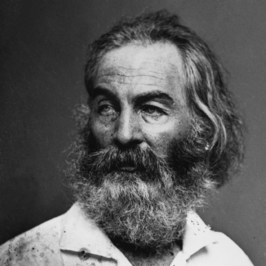
Walt WhitmanI’ve indirectly talked about Walt Whitman on this blog before, when I applied his introduction to the original, 1855 edition of Leaves of Grass to the 1938 film If I Were King. But I’ve never discussed any of his actual poetry. Much like John Dryden, the last poet whose work I analyzed, most of Whitman’s best-known poems are both long and dense. Think “Song of Myself” or “I Sing the Body Electric.” As such, he doesn’t lend himself to the casual blog treatment.
Still, I think it’s time I give this central figure in American verse his due. As such, let’s take a quick dive into one of his shorter gems, “A Noiseless Patient Spider.” The text is as follows:

A Noiseless Patient Spider

A noiseless patient spider,
I mark’d where on a little promontory it stood isolated,
Mark’d how to explore the vacant vast surrounding,
It launch’d forth filament, filament, filament, out of itself,
Ever unreeling them, ever tirelessly speeding them.

And you O my soul where you stand,
Surrounded, detached, in measureless oceans of space,
Ceaselessly musing, venturing, throwing, seeking the spheres to connect them,
Till the bridge you will need be form’d, till the ductile anchor hold,
Till the gossamer thread you fling catch somewhere, O my soul.

“A Noiseless Patient Spider” provides us with a perfect example of what’s called an emblem structure. A poem using an emblem structure builds an argument in two parts. In the first part, the speaker describes an object in some detail; in the second part, they reflect on the meaning, the significance, of that object. What starts out like a still life soon becomes a metaphor.

Now, unlike the octave-sestet structure of a Petrarchan sonnet, say, there’s no rule dictating where the shift in an emblematic poem will occur. However, in the case of Whitman’s poem, the two parts of the argument are very easy to spot. The first stanza gives us the description of the object (a spider spinning its web), and the second stanza gives us the speaker’s reflection on the object (how his soul is like the spider). The first lines of each stanza even act as signposts, introducing the subject of each stanza so the reader can track the speaker’s thought progression.

So how is the soul like the spider? Let’s look at how Whitman presents the spider. Before the creature even appears in the body of the poem, we learn that our subject is both “noiseless” and “patient,” which is a calming pair of adjectives, and though accurate, perhaps not the first things we think of when we hear “spider.” In the second line, the speaker gives us the spider’s situation: “on a little promontory it stood isolated.” There’s our starting premise: a spider, all alone, sitting calmly on the ledge.

From here, though, things start moving. Line 3 presents us with a syntactical ambiguity. “Mark’d how to explore the vacant vast surrounding” is parallel to the previous line, so we instinctively make the speaker the agent of everything in the phrase. In this case, that would mean the speaker is considering “how to explore the vacant vast surrounding.” But the subsequent line clarifies the agent here is the spider, not the speaker. The spider “launch’d forth filament” with goal of confronting the emptiness before it.

Whitman has put the still life into literal motion, and if line 5 is any indication, it’s a perpetual motion at that: “[e]ver unreeling…ever tirelessly speeding.” It’s also a motion the spider itself generates, for it launches the filament “out of itself.” Here we have all the material needed for a metaphor. All Whitman needs to do is to make the target of that metaphor explicit.

Indeed, the parallels between the first stanza spider and the second stanza soul are extensive. The “measureless oceans of space” that the speaker’s soul is “[s]urrounded, detached” within recall the “vacant vast surrounding” that the spider faced, as does “ceaselessly” bring us back to “tirelessly”: neither being’s efforts will end anytime soon. And of course, the soul’s actions are those of the spider as well. Just as the spider spews out its silk, the soul is always “musing, venturing, throwing, seeking the spheres to connect them.” The soul’s efforts are even likened to the spider’s material: it shoots out a “ductile anchor,” a “gossamer thread.” Just what the soul is seeking to achieve may be nebulous—and what great metaphysical mystery isn’t?—but we at least have a sense of what the soul’s actions are like. And that’s probably more than we could say going in.

Something else I’d highlight is how Whitman’s musicality perfectly reflects the actions of both the spider and the soul. Now, Whitman is of course famous as a pioneer in free verse, but free verse doesn’t reject meter, merely the rigidity of fixed forms. It embraces the flexibility of everyday speech while still elevating it to the level of verse.

Specifically, the first stanzas’s use of falling rhythms, of trochees (a stressed syllable followed by an unstressed syllable) and dactyls (a stressed syllable followed by two unstressed syllables), embodies how the spider must reach out into the unknown emptiness before it. The repetition of “filament,” of the spider’s instrument of exploration, is the most overt instance of this: “filament, | filament, | filament, | out of it | self.” But it continues into the subsequent line: “Ever un | reeling them, | ever | tire | lessly | speeding them.” The switch to trochees is a nice touch here, tightening the rhythm right at that most determined phrase: “ever tirelessly.”

As an exercise, you might go through the second stanza of the poem, and see if Whitman uses the same musical underscoring for the soul as he does for the spider. If so, then we have a consistent “pattern” (however unpatterned it actually is) for soundplay in the poem. If it’s different, what does that change tell us about how Whitman sees the soul in comparison to the spider?

What are your thoughts on “A Noiseless Patient Spider”? Feel free to share your opinions and analyses, or to suggest more classic poems to give this sort of treatment to, in the comments.

The Power of Constraints: “In the Body of the Sturgeon” by Mary Reid Kelley and Patrick Kelley

Recently while at the Baltimore Museum of Art, I saw a new film by the artistic duo of Mary Reid Kelley and Patrick Kelley, called In the Body of the Sturgeon. Set on a doomed submarine stationed in the Pacific on the day President Harry S Truman announces the atomic bombing of Hiroshima, In the Body of the Sturgeon is by turns solemn and bizarre. Truman’s grave message and the ghosts of the sunken sailor share screen time with ecstatic odes to urination and pratfalls about drinking torpedo fuel. And yet it all fits together, thanks in no small part to the Kelleys’ visual aesthetic, which renders their human forms as disturbing, monochrome muppets.

But rather than talk about the filmmaking, I’d like to talk about the script. What drew my attention to the Kelleys’ film was not the lightbox pictures which served as previews, but rather the placard’s account of the writing process. The text of In the Body of the Sturgeon is draw entirely from Henry Wadsworth Longfellow’s 1855 poem The Song of Hiawatha. Every word in the script is either a word or a phrase repurposed from Longfellow’s work, and on top of that, the script maintains the original poem’s (in)famous use of trochaic tetrameter (i.e., eight syllables, alternating between stressed and unstressed syllables: By the | shores of | Gitche | Gumee).

Now, I don’t think I’d go so far as the placard does and call those rules “absurdly strict parameters.” The Song of Hiawatha is an epic poem, and as such it presents the found poet with an extensive lexicon to play with. And while trochaic tetrameter is an unnatural rhythm for English poetry, writing a poem in the same meter as the source material may be easier than expected. After all, Longfellow did a lot of the grunt work, finding words that fit the meter. Mining a good poem out of The Song of Hiawatha may still be a challenge, but it’s not an inconceivable one.

No, the real “absurdly strict parameter” is using Longfellow’s poem to write about this particular subject: a submarine crew during World War II. A lot of the vocabulary that one would think vital to such a story (“torpedo,” “bomb,” “submarine,” even “sailor”) is not present in the source material, and so cannot be used while still keeping with the form. That ninety-year gap between the Kelleys’ subject and their lexicon makes the whole script into a game of Taboo. So how do they work around those forbidden words?

Most obviously, the Kelleys have the advantage of working in film. Even if they do not permit themselves to say “tank of torpedo fuel,” for example, they can still depict the tank of torpedo fuel on-screen as itself. They just use a somewhat-related, metaphorical name in that phrase’s place, in this case, “kettle.” But that’s not quite satisfying to me as a writer; I want to see something beyond a one-to-one substitution.

Perhaps the Kelleys can simply write around the restricted vocabulary. Consider the following excerpt from Part I of the film:

Now he stirred that sluggish water,

And the food had been transfigured,

Changed into a weak, old whiteness,

Bitter so that none could drink it.

Take a moment, if you need to, to figure out what they’re describing in this excerpt.

If you guessed “powdered milk,” you’d be correct. That second line, “And the food had been transfigured,” is perhaps the most direct clue that the speaker is discussing instant food of some sort, and “that sluggish water” and “weak, old whiteness” would point towards milk in particular (“milk” being another word not found in The Song of Hiawatha). This is of course a long-winded means of describing a simple action, but that only enhances the grand sweep the Kelleys are going for here.

Yet my favorite moment of the Kelleys’ indirect description is perhaps the plainest. It comes during Truman’s speech following the atomic bombing of Hiroshima. Truman notes that many countries had “Chased the fearful, great achievement,” i.e., the production of nuclear weapons. That’s a wonderfully euphemistic way of framing an arms race: maybe acknowledging the dangers and the vices involved (“fearful”), but at the same time affirming the value and goodness of the mission (“great achievement”). Indeed, he later lists of the qualities of this “fearful, great achievement,” as though it were the hero in an Old English epic: “Smooth and polished, keen and costly.”

It’s no secret that I think constraints, especially self-imposed ones, are a boon for creativity. The past two semesters I’ve sent students a video series on the philosophy of creativity just to drive that point home. But what In the Body of the Sturgeon shows is that working within such constraints doesn’t require the flashiest metaphors, or the most virtuosic command of meter. Sometimes, restraints compel us toward understatement, toward plain language. And there is plenty of poetry to find therein.

If you’d like to see In the Body of the Sturgeon for yourself, you can do so at the Baltimore Museum of Art through August 19, 2018, alongside another of the Kelleys’ works, This Is Offal, as part of their exhibition We Are Ghosts. More information about the exhibition is available here.

Recent Publication: Valparaiso Poetry Review

VPR

Here’s some exciting news: one of my poems is now available in the most recent issue of Valparaiso Poetry Review! It’s called “Indiscriminate Archive,” and here’s a bit of trivia for you: this was the very last poem that I wrote while I was an MFA candidate at Johns Hopkins.

You can read “Indiscriminate Archive” here. Special thanks to VPR’s editor, Edward Byrne, for selecting my work. While you’re there, be sure to read the other fabulous poets featured in the issue, including work from Jeff Ewing, Elizabeth Knapp, and John Sibley Williams.

John Dryden’s “To the Memory of Mr. Oldham”: An Analysis

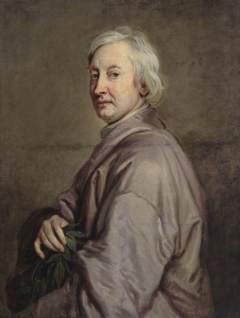
Kneller, Godfrey, 1646-1723; John Dryden (1631-1700), Playwright, Poet Laureate and CriticI’ve talked about John Dryden on this blog before, way back in 2016, in a look at his poem “Astræa Redux.” But for today, I’m not interested in 17th-century English politics or lovely descriptions of Dover’s cliffs. Nor am I interested in tackling any of Dryden’s extended satires and allegories—no point trying to condense “Absalom and Achitophel” into a blog post. Instead, I’d like to highlight a short delight of his, one which I envy for its tight control of tone and language: “To the Memory of Mr. Oldham.”

The “Mr. Oldham” of the title refers to John Oldham, a 17th-century satirist whom Dryden greatly admired and who died in 1683 at the age of thirty. Published the following year, “To the Memory of Mr. Oldham” is both a tribute to a talent gone too soon and a showcase for Dryden’s own skills as a poet. Like a great number of Dryden’s poems, it’s written in heroic couplets: rhyming, self-contained and balanced pairs of iambic pentameter lines.

Let’s have a look at the text, shall we?

“To the Memory of Mr. Oldham”

Farewell, too little and too lately known,
Whom I began to think and call my own;
For sure our souls were near ally’d; and thine
Cast in the same poetic mould with mine.
One common note on either lyre did strike,
And knaves and fools we both abhorr’d alike:
To the same goal did both our studies drive,
The last set out the soonest did arrive.
Thus Nisus fell upon the slippery place
While his young friend perform’d and won the race.
O early ripe! to thy abundant store
What could advancing age have added more?
It might (what nature never gives the young)
Have taught the numbers of thy native tongue.
But satire needs not those, and wit will shine
Through the harsh cadence of a rugged line.
A noble error, and but seldom made,
When poets are by too much force betray’d.
Thy generous fruits, though gather’d ere their prime
Still showed a quickness; and maturing time
But mellows what we write to the dull sweets of rhyme.
Once more, hail and farewell; farewell thou young,
But ah too short, Marcellus of our tongue.
Thy brows with ivy, and with laurels bound;
But fate and gloomy night encompass thee around.

The great challenge Dryden faces in writing “To the Memory of Mr. Oldham” lies in its very concept: it is an elegy written to honor a satirist. The poem cannot be entirely mournful, as that would not fit the person of John Oldham. But it cannot be entirely playful, either; neither the dictates of the genre nor basic respect for the dead would allow for it. No, Dryden must balance these two disparate moods, which requires some finely-tuned craft.

One way Dryden successfully negotiates these mixed moods is through his choice of allusions. In lines 9-10, he invokes the friendship between Nisus and Euryalus, two figures who appear in Virgil’s Aeneid. Specifically, Dryden refers to an episode in Book V, a footrace that Nisus and Euryalus partake in during the funeral games for Anchises. The text of Dryden’s poem lays out a solemn treatment of the event: Nisus loses his footing (“fell upon the slippery place”), which allow Euryalus, who had been trailing, to come from behind and win. This is of course a parallel for the relationship between Oldham and Dryden: Oldham’s great satires predated Dryden’s, but Dryden lived longer and would achieve much greater fame (“The last set out the soonest did arrive”).

However, looking into the full context of the allusion reveals a comic, almost absurd dimension to it. Nisus doesn’t merely trip; he sets off a chain of events befitting a gross-out slapstick comedy, complete with animal viscera. I’ll quote the full sequence from Dryden’s own translation of the Aeneid, which he’d publish a full fourteen years after Oldham’s death:

Now, spent, the goal they almost reach at last,
When eager Nisus, hapless in his haste,
Slipp’d first, and, slipping, fell upon the plain,
Soak’d with the blood of oxen newly slain.
The careless victor had not mark’d his way;
But, treading where the treach’rous puddle lay,
His heels flew up; and on the grassy floor
He fell, besmear’d with blood and holy gore.
Not mindless, then, Euryalus, of thee,
Nor of the sacred bond of amity,
He strove th’ immediate rival’s hope to cross,
And caught the foot of Salius as he rose.
So Salius lay extended on the plain;
Euryalus springs out, the prize to gain,
And leaves the crowd: applauding peals attend
The victor to the goal, who vanquish’d by his friend. (5.426-441)

In other words: Nisus slips in a pool of sacrificial blood, getting absolutely soaked in it; then, he grabs the second-place runner, Salius, by the foot, so that his good friend Euryalus can cross the finish line first. Not the most dignified conclusion to a sporting event. One can see why Dryden would leave out certain parts of that anecdote in his elegiac poem, at least explicitly. But the context for the allusion is still there, and the informed reader could get a little chuckle from that knowledge.

Beyond the content of the poem, Dryden also uses its form to balance its serious and comic aspects. After spending the first ten lines establishing the close connection he felt with Oldham, Dryden wonders what “could advancing have added more” to his friend (line 12). It’s at this point that Dryden brings up a common criticism of Oldham’s verse: it’s rough and lacking in polish. Dryden, though himself a paragon of Restoration sophistication, doesn’t hold Oldham’s rugged poetry against him—at least, not beyond some lighthearted ribbing.

That Oldham apparently required schooling in “the numbers of [his] native tongue” (i.e., the meter of English poetry) certainly sounds like a diss (14). And Dryden is more than capable of taking inferior poets to task; just read “Mac Flecknoe” for proof. But that one line is as pointed a Dryden’s pen gets. If anything, he is apologetic for Oldham’s technical deficiencies.

First off, the “native tongue” quip is preceded by the parenthetical qualifier, “(what nature never gives the young)” (13). Meter takes time to master, and Oldham alas was robbed of so much time. Second, Dryden insists that Oldham’s chosen field, satire, “needs not those” strictly metrical lines, and that “wit will shine / Through the harsh cadence of a rugged line” (15-16). Indeed, that line is self-demonstrating: leading with a two deviant metrical feet, full of sibilants, stops, and weak central vowels. It’s not quite Pope’s Essay on Criticism, but it’s still pretty clever. Finally, Dryden elevates Oldham’s esteem by tacking a swipe at their poetic rivals: rough meter is “a noble error” in a time “When poets are by too much force betray’d” (17-18).

Now, at this juncture, Dryden is at risk of drifting too far into satire. In a 25-line poem, there isn’t that much room for digressions on poetic fashions. This is why I find lines 18-21 so crucial in the poem’s overall construction. On a formal level, these lines bear all the marks of a turning point in a poem of heroic couplets: a triplet rhyme ending with an alexandrine (i.e., a line of iambic hexameter). On a content level, these lines return our attention to Oldham himself, to his “generous fruits…gathered ere their prime”. Those poems Oldham wrote, Dryden says, “showed a quickness,” one which “maturing time” may not have aided, for it “mellows what we write to the dull sweets of rhyme.”

Yet this is the exact moment the poem itself “mellows,” use the “dull sweets” of the triplet and the extra foot of the alexandrine to slow the pace, to wind the reader down into an appropriately reflective mood. From this point on, the satirical aspects of the poem recede, giving ground entirely to elegy. Dryden goes on to call Oldham the “Marcellus of our tongue” (referring to the great but short-lived Roman general), bestowing his spirit “with ivy, and with laurels,” while the reality of death, “fate and gloomy night,” “encompass” his friend (24-25). If the poem has lost some of the tonal complexity seen in the Nisus and Euryalus allusion or the riffs on numbers, it’s only because the world has lost, in Dryden’s eyes, an unappreciated source of humor.

What do you think of Dryden’s poem? If you have thoughts you’d like to share, or suggestions more classic poems to give the old close reading, let me know in the comments.

Charlotte Smith’s “Written in the Church Yard at Middleton in Sussex”: An Analysis

Charlotte SmithLet’s take a deep dive into a poem, shall we?

I first became aware of Charlotte Smith’s poetry during the first semester of my MFA, when, for reasons I won’t bore you with, I had to recite her “Ode to Death” for workshop. I distinctly remember its accepting attitude towards its subject—not quite Dickinson’s friendly relationship with it in “[Because I could not stop for death],” but still cordial, curious even.

Recently I decided to look through more of her work, and lo and behold, the first of her poems in The Norton Anthology of Poetry deals with a similar theme:

“Written in the Church Yard at Middleton in Sussex”

Pressed by the moon, mute arbitress of tides,
While the long equinox its power combines,
The sea no more its swelling surge confines,
But o’er the shrinking land sublimely rides.
The wild blast, rising from the western cave,
Drives the huge billows from their heaving bed,
Tears from their grassy tombs the village dead,
And breaks the silent sabbath of the grave.
With shells and seaweed mingled, on the shore
Lo! their bones whiten in the frequent wave;
But vain to them the winds and waters rave;
They hear the warring elements no more:
While I am doomed, by life’s long storm oppressed,
To gaze with envy on their gloomy rest.

There’s a lot we can, and will, talk about here, but this being a sonnet, why don’t we start with the turn in the final couplet?

The ending of this poem is somewhat odd, even unsettling. After three quatrains of detached observations of a coastal graveyard, the speaker turns to her own, morbid concerns: she is “doomed” to “envy…their gloomy rest.” Not only is this turn emotionally dispiriting, but it also seems to rest on a false premise: what “gloomy rest” is there in this graveyard?

In “The Sonnets of Charlotte Smith” (published in Critical Survey 4.1, pp. 9-21, 1992), Stella Brooks focuses on the poem’s diction to get to the heart of the apparent contradiction. Although the speaker

longs for their oblivion for herself…the preceding violation of the “silent sabbath” of the graves, the shock of the “village dead” being “torn” from their tombs by the “huge billows,” the “raving” of the “winds and waters” have suggested anything but the claimed oblivion; the graves have been disturbed, there is no “gloomy rest” for their inmates. (p. 14)

Of course, Brooks does not see this discrepancy between the speaker’s description of the graveyard and her interpretation of it as a flaw in the poem. Rather, that discrepancy is emblematic of a “turbulent Romantic fantasy” (p. 14). The speaker has a need to express her heightened emotions, in spite of the constraints placed upon her.

I’d like to push Brooks’ reading a bit further, for the poem strains against more than just the facts of the case. The formal elements of a poem, after all, are another kind of constraint. In case of this sonnet, elements that would ordinarily suggest calm and composure in fact hold back an uncontrolled force of emotion.

To start, let’s continue talking about endings: line-endings. A quick glance reveals that of the sonnet’s 14 lines, 13 of them end with some form of punctuation, from the brief pause of a comma to the heavy stop of a period. End-paused lines are famous for slowing the pace at which one reads a poem, as they represent both the end of a unit of syntax (a phrase or a clause) and a unit of verse (a line). Further, when end-paused lines occur with such regularity, they give the poem another measured music in addition to the meter (more on which later).

There’s only one line in Smith’s sonnet, line 9, which lacks end-pausing punctuation, and naturally this moment represents a turning point in the poem: “on the shore / Lo! their bones whiten”. It’s an awkward line-ending, as the next line all but starts with terminal punctuation, with that exclamation point coming just one syllable in. The poem’s rhythm staggers right as the speaker confronts the full extent of the graveyard’s damage. The speaker has mentioned how the sea has degraded the graveyard prior to this, but those descriptions tend towards abstraction: “village dead,” “the silent sabbath of the grave.” Here, though, death is rendered concrete: whitened bones “with shells and seaweed mingled.”

Now, line 9 may be the point where the poem’s composure completely dissolves, but Smith has been building up to this moment throughout the first two quatrains.  The apparent calm in the lead-up is illusory. For one thing, the sound-play in the first eight lines is incredibly emphatic. The first two rhymes are on the similar-sounding [aɪdz] (“tides”/”rides”) and [aɪnz] (“combines”/”confines”), with either sound amplifying the other. Internally, the lines are super-charged with repeated sounds: “Pressed”/”arbitress” and “moon”/”mute” in line 1, the double alliteration of “huge billows” and “heaving bed” in line 5, the sibilance of “breaks the silent sabbath” in line 8, and so forth.

It’s difficult to read this poem aloud without feeling a bit pompous, the sound-play is so heavy and the lines so measured. One imagines Smith declaiming this piece to the decay before her, arms raised to the heavens like a capital-R Romantic heroine, trying to convey her emotions to the spirits. But behind all that power, there’s also strain, and that strain comes through in the poem’s meter.

The first quatrain scans pretty regularly for a sonnet, with no line straying too far from iambic pentameter. Line 1 has an authoritative initial trochee (“Pressed by | the moon…”) and line 2 starts with a double iamb (“While the | loud e | quinox…”), but beyond those two substitutions, it’s four lines of forceful iambs. (Even if we give “power” its modern two-syllable scansion, the stresses stay on the same syllables in the line; the anapest changes very little.) What’s more, the stresses keeps accentuating words relating to strength: “pressed,” “loud,” “power” “swelling surge.”  If not for the rhyme, I could almost see King Lear reciting these lines on the stormy heath.

But the second quatrain does not scan so easily. Consider lines 5 and 6:

The wild blast, rising from the western cave,
Drives the huge billows from their heaving bed

Forcing these lines to fit the mold of iambic pentameter is a challenge. The mid-line comma and the possibility of pronouncing “wild” as two syllables suggest we scan the first three words as two iambs (“The wi | ld blast“). The rest of line 5, meanwhile, has a fairly intuitive cadence: “ris | ing from | the wes | tern cave.” Putting both parts together, though, we end up with six stresses instead of five. We can either demote “from” to an unstressed syllable, which maintains the semantic emphases but producing an ungainly scansion (“The wi | ld blastrising | from the wes|tern cave“), or we can elide “wild” into one syllable and demote either it or “blast,” which makes for a better-scanning line but is unsatisfying semantically. Who says “wild” or “blast” weakly?

Line 6 presents a similar problem, with a natural reading producing a six-stress line. Demoting “from,” as it did before, makes for an even worse scansion than before: “Drives the | huge bil | lows from | their hea | ving bed.” The other option, demoting “drives” or “huge,” as it did before, forces us to de-emphasize a strength-related word, exactly what the poem encouraged us to do in the first quatrain. Gone are the forceful declamations; uncertainty now reigns. The poem may get back on song in the next two lines, with just the initial trochee in line 7, but it does so just in time for the bodies to start surfacing.

All of the above may be interesting, but how does it factor in to the poem’s conclusion? Well, it justifies how the speaker could possibly see “gloomy rest” in this scene. The disturbed dead are numb to the chaos around them, unable “to hear the warring elements.” But more than that, the dead cannot think or feel, whereas the speaker is compelled to contemplate their fate, with all that loud language and emotion discussed above bouncing about in her head. The one thing someone in such a position could envy is quiet. But in the Romantic world of Smith’s poetry, that is impossible. The speaker can only “gaze with envy” at the possibility.

To end on a (slightly) cheerier note: Lit Brick has an amusing summation of the poem in webcomic form, so enjoy that!

What do you think of Smith’s sonnet? Have any suggestions for more classic poems to dissect? Feel free to share in the comments.