Seeing the Beating Heart: Adapting Poe’s “The Tell-Tale Heart” for Film

As as adaptation of Edgar Allan Poe’s short story, The Tell-Tale Heart (dir. Jules Dassin, 1941) strays a fair bit from its source material’s plot, mostly in terms of resolving ambiguities. Notably, whereas Poe’s story (which you can read here) leaves both the narrator’s motive and his relationship to the old man ambiguous, Dassin’s short film casts the protagonist (played by Joseph Schildkraut) as a decades-long victim of abuse who is suddenly driven to kill his alleged caretaker (Roman Bohnen). And I will say up front that I believe that additional information ultimately weakens Dassin’s The Tell-Tale Heart as a work. The uncertainty that surrounds the narrator’s account of the crime, so central to the original story, is lost in the process and replaced with a fairly mundane tale of revenge.

However, while the short film is not the best translation of Poe’s plot, I think Dassin and his crew capture something far more important about the source material. They find ways to bring the narrator’s mental state to the screen.

Before we can talk about how the filmmakers accomplish that task, we need to talk about Poe’s story. The opening lines of “The Tell-Tale Heart” give the reader an immediate sense of how the narrator perceives the events he’s lived through. And when I say “perceive,” I mean that in a literal sense, for the narrator is keenly aware of his senses:

True! –nervous –very, very dreadfully nervous I had been and am; but why will you say that I am mad? The disease had sharpened my senses  –not destroyed –not dulled them. Above all was the sense of hearing acute. I heard all things in the heaven and in the earth. I heard many things in hell. How, then, am I mad?

For those of you who have read the story, you know why that fine sense of hearing is significant: the narrator would have gotten away with the old man’s murder if he hadn’t heard the sound of the old man’s beating heart beneath the floorboards. That heartbeat from beyond the grave is almost certainly a manifestation of the narrator’s guilty conscience, but what makes the narrator’s breakdown palpable is the possibility that what he’s hearing is real. And if there’s one type of sensation which language is best able to convey to the reader, it’s sound.

“The Tell-Tale Heart” is remarkably vague on the visual aspects of the story, with the old man’s eye (“the eye of a vulture –a pale blue eye, with a film over it”) being the one standout detail. The rest of the story’s world is sketchy, with some floorboards here, a bathtub there, but nothing too evocative. By contrast, the story’s soundscape is incredibly vivid. The beating heart is likened to “such a sound as a watch makes when enveloped in cotton” (incessant, but muffled), while the old man tries to pass off the creaking in his room as “the wind in the chimney,” “a mouse crossing the floor,” and “a cricket which has made a single chirp.” There’s nothing vague about this material; Poe’s imagery is detailed and specific.

Still, all the above devices work on the level of labeling, rather than evoking. Intellectually, I can understand what a muffled watch or a scurrying mouse sounds like, but the phrases used to describe them don’t necessarily make one feel those sounds. No, Poe achieves that feat through the rhythm of his prose and the repetition of words and phrases. Much of the story relies on short, staccato sentences and parallel syntax, which suggest the regular beat of the human heart. The block quote above provides some obvious examples: “very, very dreadfully,” “not destroyed…not dulled…,” “I heard…I heard…,” etc. But this dark music works in more subtle ways, too. Consider the start of the third paragraph. The short, even sentences are readily apparent, but note the driving meter as well: “Now this is the point. You fancy me madMadmen know nothing. But you should have seen me.” Read aloud, this stretch of two-beat sentences is, well, maddening. Imagine, then, what reciting the whole story must feel like.

That ceaseless rhythm is, I think, central to feeling the narrator’s mental state, and not merely to understanding it. Just as the narrator becomes fixated on the beating heart, on his guilty conscience, so the reader becomes fixated on the beating heart of the prose. More than the murderous act or the narrator’s madness, that is the true horror of “The Tell-Tale Heart.” So how do the filmmakers preserve that rhythm through the adaptation process?

Let’s get the obvious techniques out of the way. The sound mix emphasizes such auditory elements as the old man’s footsteps and the ticking clock, sounds which are short and regular. They of course prefigure the beating heart which will take prominence after the murder. Also, the film’s score tends to highlight the percussion instruments and uses short, repeating phrases to underline the tension during the police interrogation scene. These are approaches I expected to see (hear?) coming into the film, and they’re also the ones I’m least interested in.

No, film is a visual medium, and I wanted to see, actually see, the story’s rhythm rendered in visual terms, whether through acting, editing, set design, or what have you. I’m not going to say it’s easy, mind, but it’s what I was looking for.

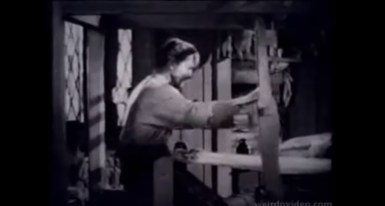
From the film’s opening shot, I knew they’d nailed it.

TTH1941-Loom

We first see our protagonist working at a weaver’s loom, mechanically moving and adjusting the various parts, the shuttle and the batten, back and forth as the camera slowly zooms in on him. That particular prop on its own would be enough to start with, but the protagonist’s relationship to the device finishes the job. He’s focused on his task, almost emotionless, until the camera reaches that all-important instrument: his ear. In a single shot lasting about 25 seconds, the filmmakers key the viewer into the physical rhythms of the picture, telling them to “listen” for those patterns.

As the film progresses, we see similar visual rhythms, such the robotic process by which the protagonist oils the hinges on the old man’s bedroom door, or in a scene borrowed from the source material, the way he drags the chair back and forth over the floorboards concealing the old man’s corpse. It’s so pervasive a technique that when the filmmakers break from the pattern, the effect is unsettling. There’s a sequence in which the protagonist, while speaking to the police, hears that tell-tale beating sound. He looks around the room and finds that the clock’s pendulum is motionless and the faucet is no longer dripping. In that moment, he knows every mundane explanation for the sound—every proverbial mouse, cricket, and chimney gust—is untenable. We the audience see the instant where his conscience becomes too much to bear. That, right there, is solid film-craft.

So, if you’re looking to watch some Poe adaptations this Halloween, give this one a chance in between your Vincent Price and Bela Lugosi vehicles. Like the best adaptations of his work, while it plays loose with some plot elements, it captures the experience of reading the story exceptionally well.

Also, it’s only 20 minutes long. You have time to watch it this month, trust me.

*          *          *

Thank you for reading! If you’re in the mood for some more unsettling cinema, a while ago I dedicated a post on this blog to celebrating the “inspired unpleasantness” of Fritz Lang’s 1931 film M. Or, if you’d prefer something (marginally) lighter, here’s a short reflection on why I find murder mysteries relaxing. Happy Halloween!

James Wright’s “Autumn Begins in Martins Ferry, Ohio”: An Analysis

James WrightHere in the United States, we’re currently in the midst of American football season, which means it’s historically a fallow time for poetry. Unlike with baseball or basketball, there isn’t really a long tradition of poetry about football. As a sport, it lacks the aura of pastoral myth that surrounds baseball and the graceful control of the body that defines basketball. No, football is kind of an ugly sport: violent and dangerous, cloaked in concealing equipment, and overly complicated to describe. It just doesn’t lend itself to poetry.

There are, however, some noteworthy poems on the sport, like the one I’d like to talk about today: James Wright’s “Autumn Begins in Martins Ferry, Ohio.” Unlike every other poem I’ve previously given a close reading for, this poem is still protected by copyright, but you can read it over at poets.org, where they also have a recording of Wright reading the poem aloud.

Let’s start with the title, because titles are something that James Wright is especially famous for. I’ve sometimes talked about poem titles as though they were sluglines in a screenplay, in that they can ground the reader in the poem’s situation before it actually begins. This way of viewing titles holds especially true in Wright’s poetry, which are very explicit (and lengthy) in laying out the occasion of the work. This is a man who titles his poems “Lying in a Hammock at William Duffy’s Farm in Pine Island, Minnesota” or “In Response to a Rumor That the Oldest Whorehouse in Wheeling, West Virginia Has Been Condemned.”

Compared to those examples, “Autumn Begins in Martins Ferry, Ohio” is relatively restrained, simply giving us the time and place. The first line of the poem then narrows the focus even further, placing us in “the Shreve High football stadium” (line 1). With a little knowledge of American sports schedules, one can piece together that it’s the start of the high school football season. So there’s our subject: a high school football game.

Except, the speaker then immediately moves the poem outside the football stadium, outside the bounds of Martins Ferry. Rather than talking about the game in front of him, he turns to the lives of working class people in the surrounding towns:

I think of Polacks nursing long beers in Tiltonsville,
And gray faces of Negroes in the blast furnace at Benwood,
And the ruptured night watchman of Wheeling Steel,
Dreaming of heroes. (2-5)

There’s a Whitmanesque quality to these lines, listing off the laborers who make the Ohio River region what it is. But where Whitman might celebrate the image of the American worker, Wright takes a more subdued approach. People are “nursing” their drinks; they’re “ruptured” or have “gray faces.” When he ends the stanza by claiming that they’re “[d]reaming of heroes,” it sounds less aspirational and more hopelessly escapist. Life in the Wheeling area is drudgery, and the most that people can do is to imagine something better.

The landscape of the post-industrial Midwest is a recurring feature of Wright’s poetry. “Outside Fargo, North Dakota” opens with the image of “the sprawled body of the derailed Great Northern freight car,” while “In Response to a Rumor…” is actually about women leaving a vinegar factory and appearing to disappear into the Ohio River. A sense of isolation and unease often overwhelms the speaker’s thoughts in these works: he is “lonely / And sick for home” in Fargo, and “will grieve alone” in Wheeling. Finding a similar malaise hanging over small towns in Ohio and West Virginia, then, is of a piece with the rest of Wright’s work.

Still, I detect something more personal in “Autumn Begins in Martins Ferry, Ohio.” In most of what I call his Midwest Hellscape poems, the speaker is an interloper, a visitor to vast decay, one who may interact with the people around him but only on a surface level. There’s no intimacy with the man in the train in “Outside Fargo, North Dakota” or the factory workers of “In Response to a Rumor…,” just a fearful fascination. But here, if only in the speaker’s mind, we follow the crowd back home.

There’s some initial ambiguity in just who the “proud fathers…ashamed to go home” refer to (6). Are they the various workers mentioned in lines 2-5, or the people joining the speaker in the stands of the football stadium. Of course, that ambiguity may well be meaningless, and I feel the poem is richer if one supposes that they’re both: steel workers on aluminum bleachers. Yes, they’ve come to watch their kids, but also to avoid a home life that they’ve long neglected—their wives are likened to “starved pullets,” i.e., young hens (7). And what are they starving from? They’re “[d]ying for love” (8). The struggles of the industrial working class don’t stop at the factory gates. They follow them into the house.

It is perhaps more than a coincidence that James Wright’s hometown is Martins Ferry, Ohio.

The final stanza, though, is where I think this poem truly becomes something special, which is interesting because it opens with one of the least poetic words in the language. Line 9 is the only one-word line in the poem, and that word is: “Therefore.”

Up until this point, you’d be forgiven for thinking this poem wasn’t making an argument, but just presenting a landscape. This sudden introduction of rhetorical logic is a little disorienting at first. The reader must readjust their expectations, and understand that the preceding stanzas are in fact the premises for the conclusion which is to follow:

Therefore,
Their sons grow suicidally beautiful
At the beginning of October,
And gallop terribly against each others bodies. (9-12)

I adore this last stanza for two reasons. First, it perfectly captures the contradictions at the heart of watching football. The game is both a showcase of humanity’s physical potential and an exercise in self-destruction. Look at the language Wright uses here: “suicidally beautiful,” “gallop terribly.” The sons of Martins Ferry embody both these aspects of football in two strange yet powerful word pairs.

Second, as a final stanza and a conclusion to an argument, these four lines offer something of a twist. Introducing this wholly mundane scene—beautifully described, yes, but mundane as a scene—with such a heavy “Therefore” is the exact sort of surprise I look for in a poem. It’s attempting to justify something that we take for granted: why do kids play football? In Wright’s poem, the answer lies in everything that came before. What good does it do the sons of Martins Ferry? Lord knows, but then again, they are “suicidally beautiful.” The endgame may well not be the point. All that matters is the feeling that comes from “galloping terribly against each other’s bodies.”

What do you all think about “Autumn Begins in Martins Ferry, Ohio?” Are there any other poems (or stories, etc.) that you think do well in tackling the reasons we play sports? Let me know in the comments!

And as always, thank you for reading.

On Paying to See Free Shakespeare

I was already aware of the line-standing business—people getting hired to stand in lines on behalf of others—before I picked up Michael Sandel’s What Money Can’t Buy: The Moral Limits of Markets. But I had only heard about it in the context of American government, mostly in the form of lobbyists hiring homeless people to wait in line for seating at the Supreme Court or Congress. Sandel brought another place where the business has bloomed to my attention: getting tickets to Free Shakespeare in the Park.

Free Shakespeare in the Park is a New York City civic tradition dating back to the 1950s. It is, as the name suggests, free to the public, but because Central Park’s Delacorte Theater has a finite number of seats, tickets are given out on a first come, first served basis. Some folks, who either can’t or don’t want to stand in line to get tickets, have taken to employing line-standers to do the waiting for them. According to Sandel, the price for a line-stander in 2010 was “as much as $125 per ticket for the free performances” (p. 21). A lot of people, including the festival organizers and New York governor Andrew Cuomo, have criticized the trend. So why don’t we talk about it some? Why does paying someone to wait in line for free Shakespeare tickets strike so many people as wrong?

On their website The Public Theater, the organization that produces Free Shakespeare in the Park, puts forth their dedication to “to developing an American theater that is accessible and relevant to all people.” The fact that tickets are free is vital for both of those goals.

Accessibility is obvious: not charging for admittance removes one of the biggest material barriers to seeing live theater. So long as one has the time and the ability to go, anyone from the richest to the poorest can attend. In terms of making theater relevant: how relevant can theater possibly be if the great majority people are, for practical purposes, barred from seeing it? You could put on the most perceptive, challenging, socially-conscious production of The Taming of the Shrew, a production that would meaningfully contribute to conversations on gender relations in modern and period societies, but its impact will be limited if only the most elite members of society can afford a ticket.

On top of all that, Sandel would add that charging money for public theater not only thwarts the festival’s goal of making theater accessible and relevant, it fundamentally corrupts the whole enterprise:

The Public Theater sees its free outdoor performances as a public festival, a kind of civic celebration. It is, so to speak, a gift the city gives itself. Of course, seating is not unlimited; the entire city cannot attend on any given evening. But the idea is to make Shakespeare freely available to everyone, without regard to the ability to pay. Charging for admission, or allowing scalpers to profit from what is meant to be a gift, is at odds with this end. It changes a public festival into a business, a tool for private gain. It would be as if the city made people pay to watch the fireworks on the Fourth of July. (p. 33)

(Upon reading that last sentence, I said aloud to myself: “Sandel, don’t give people ideas!”)

Moving past the ethical implications of paying people to stand in line for Shakespeare in the Park, which I find distasteful, I find myself wondering what this phenomenon says about our attitudes towards Shakespeare.

On the one hand, I’m absolutely heartened that Shakespeare is still popular enough that people are willing to pay actual money for a chance to see a free performance of his work. There’s still a demand for his alchemical mixtures of drama, humor, character and poetry. There are still plenty of people who want to see his plays put on stage, who may find themselves inspired to delve deeper into his work, to further adapt it, to challenge or rebut it, and to spread it to subsequent generations. That a public festival for Shakespeare draws such interest warms me further: in an era of infinitely many niche audiences, it’s nice to hang on to the few common touchstones in English literature.

On the other hand, the fact that some people are willing to pay to see free Shakespeare doesn’t mean that those people necessarily value it more than those who aren’t. One suspects that the wealthy are most likely to pay for this sort of service, and the marginal value of a dollar is just so much lower for them. Sandel hints at this point when he draws an analogy to another gathering of the masses, a baseball game:

[T]he people sitting in the expensive seats at the ballpark often show up late and leave early. This makes me wonder how much they care about baseball. Their ability to afford seats behind home plate may have more to do with the depth of their pockets than their passion for the game. They certainly don’t care as much as some fans, especially young ones, who can’t afford box seats but who can tell you the batting average of every player in the starting lineup. Since market prices reflect the ability as well as the willingness to pay, they are imperfect indicators of who most values a particular good. (pp. 31-32)

For the people in the luxury boxes and the seats behind home plate, going to a baseball game is more of a status symbol or a networking opportunity than an expression of actual interest in the sport. I’m not sure theater works in quite the same way. But now I’m thinking of the first episode of Slings & Arrows, in which the VIPs in the crowd are listening to a hockey game during a production of A Midsummer Night’s Dream, and I’m starting to see that scene as less comically absurd than I’d first taken it.

But what do y’all think? What does the line-standing trade for Free Shakespeare in the Park tell us about our relationship to Shakespeare? Is it good or bad, both or neither, or at least interesting? Let me know in the comments!

Exceeding Weary: A Look at “2 Henry IV,” Act II, Scene 2

When I was a sophomore in undergrad, I took a course on William Shakespeare’s histories and tragedies, in which we read most of the Henriad, the series of plays that follow Prince Hal (the future Henry V) through his wayward youth, maturation, and eventual triumph in battle. The plays of the Henriad feature some of my favorite bits of Shakespeare: the poetry of Richard II is a delight from start to finish, the character dynamics in 1 Henry IV are sharp and nuanced, and even my least favorite of the bunch, Henry V, includes some inspired comic relief.

However, the class skipped over actually reading 2 Henry IV. Instead, the professor condensed the major plot points down to single PowerPoint slide: Prince Hal takes the crown upon his father’s death and coldly turns asides his tavern buddy, Sir John Falstaff. Notably, all these events happen in the play’s final two acts, which only made me wonder: “What exactly happens in Acts I–III?”

This past week, I finally read 2 Henry IV, and to respond to my past self’s question, the answer is, “Not very much.” The play must arrive at the ending described above so as to set up the events of Henry V, but that ending is so short on paper that the play must bide its time before getting there. Throughout the first three acts, the characters are generally stuck for things to do: Henry IV is ill and still worried about Prince Hal’s imminent succession; the rebellion against the king has stalled out from indecision; and even joyous Falstaff, grown older and full of gout, can’t muster the same energy for his crimes and antics. All at once, so much fails to happen.

This meandering, holding-pattern quality of the first three acts makes it difficult to talk about them as a whole, so instead, I’ll look at once sequence in particular: Act II, Scene 2, lines 1–65, in which Prince Hal, the central figure of the whole tetralogy, finally appears on stage.

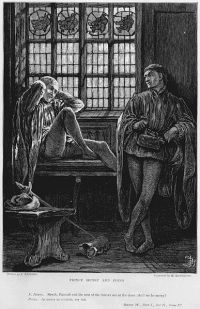
Prince Hal and Poins
Source: Wikimedia Commons. [Note: this image actually depicts a scene from 1 Henry IV, but the characters are the same.]

The scene, set in the prince’s quarters in London, is primarily a dialogue between the prince and Poins, one of the commoners the prince has spent years running wild with. Just from that set up, we see the prince stuck between two phases of his life: hanging out with his Eastcheap drinking buddy, but in the halls of royal power. On top of all that, his father is ill and he’s coming off an exhausting victory at the Battle of Shrewsbury. Little wonder, then, that he enters the scene by saying,  “Before God, I am exceeding weary” (II.2.1) Poins, for his part, has a hard time believing that “weariness … attached one of so high blood,” but while the prince indeed says that “it discolors the complexion of my greatness to acknowledge it,” he cannot help but desire the base salve of “small beer” (2–6).

Up to this point, the conversation between the prince and Poins is fairly genial, but it takes a sharp turn when the prince moves the discussion from his thirst to his companion:

What a disgrace is it to me to remember thy name! Or to know thy face tomorrow! Or to take note of how many pair of silk stockings thou hast, viz. these, and those that were thy peach colored ones! Or to bear the inventory of thy shirts, as, one for superfluity, and another for use! But that the tennis-court keeper knows better than I; for it is a low ebb of linen with thee when thou keepest not racket there, as thou hast not done a great while, because the rest of the low countries have made a shift to eat up thy holland. (12–22)

On a superficial level, this little speech recalls Prince Hal’s banter with Falstaff from 1 Henry IV, but there’s a noticeable lack of verve to it. The barbs are longer, and thus limper; more generic, and thus less biting. There’s nothing so driving as Falstaff’s litany of “you starveling, you eel-skin, you dried neat’s-tongue, you bull’s-pizzle, you stockfish” (1 Henry IV, II.iv.235–236). And while the “tennis-court keeper” bit sets up a half-clever play on “holland” (Netherlands / nether regions), more than anything it makes me long for the tennis ball monologue from Henry V.

Prince Hal, it would seem, is not really in the mood for jesting. No, it’s easier to read this halfhearted series of insults as a genuine display of frustration. The tavern scene no longer enlivens him like it used to; people like Poins and Falstaff and so forth are more tiring than they may be worth. In theory, this isn’t exactly bad news for the prince. It may be the perfect time to cast aside the Eastcheap crowd and start his premeditated reformation. The goal, after all, is to make his countrymen admire him for his conversion; as he says in 1 Henry IV,  “My reformation, glitt’ring o’er my fault, / Shall show more goodly and attract more eyes / Than that which hath no foil to set it off” (I.2.206–208). So what’s the hold up? Why is the prince so “exceeding weary” that even shedding what wearies him proves difficult?

For one thing, the scheme he mentions in the previous play conveniently elides the emotional reality of succession: his father must die for Prince Hal to become king. It’s a fact that the prince seems reluctant to admit, saying “it is not meet that I should be sad, now my father is sick” (37–38). It takes a good deal of throat-clearing for him to say even that much; he prefaces that statement three different times (“Shall I tell thee one thing, Poins?” [31]; “It shall serve among wits of no higher breeding than thine” [33-34]; “Marry, I tell thee” [37]). There are many reasons why Prince Hal might find his own sadness unbecoming: he’s a man, a royal, and someone about to receive a great fortune. Hence why Poins judges it “[v]ery hardly” to weep in such circumstances (41).

This leads to the second problem Prince Hal faces: he’s perhaps played the part of ne’er-do-well too convincingly. “By this hand,” he tells Poins, “thou thinkest me as far in the devil’s book as thou and Falstaff for obduracy and persistency” (42–44). But given how thoroughly Hal sunk himself into the tavern crowd in the previous play, why wouldn’t Poins or his father or anyone else in England think his behavior to be genuine, and genuinely revolting? He knows that Poins would believe him to be “a most princely hypocrite” if he were to weep for his father’s illness out in the open, for outwardly he has cared little for his father up to this point (51). Instead, as Poins says, Prince Hal has “been so lewd and so much engraffed to Falstaff” (58–59). The prince therefore has reason to doubt his prodigal son routine will even work, now that he has the chance to finally enact it.

Like just about everyone else in the play, then, the prince appears to just be going through the motions, continuing in his bar-crawling ways without much purpose. That, at least, is how I make sense of the way Act II, Scene 2 ends, with Prince Hal and Poins plotting to spy on Falstaff in disguise. Their little prank reads like a lesser version of the robbery ruse in 1 Henry IV, in the same way that Prince Hal’s insult speech here is a wearier rehash of the earlier play’s banter. The prince ends the scene by claiming that “in everything the purpose must weigh with the folly” (166–167). That claim, I think, holds true. In this scene, and in this play, there’s often very little of either.

*          *          *

Thanks for reading! If you’re in the mood for more literary analyses, perhaps you would be interested in my discussion of how section breaks are used in Aldous Huxley’s Brave New World and John Hersey’s Hiroshima.

On Buying New Editions of Classic Books

If you’ve read my blog for any length of time, you will have noticed that I have a taste for the canon. I’ve recently written about Albert Camus’s essay “The Minotaur,” for example, and I have an ongoing series of blog posts offering close readings of old poems. Something you notice when you read classics is that there are a ton of different editions for each title. Every publisher has its own version of Great Expectations or Jane Eyre, and each edition comes with its own set of bells and whistles. You’ll even find people who collect different versions of the same book.

I find all this fascinating, because classics are the genre of literature which is probably easiest to find at a low cost, and a lot of these new printings of classics will run you more than a negligible sum. I’ve started wondering what these more expensive versions offer the reader beyond the text itself, and whether that’s worth the higher cost.

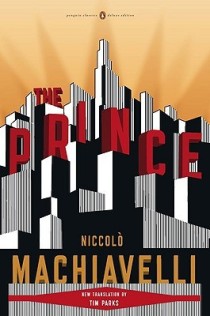
Just so we’re working with a concrete example, let’s consider a book that I’m currently reading: The Prince by Niccolò Machiavelli. Specifically, we’re going to look at the 2009 Penguin Classics Deluxe Edition, published in 2009 and translated by Tim Parks.

The PrinceGoing in, I know that The Prince is an important work in the history of political writing, and that it was rather infamous in its day regarding its arguably amoral advice for rulers. I’ve even had to write a few essays for classes using scanned excerpts of the text, so I’m somewhat familiar with its prescriptions. But I’ve never read the work in its entirety, and given the state of the world, I figure it’s high time I read it. Now, supposing that I didn’t already possess this particular edition of the book, how might I go about finding a copy of it for a decent value?

The Prince dates back to the early 16th-century, so the original Italian text is unquestionably in the public domain. I don’t speak Italian, however, let alone the Italian of Machiavelli’s day, so I’m going to need an English translation. Even though translations are derivative works, they may still be protected by copyright. As such, it can sometimes be difficult to find translations of works in other language freely and legally available on the Internet.

Lucky for me, The Prince has been around so long that there are multiple English translations which have also entered the public domain. I can simply search through Project Gutenberg, for instance, and find the full text of W. K. Marriott’s 1908 translation. It’s fairly bare-bones as a book, but if all I want is the text, then it suits me fine. Indeed, I’ve lately been reading some translations of Plato via Project Gutenberg, and I haven’t had any complaints so far.

But maybe e-books aren’t for me, for whatever reason (e.g., difficulty reading off a screen for extended periods of time). Maybe I’d feel better holding a copy of The Prince in my hands. Assuming the local library doesn’t have a copy available—and if, like me, you live out in the country, that’s a distinct possibility—there are still ways to get the book for cheap. If you went to an American high school, you might be familiar with Dover Thrift Editions, which are no-frills editions of classic, public domain works. (One of these days, I’ll write an appreciation post about them.) Per their website, a copy of N. H. Thompson’s 1910 translation of The Prince retails for $3.00. That doesn’t include shipping, obviously, but that’s still a pretty low price point.

So: if the options I’ve just listed, and others that I haven’t, let me get a copy of The Prince at little to no cost, why on earth should anyone spend $16.00 for Penguin’s version? If I want the text, I have Project Gutenberg; if I want the text printed and bound, I have Dover. What, if anything, does the aptly-named Penguin Classics Deluxe Edition offer that the more affordable channels don’t?

Well, a few things, actually, but whether they’re worth the additional cost is entirely up to the reader.

In addition to the text of The Prince, the Penguin edition comes with four additional features: an introduction, a translator’s note, a map of Italy c. 1500, and a glossary of proper names mentioned in the text. The latter two, for my money, are the least inspiring aspects here. The map gives some sense of the political geography of 16th-century Italy, but since many of Machiavelli’s examples are historical it’s also of limited utility. And while the glossary of proper names is perhaps a more convenient reference when reading the book than a search engine might be, and only includes those facts the translator believes are important, it’s still a repackaging of easily available information. I’m not sure I’d pay a premium for that kind of editorial work.

The translator’s note is more compelling. For starters, it gets at why, even if one wouldn’t pay extra for a new edition of, say, a Jane Austen novel, one might do so for a new edition of a work in translation. Unlike original works, Parks argues, translations “have a way of gathering dust”:

If we read [Alexander] Pope’s translation of Homer today, we read it because we want to read Pope, not Homer. Linguistically, the translation draws our attention more to the language and poetry of our eighteenth century than to Homer or ancient Greece. (p. xxxi)

In Parks’s estimation, original texts maintain their freshness, as though they have a sustaining aura to them. Works in translations, however, need to be updated or they’ll turn stale. Maybe a new English translation of The Prince won’t evoke Renaissance Italy so much as the era in which the translation was written, but at least it won’t end up evoking Edwardian England instead.

For something specific to this edition of The Prince, I like how Parks uses the translator’s note as an opportunity to discuss his process. He mentions the difficulty in translating certain critical words from Machiavelli’s original text, such as “principe” and “virtù.” He also explains how his version differs from previous translations, and provides side-by-side comparisons of selected passages to illustrate the difference. Whether or not one prefers Parks’s translation to the others is a matter of taste, sure, but I like seeing a writer justify their choices regardless.

Finally, there is the introduction, which I’d wager is the most common feature in new editions of classics. Introductions are a chance to place the original work in context: to explain the historical and social forces which may have influenced the author, synthesize how critics have approached the work through the years, and draw attention to details the editor believes are important but worries the new reader might miss. The premium price for a new edition includes some insurance that one won’t blindly stumble through a difficult work.

This is especially important for a book like The Prince, whose reputation precedes it. If you’ve never read The Prince, you might imagine that it’s a handbook for being an absolutely ruthless tyrant, when the reality is a bit more nuanced and complicated. That’s why, after a sizable biography of Machiavelli, Parks goes into a brief history of the book’s reception through the centuries, as well as its noticeable influence on early modern English drama. (It’s certainly a more detailed history than one finds in Marriott’s introduction, for instance.)

And unlike with the glossary of proper names, where the bare facts take precedence over style, both the introduction and the translator’s note are enjoyable pieces of writing in their own right. Parks has a knack for wry appraisals, whether he’s noting “a certain Victorian bashfulness in previous translations” (p. xliii), or wondering how Machiavelli thought writing this book would bring him back to the center of Florentine politics:

[T]here is something ingenuous and almost endearing in the clever diplomat’s miscalculation here. The brilliant reasoning required to convince yourself that you had got a grip on politics and history, the profound analysis that would demonstrate to your fellow intellectuals that you were as clear-headed as Livy, Tacitus and Thucydides put together, were not the qualities that a young and hardly well-read Medici prince was likely to comprehend, never mind enjoy. (p. xxi)

In effect, if one buys this new edition of The Prince, one gets two good essays about the book in addition to the original work. And that’s not an insubstantial amount of writing. All told, the supplemental material is about sixty pages long, whereas The Prince itself takes up about a hundred. If you apportion price to page count, all this new material would run you $6.00 out of $16.00. Is that worth it? That’s up to you.

We could mention other elements of new editions of classic books: design elements like the cover and typeface, or the primary source documents found in more scholarly publications. But I think here’s a good place to stop for now. (I would like to actually finish reading The Prince, after all.)

So, to open up the discussion: Do you buy new editions of classic books, and if so, what aspects of those new editions convince you to do so? Let me know in the comments!

A Ramble on Used Book Sale Clutter

Used book sales, at least in my estimation, are bit like prospecting: you have to pan through an ungodly amount of silt before you find the faintest flakes of gold. I’ve uncovered some gems in my searches, sure: my first collection of E. E. Cummings’s poetry, a copy of David McCullough’s biography of Harry Truman, etc. And there must be something especially satisfying about finding such a book amidst all the otherwise uninteresting selections.

For the most part, though, browsing through the bins is mostly an exercise in idle curiosity. I start wondering, for example, how long the library has held onto this how-to guide for using the Internet from 1997, and how many times they’ve considered just recycling it already. I start wondering where exactly all these John Grisham and Jodi Picoult novels are manufactured and distributed, because there’s a ton of unsold inventory to contend with. (And don’t even get me started on all the Bibleman VHS tapes just lying on the floor.) I’m sure someone buys these books every once in a while, if only to qualify for a bulk purchase discount, but not enough that these books finally to disappear.

Margaret Kingsbury, a writer for Book Riot who works at a used bookstore, recently published a list of books that tend to flood her shelves. Some of these items are hardly surprising: old airport fiction, political tell-alls, Chicken Soup for the Soul. People tend to approach these books less as artworks than as content: something to be consumed quickly, and then disposed of. These titles may certainly be successes from the point of view of their publishers, as they sold quite a few copies when they first came out, but no one is surprised by their brief periods of relevance.

One might call this category of books “anti-classics,” not in the sense that they’re necessarily bad, but in the the sense that they follow the reverse trajectory in popularity we often imagine for classics. Whereas a book like Theodore Dreiser’s Sister Carrie struggled to sell even 500 copies on initial release but is today regarded as a seminal work of American realism, the books mentioned above reach far more readers in the months immediately after publication but fade out in the long run. (We’ll ignore the fact that cases like Sister Carrie are the exception rather than rule; most classics were at least moderately successful from the start, albeit rarely hugely so.)

More interesting, I find, are the books that Kingsbury names which are/were genuine cultural phenomena: young adult series like Twilight and The Hunger Games, Harper Lee’s Go Set a Watchman, even (to Kingsbury’s own surprise) George R. R. Martin’s A Song of Ice and Fire. These are books that people care about specifically (as opposed to  “the newest James Patterson novel”), so perhaps they’re more likely to see a resurgence in popularity at some point in the future. But just as likely, they’ll end up as pieces of historical trivia, as semi-obscure markers of their respective eras.

I can easily envision, for instance, The Hunger Games getting a mention in a future U.S. history textbook as a way of demonstrating the political distress of the early 21st century, in the same way that textbooks currently use Edward Bellamy’s Looking Backward as an example of late-19th-century utopianism or Elizabeth Stuart Phelps’s The Gates Ajar for post-Civil War spirituality. (And let’s not forget Uncle Tom’s Cabin by Harriet Beecher Stowe, which must be the Ulysses of this peculiar category.) Surely a passing reference on page 837 is not exactly Suzanne Collins’s ideal in terms posterity, but I can think of worse legacies for books.

I think what used book sales and textbooks and Kingsbury’s lists remind us is that “popularity” is a rather nebulous concept. To quote a Lincoln Michel piece from Electric Literature, “[I]s popularity only measured in the short-term? Is a book that sells 100,000 copies in a year, but is quickly forgotten, more ‘popular’ than a book that sells 10,000 copies a year for 50 years?” And at any rate, are those questions relevant to anyone who doesn’t obsessively check BookScan figures?

What are your thoughts on, well, any of this? What books do you keep coming across in the used sections? Are there any works that you think will wind up as textbook fodder? Let me know in the comments!

Now if you’ll excuse me, I’ve got more Mary Higgins Clark novels to unceremoniously sift through. There’s got to be a decent poetry collection in here somewhere.

“Brave New World,” “Hiroshima,” and the Art of the Section Break

In his reference book A Dash of Style: The Art and Mastery of Punctuation, Noah Lukeman calls the section break “the most subjective of punctuation marks,” noting that “there is not even a consensus on how to indicate it” (p. 160). Some books use a blank space between paragraphs to mark a section break, while others use a dingbat for the same purpose. The section break is such a nebulous punctuation mark, in fact, that I hadn’t even considered it as such until reading Lukeman’s book.

Now, even if you would rather think of section breaks as structural devices rather than punctuation, I think you can agree that their usage is somewhat interesting.

As with any break in the text of a book (paragraph, chapter, etc.), the section break is primarily used to indicate a transition, whether it’s in terms of location, time, or point of view. It’s a way of bridging the gap between two passages which are conceptually close (they are, after all, in the same chapter), but are disconnected enough that moving directly from one to the other would seem jarring. It can also be used to give the reader an extended moment to pause, to reflect on what they’ve just read.

In his discussion of the section break, Lukeman advises writers to practice moderation in using it. He gives two main reasons for this. First, he says that the section break’s brief pause can literally take the reader out of the book:

When considering whether to use a section break, the first thing you must realize is that every time you use one, you give the reader a chance to put your book down. The section break carries nearly the power of a chapter break and also has nearly the visual appeal of one: it creates a nice, too-convenient place for a reader to rest. So first ask yourself if you truly need it. Can the chapter live without it? (p. 167)

Second, he argues that using too many section breaks in a chapter can hamper the reader’s ability to parse the text:

Sometimes one encounters a work where there are four, five, or more section breaks per chapter, and the effect is immediate. It lends the chapter a choppy feel, as if it’s been carved into small parts. As a rule of thumb, there should rarely be more than one or two section breaks per chapter. There is a certain satisfaction for the reader in absorbing himself in fifteen or twenty pages at once; multiple section breaks detract from that…It also makes them work harder, as they’ll have to exert the mental energy of going through multiple beginnings and endings, going through major transitions (whether of time, setting, or viewpoint) several times in a single chapter. (p. 174)

I think it’s fair to say that Lukeman’s advice holds true in most contexts. Most pieces of writing don’t require more than handful of section breaks, and as Brandon Taylor recently observed, writers often use section breaks to “conclude” passages they haven’t fully thought through yet. (Case in point: my “X Fragments on Y” posts, with the Roman numerals in place of dingbats.)

Yet wherever there’s sound advice, there’s also room to ignore it with abandon, and such experiments often have artistically interesting results.

*          *          *

The first place I remember seeing section breaks used imaginatively was in Chapter 3 of Aldous Huxley’s Brave New World (1932). If Lukeman would find four section breaks in a chapter suspicious, then he would have Huxley arrested on the spot for what he does there. In my edition of the book, Chapter 3 is 27 pages long, and by my count contains 119 section breaks; that’s an average of more than four such breaks per page. What’s more, the sections are of widely variable length. While the first fragment of text goes on for about four pages, the sections grow progressively shorter, even as short as one line. The result is the print equivalent of a fast-cutting, action movie montage.

At least, it is on a formal level. The content is not nearly so exciting. The bulk of the chapter consists of three conversations that Huxley “intercuts” for his montage: Mustapha Mond’s history lecture, which he delivers to a group of confused students; Lenina’s dressing room chat with her friend Fanny, which centers on their sex lives; and a conversation about Lenina which Bernard Marx, our alleged protagonist, overhears and internally condemns. At no point do these threads actually intersect in the chapter; they merely occur simultaneously and in very rough proximity.

If you’ve ever listened to a radio frequency while at the edge of two station’s ranges, you’ll recognize the feeling of reading this chapter: picking up pieces of different discussions, but in such a way that it’s difficult to piece together a coherent through-line for them. At a certain point, you lose track of which words are coming from which station, and all that noise becomes one song. Such is the case for Chapter 3. If you pay attention to context clues, it’s possible to assign every section to its proper scene, but it’s easier—tempting, even—to just indulge in the implied poetry of all that rapid cutting.

But that very temptation, to just bathe in the pleasures of the rhythm without regard to meaning—that seems to be on Huxley’s mind here.

The previous chapter of Brave New World, Chapter 2, introduces a concept called “hypnopædia,” that is, sleep-teaching. While they are sleeping, children in the conditioning centres “listen” to recordings of lectures and pithy sayings that espouse the values of this society. The constant repetition, heard subconsciously, fundamentally shapes the mind of every person to guarantee their contentment with the status quo. As the Director of Hatcheries and Conditioning tells his students, hypnopædia continues until

“…at last the child’s mind is these suggestions, and the sum of the suggestions is the child’s mind. And not the child’s mind only. The adult’s mind too—all his life long. The mind that judges and desires and decides—made up of these suggestions. But all these suggestions are our suggestions…Suggestions of the State.” (pp. 28-29, emphasis original)

Chapter 3, however, is where the reader first sees the effects of hypnopædia outside the context of the conditioning process, with two characters who flout the norms of society. The first is Lenina, who, contrary to societal expectations of promiscuity, has been exclusively going out with the same coworker for the past four months. Fanny cajoles her into seeing someone else, but Lenina seems passively stubborn until Fanny whips out a hypnopædic proverb: “After all, every one belongs to every one else” (p. 43). Confronted with the inculcated wisdom, Lenina finally relents.

The second is Bernard, the one eternally glum man in London and the target of much ridicule and rumor. His coworkers mock him with exhortations to simply drug his way to happiness, knowing he’ll scoff at their suggestions. “One cubic centimetre is worth ten gloomy sentiments,” one person tells him. “And do remember that a gramme is better than a damn.” (pp. 54-55). Bernard predictably gets riled up, and they leave with a good laugh.

As it happens, Bernard specializes in hypnopædia, and so one might assume that he resists obeying conditioning because he knows how it works. (“Sixty-two thousand four hundred repetitions make one truth. Idiots!” [p. 47]) But as the novel progresses, it becomes clear that Bernard doesn’t actually reject the values of his world; he’s simply unhappy because he doesn’t feel like he’s benefiting from them. Once he’s accepted into the higher echelons of society, his rebellious attitude evaporates. Hypnopædia, as it turns out, is hard to escape—which is why, when the verbal montage really kicks into gear, Huxley starts interpolating some of the hypnopædia recordings into the mix.

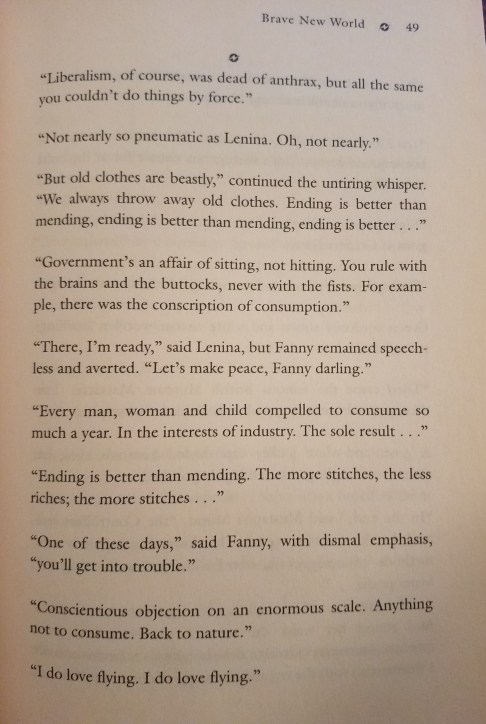
To give you a taste of what this montage feels like, have a look at page 49:
BNW p49

The rhythm of the short sections becomes so incessant that it takes on the air of a chant, of an indoctrination. It’s an effect I’m not sure could be achieved without heavy use of the section break.

However, Chapter 3 is an outlier in the novel. Nowhere else does Huxley deploy the section break with anywhere near this frequency, and as such the whole chapter can feel like an experiment, even a gimmick. (Huxley’s not even consistent with how he breaks sections in the novel: most chapters just use line-spacing, but Chapters 4-6 split chapters into explicitly labelled parts.) For a more consistent demonstration of the power of section breaks, we’ll need to look elsewhere.

*          *          *

I recently finished John Hersey’s Hiroshima (1946), a journalistic account how six people lived through the atomic bombing of the Japanese city on August 6, 1945, and its immediate aftermath, with an extended epilogue added to the 1985 re-printing that catches up on the subjects’ post-bombing lives. As a work of journalism, the fact that Hiroshima would feature more section breaks than is standard is not all that surprising; articles tend to include them at much briefer intervals than novels do. Indeed, Hiroshima was originally supposed to be printed as a series of four articles in The New Yorker before the editors decided to dedicate an entire issue to the work and printed it all at once. To a certain extent, it simply bears the marks of its medium.

However, I would still say Hersey uses the section break more often that Lukeman would ever deem strictly necessary. For example, the third chapter, “Details Are Being Investigated,” has 27 section breaks over the span of 24 pages. That’s not quite a Chapter 3 of Brave New World clip, but it still averages out to more than one per page. And unlike Huxley, Hersey keeps up with this rough pace for the entire length of the book. Why does he do that?

Part of the reason is practical. As in the third chapter of Brave New WorldHiroshima follows multiple groups of people through events that are happening simultaneously. The section breaks quickly tell the reader that the narrative is moving from one part of the city to another, shifting perspectives among its central figures. That extra space between paragraphs gives the reader’s mind a chance to recalibrate, to file one person’s experiences away for the time being and give their full attention the next part of the story.

The first chapter, “A Noiseless Flash,” is methodical in how it uses its section breaks. The first section lists off what each of the survivors the book follows was doing at the moment before the A-bomb exploded, functioning as a dramatis personae. After the first section break, Hersey gives a more detailed account of one of those person’s actions, the Rev. Kiyoshi Tanimoto’s. After another section break, Hersey briefly turns back the clock and does the same for the second survivor, Mrs. Hatsuyo Nakamura, and so on for each figure. Everyone’s lives, in Hersey’s telling, are allowed to play out in parallel.

At least, they are at first, and this is where Hersey’s book demonstrates the real versatility of the section break. As the book progresses, and the various survivors start to cross paths and interact with each other, the strictly-divided sections give way to something more patchwork, more like verbal montage. Granted, the sections are not nearly as short as in Huxley’s case, but the narrative of the bombing’s aftermath does move quickly from setpiece to setpiece.

The subtle change in how the section break is applied underscores the dramatic change in how the central characters experience the world. Before the atomic bomb drops, there is something resembling order in Hiroshima. Yes, the city is struggling through the waning days of the war, with air raid sirens constantly warning of impending destruction. But in a way, everyone involved has adjusted to that status quo; their daily rhythms are unorthodox, but they’re still present. The atomic bomb, however, obliterates them. Confusion reigns over the city, so much so that one could conceivably turn Hersey’s journalism into a mystery story: What on earth just happened?

Hersey’s section breaks resemble montage in another sense: the juxtaposition of one section with another allows for commentary. We see this in Huxley, of course, what with those hypnopædic proverbs, but Hersey’s usage, though less frequent, is even more blunt. In “The Aftermath,” the epilogue written forty years later, Hersey writes about Rev. Tanimoto’s efforts as a peace activist, and inserts into that narrative brief snippets of world affairs, none of which are promising. Consider the following sequence from page 139, after President Harry Truman refuses to acknowledge a petition from the peace-oriented United World Federalists:
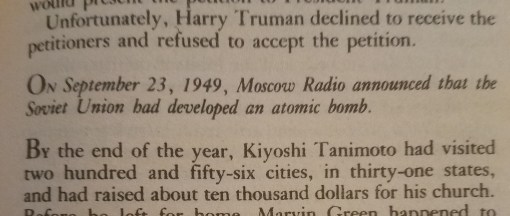
Hiroshima p139

Hersey does this repeatedly in the home stretch: Rev. Tanimoto’s peace advocacy, confronted with incessant nuclear proliferation. Blunt? Yes. But a perfect example of how a section break is not just functional, but meaningful.

Finally, Hersey’s use of section breaks actually makes me question one of the premises of Lukeman’s discussion: that something has gone wrong if the reader feels like putting the book down mid-chapter. Perhaps an author might think that there are situations where doing so is perfectly fine.

The subject matter of Hiroshima is, to put it mildly, heavy.  It’s the sort of book that inspires one to spend some time staring blankly at a wall, reflecting on the fallen state of humanity. One moment in particular got to me: a short section, which I shall quote in full, in which Father Wilhelm Kleinsorge, a German priest, attempts to comfort a girl rescued from a river following the bombing.

The night was hot, and it seemed even hotter because of the fires against the sky, but the younger of the two girls Mr. Tanimoto and the priests had rescued complained to Father Kleinsorge that she was cold. He covered her with his jacket. She and her older sister had been in the salt water of the river for a couple of hours before being rescued. The younger one had huge, raw flash burns on her body; the salt water must have been excruciatingly painful to her. She began to shiver heavily, and again said it was cold. Father Kleinsorge borrowed a blanket from someone nearby and wrapped her up, but she shook more and more, and said again, “I am so cold,” and then she suddenly stopped shivering and was dead. (p. 45)

Readers may well find themselves overwhelmed with anger or despair or some other powerful emotion here. The section break serves as a humane exit point. “Do you need some time to process what you just read?” this use of the section break asks. “Well, here’s a fine spot to leave off. Come back when you’re ready.”

*          *          *

What do you think? Are there other books that you think use section breaks in creative or unique ways? Are there other punctuation marks or literary techniques that you think deserve more scrutiny? Share your thoughts down in the comment section.

If you want more examples of how to break the rules of writing productively, check out this older piece of mine: “‘The Sin of the Apple’: Writing from the POV of an Object”

And, as always, thank you for reading!
Lady Mary Wortley Montagu’s “A Receipt to Cure the Vapors”: An Analysis

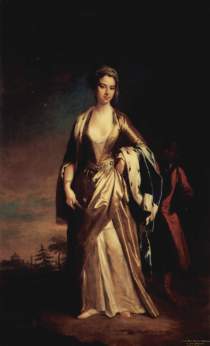
Lady Mary Wortley MontaguWriting these close readings as a regular feature for the blog has given me many things: a chance to sort out my own, disordered thoughts; a venue to practice my critical reading skills; even a microscopic audience for my writing. But one benefit I’ve just started to appreciate is that, in writing up these pieces, I’ve introduced myself to some interesting historical figures. I wasn’t much aware of Charlotte Smith’s role in the early Romantic movement, or Thomas Moore’s involvement in revolutionary Irish politics. But I think, in terms of having a fascinating biography, no one I’ve covered quite stacks up to Lady Mary Wortley Montagu.
We’ll hit some of those notes along the way, but for now, let’s take a look at one of her poems: “A Receipt to Cure the Vapors.” The title alone got my attention, we’ll give the whole text a read-through.

A Receipt to Cure the Vapors

I.
Why will Delia thus retire,
And idly languish life away?
While the sighing crowd admire,
‘Tis too soon for hartshorn tea:

II.
All those dismal looks and fretting
Cannot Damon’s life restore;
Long ago the worms have eat him,
You can never see him more.

III.
Once again consult your toilette,
In the glass your face review:
So much weeping soon will spoil it,
And no spring your charms renew.

IV.
I, like you, was born a woman,
Well I know what vapors mean:
The disease, alas, is common;
Single, we have all the spleen.

V.
All the morals that they tell us,
Never cured the sorrow yet:
Chuse, among the pretty fellows,
One of honor, youth, and wit.

VI.
Prithee hear him every morning
At the least an hour or two;
Once again at night returning—
I believe the dose will do.

We might as well begin with the title, which promises the reader something useful: “A Receipt [i.e., a formula] to Cure the Vapors.” The “vapors,” as the term was used in the 18th century, refers to a nebulous mental disorder primarily diagnosed in women and characterized by depression, hypochondria, fainting, and so forth. (The name comes from its supposed cause: gaseous emanations from the internal organs. This condition was also known as “spleen,” as we see in the fourth stanza.) Thus, the poem presents itself as a remedy for something that resembles depression.

That Lady Mary would write a poem of medical advice is not surprising when you consider her biography. In addition to her career in letters, Lady Mary was England’s leading advocate for small inoculation, which she learned about during her husband’s tenure as an ambassador to the Ottoman Empire. Reading this “Receipt,” one gets the sense that the speaker’s medical knowledge covers more than smallpox; she says it is “too soon for hartshorn tea” (line 4), an ammonia-based brew related to smelling salts that was commonly used to treat the vapors.

In addition to any public-minded goals, Lady Anne may have had a personal impetus to write this remedy down. The footnotes to the poem in The Norton Anthology of Poetry say that the “Receipt” was “apparently written to Lady Anne Irwin, widowed eight or nine years previously,” though she is not referred to by name here. Rather, the speaker gives her the generic poetic name of Delia, and so one can reverse engineer that Damon in stanza 2 is Lady Anne’s deceased husband. These pseudonyms allow Lady Mary to respect her friend’s privacy while still using her situation to address a social concern.

So what is this promised cure for the vapors? Well, it takes the speaker the length of the poem to actually get to it. Indeed, the speaker spends much more time detailing the symptoms of Delia’s condition. Delia is inclined to “retire, / And idly languish life away” (1-2), suffers from “dismal looks and fretting” (5), and is given to “So much weeping” that she may “spoil” her appearance permanently (11). Whether or not “a case of the vapors” is the best way to describe her condition, it certainly seems that Delia is severely despondent.

To go off on a slight tangent: the poem’s musicality tends to underscore the uneasy feeling associated with the vapors. The poem’s base rhythm is alternating lines of trochaic tetrameter (eight syllables, alternating stressed and unstressed: “All those | dismal | looks and | fretting”) and trochaic tetrameter catalectic (same as before, but with the last unstressed syllable dropped: Cannot | Damon’s | life re | store“). Trochaic rhythms are particular incessant, always pushing forward, yet the stress pattern means one tends to end on the unstressed, weaker syllables. One leaves a trochaic line feeling incomplete, as though one more syllable is needed to round things out. That seems fitting for the vapors, doesn’t it? (One could say the same of the poem’s use of slant rhymes.)

Not only does the speaker linger over the symptoms of the vapors, but also she deploys some misdirection in prescribing her cure. From the first two-thirds of the poem, one would get the impression that what Delia really needs is a stern lecture. In the second stanza, the speaker tells her in no uncertain terms that her beloved Damon is gone: “Long ago the worms have eat him, / You can never see him more” (7-8). In the third, she commands her to “consult [her] toilette,” her “face review,” with the warning that “no spring [her] charms [will] renew” if she keeps on weeping (9-10, 12). And in fourth, she says the vapors are just a common problem for women: “Single, we have all the spleen” (16). The speaker doesn’t quite say, “Just get over it,” but the sentiment creeps close to it.

Yet right as the speaker got me scratching my head, the fifth stanza offers a bit of a swerve. “All the morals that they tell us,” the speaker says, “Never cured the sorrow yet” (17-18). In other words, the sort of lecturing the speaker has indulged in up to this point is of no use in bringing Delia out of her despondency. That’s an unexpectedly comforting thought coming from 1730. Further, rather than offering a universal cure for the vapors, the speaker suggests something more specific to her friend’s case.

And that cure is: another man. She tells Delia to “Chuse, among the pretty fellows, / One of honor, youth, and wit” (19-20). If the death of Damon is the cause of her condition, the thinking goes, then finding a new man to love should remedy it. It’s a little disappointing that the speaker’s cure is so other-centered, but it’s in keeping with Lady Mary’s larger body of work. Her most famous poem, “Epistle from Mrs. Yonge to Her Husband,” is a critical look at society’s double standards regarding gender relations, particularly how “The judging world expects [women’s] constancy” (14), but will forgive men their infidelity. Viewed in this context, the “Receipt” is a cheekier variation on the same theme.

This context also brings into sharp focus an ambiguity in stanza four that I haven’t mentioned yet. The last line of that stanza, “Single, we have all the spleen,” can be taken two ways. The first way, I’ve already mentioned: women are “Single” in succumbing to the vapors, that is, they are the only ones who suffer from it. But that line can also be paraphrased as, “Women will suffer the vapors when they are single, i.e., not in a relationship.” No one would object if a man in a similar position tried out the dating scene again; why should it be any different for a woman?

Again, this is not necessarily great advice. Companionship can certainly be comforting for those in a depressed state, but those relationships can’t solve the fundamental problem. But the speaker doesn’t advise going all in with this “pretty fellow,” either. She instead recommends, as one should with any remedy, exercising moderation. Delia ought to “hear him every morning, / At the least an hour or two,” and hear him “Once again at night returning” (21-23). That, for the speaker, ought to be the sufficient “dose” to overcome the vapors (24). It’s like taking two aspirin, except it’s two rendezvous.

By the end, one gets the sense that this was never “A Receipt to Cure the Vapors” at all, but rather a critique of the whole diagnosis. Conceptually, “the vapors” is not too far removed from the clinical sense of “hysteria”: a medical-sounding term used to dismiss women’s emotional states as disordered. Such states are not diseases; they’re not like smallpox. One cannot simply administer smelling salts or devise an inoculation and have them be “cured.” One must treat those who suffer “the vapors” as fellow humans, and nothing less.

*          *          *

Thanks for reading! If, like me, you’re interested in outdated medical and scientific concepts, you might want to check out a very old post on this blog, in which I analyze Stephen Jay Gould’s article “Dr. Down’s Syndrome,” which critiques some of the inaccurate and racist terminology surrounding the condition.

Other Deserts Are Needed: “The Minotaur” by Albert Camus

Albert Camus’s 1939 essay “The Minotaur, or The Stop in Oran” (translated into English by Justin O’Brien and collected in The Myth of Sisyphus and Other Essays) presents the reader with an unusual landscape of the Algerian city. Oran, in Camus’s estimation, is a city that has walled itself in, a place “devoid of poetry.” Yet when he says that, he is not disparaging the city—he is singing its virtues.

“The Minotaur” begins with one of Camus’s grand assertions about the state of the world: “There are no more deserts. There are no more islands.” He is, obviously, not referring to the physical geography of the earth but rather to the role that such places play in our psychology. “In order to understand the world,” he says, “one has to turn away from it on occasion; in order to serve men better, one has to hold them at a distance for a time.” The deserts and islands of the world, literal or metaphorical, allow one the space and silence to reflect, to confront the absurdity of our existence and accept it.

Yet, as Camus argues, it can be difficult to find such a place, especially at this late point in human history. Too many cities “are too full of the din of the past,” swarming with too many potential distractions. I’ll quote his quick tour of Europe’s cultural capitals at length, both because it will illustrate his point, and because it features some of the most sparkling prose in the collection:

Paris is often a desert for the heart, but at certain moments from the heights of Père-Lachaise there blows a revolutionary wind that suddenly fills that desert with flags and fallen glories. So it is with certain Spanish towns, with Florence or with Prague. Salzburg would be peaceful without Mozart. But from time to time there rings out over the Salzach the great proud cry of Don Juan as he plunges toward hell. Vienna seems more silent; she is a youngster among cities. Her stones are no older than three centuries and their youth is ignorant of melancholy. But Vienna stands at a crossroads of history. Around her echoes the clash of empires. Certain evenings when the sky is suffused with blood, the stone horses on the Ring monuments seem to take wing.

By contrast, as Camus would have it, Oran is the rare city “without soul and without reprieve.” Rather than classical music and Gothic architecture, a visitor to Oran will find much more evidence of the contemporary: boxing matches, commercial kitsch, and youths who model their fashion off Clark Gable and Marlene Dietrich. One might associate such modern diversions with the culture of advertising—that is, with the opposite of silence—but I can see how these features of Oran might bring one solitude. Such things can seem ephemeral, lacking the persistence of Mozart or Louis XIV. They come and go so quickly, one may fail to even take notice of them.

But for as much as I enjoyed “The Minotaur” on an aesthetic level, I can’t help but think Camus finds silence in Oran simply because he hasn’t listened closely enough. The whole world is stuffed to the brim with connections waiting to be uncovered.

I often think back to the stone wall that runs through the woods by my old middle school in northwest New Jersey. It’s the sort of feature that Camus would surely love in Oran. (Seriously, he’s rather obsessed with the role of stones in the city.) But it’s also a structure charged with history. True, I don’t know the name of the person who piled stone upon stone. But I know it was built with a purpose: to mark the boundaries between farms, back in the days before suburban encroachment. And I know the geological processes that made it possible: the receding of glaciers from the last ice age, and the raw materials they left behind. This is far from a glamorous, textbook-style history, yes. But those thoughts are still capable of distracting me from pure contemplation.

Indeed, perhaps because he is a writer, Camus cannot help but think on the history of Oran, cannot help but distract himself from his ostensible purpose. For example, when he spends a night around the boxing ring, he indulges himself by exploring the socio-historical context behind one of the bouts, a battle between a fighter from Oran and one from Algiers:

Back in history, these two North African cities would have already bled each other white as Pisa and Florence did in happier times. Their rivalry is all the stronger just because it probably has no basis. Having every reason to like each other, they loathe each other proportionately. The Oranese accuse the citizens of Algiers of “sham.” The people of Algiers imply that the Oranese are rustic. These are bloodier insults than they might seem because they are metaphysical. And unable to lay siege to each other, Oran and Algiers meet, compete, and insult each other on the field of sports, statistics, and public works.

Again, this is not necessarily the lofty sort of history that Camus has in mind when he talks about Paris or Vienna. But it’s still history, still a force that contextualizes life for the screaming fans who have flocked to the fights.

I suspect that Camus finds the silence he seeks in Oran not because it is present there, but because Camus needs it to be present. As Namara Smith has argued, the Algerian desert, a fixture of Camus’s writing, acts as a blank canvas for his thematic concerns. “Although Camus, in his journalism,” Smith argues, “was a perceptive and sympathetic observer of the mistreatment of Arab and Berber Algerians by French colonial authorities, the novels and essays on which his reputation depends all use the empty Algerian desert to stage their dramas of solitary heroism.” To say Camus denies the history present in Oran and other such places may be a stretch, but he seems willing to overlook it to suit his own artistic ends. It’s a beautiful essay, “The Minotaur,” one that I’m sure that I’ll reread many times in the future, but it’s a piece that can’t help but ring the slightest bit false.

*          *          *

Thanks for reading! I hope you enjoyed this slight detour into philosophy. I don’t often write about the subject, but if you liked this piece, then you may be interested in “Living Like the Reeds,” a post about stoicism, Aesop’s Fables, and the poetry of A. R. Ammons.

Top Ten Tuesday: Books That Should Be Taught in High School

Today’s post is part of Top Ten Tuesday, a project currently organized by the book blogger Jana (aka That Artsy Reader Girl). This week’s prompt is an education-themed freebie, as it’s back-to-school season here in the United States.

I was trying to think of a good topic to fit that theme when I came across an article on the New York Times website that asked a number of authors, from John Green to Yaa Gyasi, which books they would like to see added to high school curricula. I found that a difficult question to answer for myself, not because I couldn’t think of any candidates, but because there are so many directions to take that prompt. What exactly do high school reading lists miss? What are the ultimate goals of education? Which books best address such concerns?

To try to capture the whole breadth of that discussion, I’ve come up with a list of ten books that I feel would add something of value to a high school education. The only criterion for possible consideration was that I couldn’t have read the book while I personally was in high school. So, if any of these books were already required reading for you, then…well, you clearly went to a cooler school district than I did.

And so, proceeding chronologically:


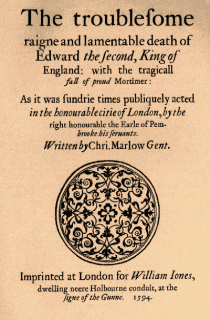
1. Edward II, by Christopher Marlowe (c. 1592)

EdwardiiquartoEnglish classes have an odd relationship with early-modern English drama. Shakespeare is all but mandatory as part of the curriculum, but his contemporaries hardly get mentioned, let alone read: none of Ben Jonson’s intricate city comedies, none of Thomas Middleton’s tragic bloodbaths. But I feel Shakespeare’s dominance is especially a shame when it comes to Christopher Marlowe, whose work not only influenced the Bard’s but also matches it in pure, visceral pleasure. Marlowe’s characters are larger than life, always scheming, and elicit viewer sympathy despite their many, many vices.

Edward II is my favorite of his works, and I would love to see it taught for two reasons. First, as a history play, it would slot well into a discussion of Shakespeare’s Richard III or Henry IV, Part 1, as the monarchs in each play respond quite differently to the dissenting nobles threatening to take the crown. Second, teaching the play would be an excuse to show students Derek Jarman’s striking 1991 film adaptation, which turns the homoerotic subtext of Edward and Gaveston’s relationship into text. It’s the perfect demonstration of how queer themes, rather than being a recent development, have been part of the Anglophone canon for centuries.


2. Washington Square, by Henry James (1880)

Washington SquareThere are some writers whose works, while critically lauded and oft-studied at the university level, rarely make their way onto high school reading lists because of their perceived difficulty. I’m thinking of authors such as William Faulkner, Virginia Woolf, and the dean of this odd school, Henry James. Untangling James’s syntax is a true challenge that every student of literature must eventually face, but Washington Square is an exception in his bibliography. Indeed, it reads less like James and more like that mainstay of English classes, Jane Austen. (Apparently this was much to James’s chagrin, but what does he know?)
Of course, I don’t count Washington Square so highly because it’s merely approachable. Instead, I think the book, by the example of its characters, is uniquely instructive in how relationships work. Over the course of the novel, Dr. Sloper judges that his daughter Catherine’s suitor, Morris Townsend, is only interested in her inheritance. As it happens, he’s right on the money (so to speak), as Townsend leaves Catherine after Dr. Sloper disinherits her. Yet in proving himself right, in proving his concerns for his daughter’s well-being were justified, he permanently damages his relationship with Catherine. Students will learn a difficult lesson by the end, one that the educational system seems particularly ill-equipped to impart: sometimes, being correct just doesn’t matter.


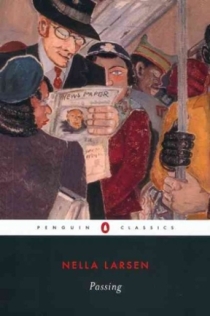
3. Passing, by Nella Larsen (1929)

PassingOne of the best literature courses I took as an undergraduate was called Capital Fictions, which was an exploration of economic themes in late 19th- and early 20th-century American literature. I was tempted to try shoehorning half the syllabus onto this list—ooh, people should actually read The Jungle! ooh, McTeague is a masterpiece of literary naturalism! ooh, “The Tenth of January” is a fantastic short story!—but in the end, I exercised something resembling disciplined and settled on the one book that I found the most eye-opening.

I don’t think we ever used the term in Capital Fictions, but that course was basically my introduction to the concept of intersectionality, and no book on the syllabus better demonstrated the interweaving of societal oppressions quite like Nella Larsen’s Passing. The novel tells the story of two light-skinned black women, Irene and Clare, who must navigate the racial, gender, and class expectations of 1920s Chicago, forces which strain their friendship and ultimately lead to sudden tragedy. It’s also a work where the prose style, empathetic but startlingly blunt, is perfectly suited to the subject, making it worthy read for any aspiring writers.


4. White Noise, by Don DeLillo (1985)

White NoiseDon DeLillo writes the accessible sort of “weird” books that I’m certain would have totally blown my mind when I was in high school. White Noise isn’t “funny,” exactly, but there’s a lot in the book to quietly snort at, and unlike, for instance, Thomas Pynchon’s The Crying of Lot 49, one doesn’t need to be well versed in Jacobean revenge tragedies to get the joke. The fact that the protagonist, Jack Gladney, is a leading scholar of Hitler studies (snort) who doesn’t speak a lick of German (snort) is amusing no matter one’s stage of cultural awareness.

Hidden beneath the humor is a prescient depiction of media and advertising saturation (written before the Internet exacerbated those problems), chemical degradation of the environment, and medicinal fixes for anxiety, as well as a sympathetic meditation on the ever-present fear of death. White Noise is the sort of novel I expect (hope?) a fair number of students will want to throw back at the instructor, frustrated with the apparent pointlessness of its events. But even that reaction would be heartening—those people might just try to patch up this world before its own version of the Airborne Toxic Event.


5. Collected Sonnets, by Edna St. Vincent Millay (1941)

MillayPoetry tends to get short shrift in English classes, with maybe a few weeks dedicated to the entire tradition. A Brit lit class might touch on the Romantics, an American lit class on Whitman and Dickinson, but not much beyond that. Still, most students graduate with at least some understanding of what a sonnet is, or at least an understanding that they exist and that Shakespeare wrote a whole bunch of them. The sonnet has proven to be an enduring form, and if anyone’s work demonstrates the power of a well-turned sonnet, then it’s Edna St. Vincent Millay.
An often under-taught aspect of the sonnet is the volta, the turn in the poem’s argument, and Millay’s poems are perfect exemplars of such twists. The movement in poems such as “[Only until this cigarette is ended]” or “[If I should learn, in some quite casual way]” is both clear and surprising. Her poems prove that contemporary concerns and classical imagery are not mutually exclusive, and that rhyme and meter are capable of speaking modern thoughts. But most of all, her speakers are so cool and confident that I think high school students will latch onto their personas. She’s the sort of poet who might convince you to become a poet.


6. Dien Cai Dau, by Yusef Komunyakaa (1988)

Dien Cai DauOf course, what high school English classes really need is more contemporary poetry, and by “contemporary,” I mean “anyone after Robert Frost.” Students come away from their secondary education with the notion that poetry is a dead art that only deals with archaic subject matter and must sound like the mad ravings of a pantalooned troubadour. And, to be sure, a lot of contemporary poetry is unintelligible to the uninitiated reader. But just as much is plain-spoken, personal, and relevant to the world outside academia, like the work of Yusef Komunyakaa.
Released in 1988, Komunyakaa’s collection Dien Cai Dau is a major work in the literature of the Vietnam War, one which details the day-to-day realities for an American soldier in the conflict. Komunyakaa rarely engages in syntactical or rhetorical fireworks, the sort that drive students batty; instead, his poems are so dense with sensory imagery that they become dreamlike (from “Starlight Scope Myopia”: “Smoke-colored // Viet Cong / move under our eyelids…”). The obvious standout is the final poem, “Facing It,” wherein the speaker reflects on the Vietnam Veterans Memorial, but every poem is thought-provoking and worthy of classroom discussion.


7. Mother Love, by Rita Dove (1995)

Mother LoveTo round out this accidental trio of poetry collections, here’s a book that straddles the line between Millay’s formalist magic and Komunyakaa’s deeply detailed free verse. Rita Dove’s Mother Love is a long sequence of loose sonnets, and part of the fun of reading it is figuring out which aspects of the tradition (length, rhyme, meter, subject, volta) is Dove employing in a given poem and which she is ignoring. In purely practical terms, it’s a great way to gauge students’ understanding of the tradition’s formal requirements.
In less clinical terms, Mother Love is also great way to teach students how to take an old story and make its wholly their own. The collection is a rewriting of the myth of Persephone, with an emphasis on how she relates to her mother Demeter, played out in the present day. The mythological/fairy tale retelling is already a popular genre, but seeing how it plays out in verse could make for a fun in-class exercise. If nothing else, share the joys of the “The Bistro Styx” with everyone you meet. You could cut the mother-daughter tension in that poem with a steak knife.


8. Voices from Chernobyl: The Oral History of a Nuclear Disaster, by Svetlana Alexievich (1997)

Voices from ChernobylWhen I was first composing this list, I thought about including some more works of history, such as Stephen Schlesinger and Stephen Kinzer’s Bitter Fruit or John W. Dower’s Embracing Defeat. But while books like those cover topics which often go undiscussed in high school history classes (the CIA-backed coup in Guatemala, post-WWII Japan), as texts they tend to be dry and rather conventional. The material that these writers tackle is vital to understand, but their particular expression is not necessarily as compelling.
But a book like Svetlana Alexievich’s Voices from Chernobyl is another matter entirely. Collecting the personal accounts of scores of people affected by the 1986 nuclear disaster in modern-day Ukraine, Alexievich’s book is a testament to the power of letting people tell their own stories in their own voices. In its arrangement of the individual testimonies, Voices from Chernobyl is also a reminder that just because journalist lets their subjects do the talking, that doesn’t mean they have no power over how the final project is presented.


9. Hateship, Friendship, Courtship, Loveship, Marriage, by Alice Munro (2001)

Hateship, Friendship, Courtship, Loveship, MarriageBefore, I said that poetry needed more presence in high school curricula, but short stories could probably make the same claim. At least in my experience, short stories were either used as supplementary material for a novel (like reading Kate Chopin’s “The Story of an Hour” alongside The Awakening), or as a means of chewing up class time after hitting all the syllabus material. And as for contemporary short stories, the sort that would fill out an issue of The New Yorker, well, those simply didn’t exist; I didn’t realize people still wrote short stories until undergrad. So why not at least give students some Alice Munro to chew over?
Munro is, I will concede, a challenging writer for students. Her stories are emotionally intense in a way high school might not immediately relate to, and her use of achronological storytelling and multiple points-of-view can take some getting used to. But at the same, the condensed short story form is a nice way of introducing students to such complications, as opposed to dropping a similarly difficult novel-length work on them. I’ve picked Hateship, Friendship, Courtship, Loveship, Marriage because I’m especially fond of its contents (the title story and “Queenie” are wonderful pieces), but really, any Munro collection could fulfill this role. At any rate, she’s Canada’s first Nobel Laureate—why not put her on the syllabus?


10. So Much Synth, by Brenda Shaughnessy (2016)

So Much SynthI fear this list has become too academic, so let’s close things out with a book that’s a bit more fun. I’ve raved about Brenda Shaughnessy a couple of times on this blog before (e.g., my list of most read authors), and I’ve praised this book in particular. And of all the books on this list, I think Shaughnessy’s So Much Synth is the book that’s most relatable to a high school audience. The early poems in the collection concern people coming to terms with their sexuality, while the “mix tape” poems are wonderful examples of literature in conversation with pop culture.

But it’s the centerpiece of the collection, “Is There Something I Should Know?,” which would most intrigue me in a classroom setting. A sprawling, 27-page poem in which the speaker recounts the various mishaps of adolescence, “Is There Something I Should Know?” is a work which perfectly captures the way that one remembers what it was like to be a teenager, a time when we “just dumped rage and hurt, yearning / for finer feelings, not the indignities [we] suffered.” To read someone who’d survived high school express the sensation of doing so, and expressing it so well, would have been more than welcome when I was fourteen.

*          *          *

Well, there’s my list, but what do you think? Which books would you like to see added to high school reading lists? Did you in fact read any of these books in high school? Let me know in the comments!